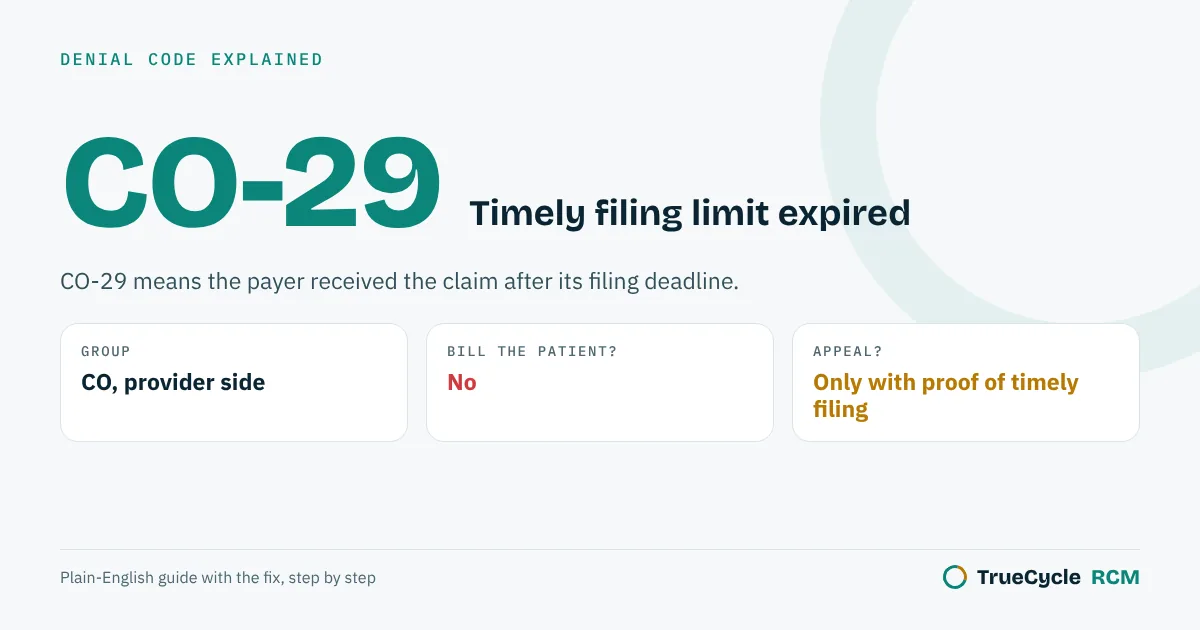
CO-29 means the payer received the claim after its filing deadline. It is the provider's write-off unless you can prove the claim was filed on time, usually with a clearinghouse or payer acceptance report. You generally cannot bill the patient.
The official wording
The X12 Claim Adjustment Reason Code list defines 29 as: "The time limit for filing has expired."
The letters in front are the group code. CO means contractual obligation (the provider absorbs it), PR means patient responsibility, and OA is other adjustment. The same reason code can come with different group codes, so always read both.
What CO-29 is telling you
Every payer sets a filing limit, from 90 days to a year or more. The clock usually starts on the date of service, or on the primary EOB date for secondary claims. CO-29 means the payer's records show the claim arrived after that.
Check the limits for big payers in our timely filing limits by payer guide, or the payer guides for Cigna and Aetna.
Send us the list: payer, date of service, denial code and amount. No patient names needed. We will tell you which claims can still be fixed, which need an appeal, and which deadlines are close. Free, usually within 2 business days. Want the full picture? Get a free 90-day denial audit from your ERA files.
Run a billing company? Add a trained biller from $8/hour, first 25 claims free.
When you can win
- You have an acceptance report from the clearinghouse or payer showing the claim was received inside the window.
- The claim was sent to the wrong payer first and you have that payer's denial within the window. Some payers and state laws allow extra time in this case.
- The payer caused the delay, for example by retroactively changing eligibility.
How to fix it
- Pull the first submission and its acceptance report.
- If you have proof, appeal or request a reconsideration within the payer's dispute window, attaching the report.
- If you do not, write it off as a contractual adjustment and find out why the claim went late.
How to prevent it
- Bill within a week of the visit.
- Work clearinghouse rejections daily; a rejected claim never reached the payer.
- Check unbilled and unpaid claims by age every week. Our timely filing calculator shows the last day for any payer.
One claim that missed the window
A visit on January 10, 2025 was billed to a commercial plan with a 90-day limit. The first claim was rejected at the clearinghouse for a bad member ID. Nobody worked the rejection. The corrected claim went out on May 2.
| Date | Event | Counts toward filing? |
|---|---|---|
| Jan 10 | Date of service | Clock starts |
| Jan 14 | Claim sent, rejected by clearinghouse | No. A rejected claim never reached the payer. |
| Apr 10 | Day 90, filing limit ends | Deadline |
| May 2 | Corrected claim accepted by payer | Too late |
| May 20 | Remittance shows CO-29 | Provider write-off |
The January 14 attempt does not help here. Payers count the date they accepted the claim, not the date you first tried.
Medicare and CO-29
Medicare's limit is 12 months from the date of service. When Medicare denies for this reason, the remittance usually shows CO-29 with remark code N211, which reads "Alert: You may not appeal this decision." So a normal appeal is not an option.
Federal rules (42 CFR 424.44) allow an extension only in narrow cases, such as:
- An administrative error by Medicare or its contractor caused the delay.
- The patient was given Medicare entitlement back to an earlier date.
- The patient was disenrolled from a Medicare Advantage plan back to an earlier date.
If one of these applies, explain it in item 19 of the CMS-1500 or the electronic note field, and keep the proof.
Proof of timely filing that payers accept
| Proof | How strong | Notes |
|---|---|---|
| Payer acceptance report (277CA) showing receipt date | Strong | Best proof for electronic claims |
| Clearinghouse acceptance report with payer ID | Strong | Must show the payer accepted it, not just the clearinghouse |
| Denial from another payer inside the window | Often accepted | For claims first sent to the wrong payer |
| Certified mail receipt for a paper claim | Medium | Keep a copy of the exact claim that was mailed |
| Screenshot of your billing system | Weak | Shows you created it, not that the payer got it |
How to post CO-29
- Check the date of service on the claim. If it was keyed wrong, send a new claim with the right date.
- Pull every acceptance report for the claim.
- If you have proof, file a reconsideration or appeal with it inside the payer's dispute window.
- If you do not, post it as a contractual write-off with a timely filing adjustment code, not as bad debt.
- Find the cause (unworked rejection, late charge entry, wrong payer) and fix that step.
CO-29 checklist
- ☐ The date of service on the claim is correct.
- ☐ You know this payer's limit. See our timely filing limits by payer.
- ☐ You have a payer acceptance report dated inside the window.
- ☐ Clearinghouse rejections are worked every day.
- ☐ The patient is not billed for the CO-29 amount.
Questions people ask about CO-29
Can I bill the patient for a CO-29 denial?
Generally no. CO-29 is a contractual adjustment, which is the provider's loss for in-network claims.
What counts as proof of timely filing?
The strongest proof is a clearinghouse or payer acceptance report showing the date the payer received the claim. A practice management screenshot is weaker. A rejection report does not count, because the claim was never accepted.
Can I appeal a Medicare CO-29 denial?
Usually not. Medicare sends CO-29 with remark N211, which means you may not appeal. Only the narrow exceptions in 42 CFR 424.44, such as a Medicare administrative error, allow late claims.
Does a rejected claim stop the timely filing clock?
No. A clearinghouse or payer rejection means the claim was never accepted. The clock keeps running until an accepted claim reaches the payer.
How long do I have to file with Medicare?
12 months from the date of service.
Seeing CO-29 on your remittances?
Send us 25 claims and we will group your denials by reason and remark code and show you which fix removes the most of them. Free, no setup fee.
Start the free 25-claim trialFiling limits, appeal windows and claim addresses change quietly. Get one short email a month with what changed and the free tools we add.
One email a month. No spam. Unsubscribe any time.Other denial code guides
All denial code guides
PR-1 · PR-2 · PR-3 · CO-4 · CO-5 · CO-11 · CO-15 · CO-16 · OA-18 · CO-22 · OA-23 · CO-24 · CO-26 · CO-27 · CO-29 · CO-31 · CO-45 · CO-49 · CO-50 · CO-59 · PR-96 · CO-97 · CO-109 · CO-119 · CO-129 · CO-140 · CO-146 · CO-151 · CO-167 · CO-170 · CO-181 · CO-185 · CO-197 · CO-198 · PR-204 · CO-234 · CO-236 · CO-242 · CO-252 · CO-253 · CO-288 · CO-A1 · CO-B7 · MA130 · N130 · N23 · N290
Timely filing limits by payer: Cigna timely filing limit · HealthSpring timely filing limit · Aetna timely filing limit · UnitedHealthcare timely filing limit · Humana timely filing limit · corrected claim timely filing limits
Sources: X12 Claim Adjustment Reason Code list (29), read October 27, 2026; CMS Medicare guidance where Medicare rules are mentioned; Noridian Medicare JE Part B reason code guidance, "Timely Filing" (CO-29 with N211), read October 27, 2026; 42 CFR 424.44 (time limits for filing claims). Last reviewed October 27, 2026. General information, not coding or legal advice. Payer rules differ, so check the remark code and the payer's own policy.