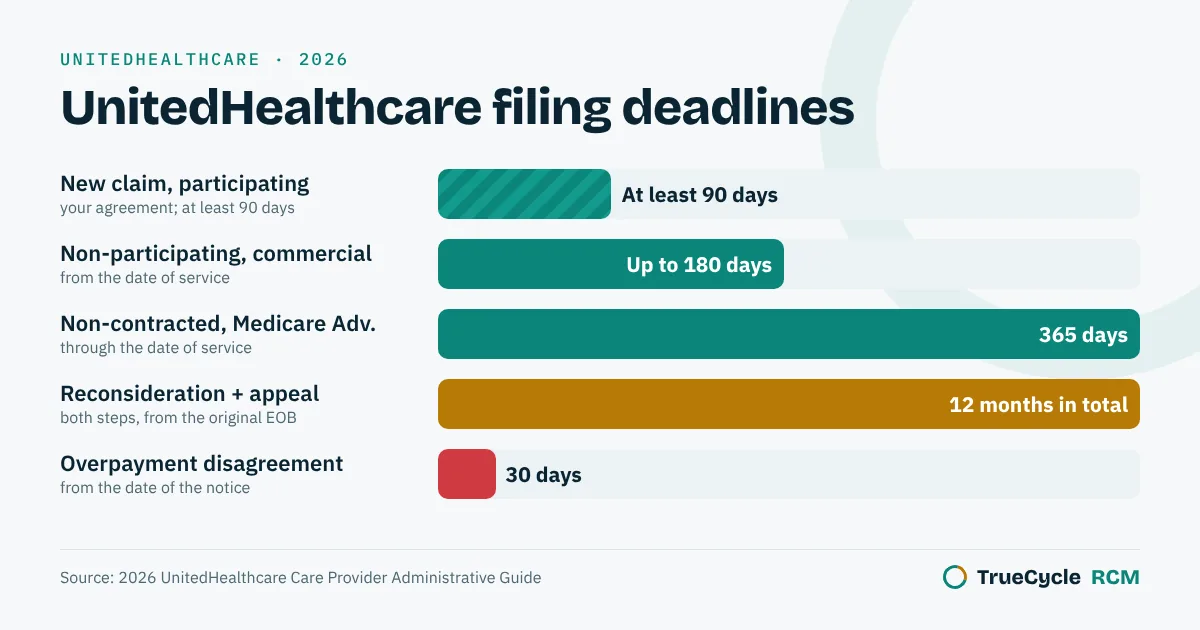
Your Participation Agreement sets the limit. UHC's 2026 guide says it allows at least 90 days for participating providers, up to 180 days from the date of service for non-participating providers on commercial plans, and 365 days for non-contracted providers on Medicare Advantage. Corrected claims use the same clock, counted from the date of service. Reconsideration and appeal together get 12 months from the original EOB.
UnitedHealthcare is the biggest health insurer in the US, and its filing deadline is one of the easiest to get wrong. The quick-reference page of the 2026 guide just says to check your Participation Agreement. The actual day counts are further in, spread across the claims chapter and a supplement near page 206.
We read the 2026 UnitedHealthcare Care Provider Administrative Guide (commercial, individual exchange and Medicare Advantage) and pulled out every filing window that a practice can act on. Page numbers are at the bottom, so you can check them yourself.
UHC filing deadlines at a glance
| Situation | Deadline | Clock starts |
|---|---|---|
| New claim, participating provider | Your agreement UHC allows at least 90 days | Date of service |
| New claim, non-participating, commercial plan | Up to 180 days | Date of service |
| New claim, non-contracted, Medicare Advantage | 365 days | Through date of service |
| UHC is the secondary payer | At least 90 days | Primary payer's payment, denial or notice |
| Corrected claim | Same days as the original | Date of service, discharge or last outpatient date of service |
| Reconsideration + appeal (both steps) | 12 months in total | Date of the original claim EOB or PRA |
| Overpayment or adjustment disagreement | 30 calendar days | Date you received the notice |
Every one of these can be changed by your agreement or by state law, and UHC says so next to each rule. Treat the table as the default and your contract as the final word.
UnitedHealthcare deadline calculator
Pick what you are filing, then enter the date that starts the clock.
The 90-day number
Ask around and most billers will tell you UHC gives 90 days. That is close, but the wording matters. The 2026 guide says UnitedHealthcare "allow[s] at least 90 days for participating health care providers," and in the same paragraph tells you to submit clean claims "per the time frame listed in your Agreement or per applicable laws."
So 90 days is the floor UHC commits to, not a number printed in your contract. Plenty of agreements say 90. Some say more, and some states set their own minimums for fully insured plans. Three things to do with that:
- Find your clause. Search your UHC agreement for "timely" or "submission of claims." It is usually one sentence.
- Until you have it, work to 90. If your contract turns out to give you longer, nothing is lost.
- Put the number in the billing system. A deadline that only lives in the contract does not stop anyone.
The guide also says how UHC counts: the limit is the calendar days between the last date of service (or the primary payer's payment or denial) and the day UHC receives the claim. Receipt is the day the claim first reaches UHC's claims office, P.O. box or processor, not the day you sent it.
Send us the list: payer, date of service, denial code and amount. No patient names needed. We will tell you which claims can still be fixed, which need an appeal, and which deadlines are close. Free, usually within 2 business days. Want the full picture? Get a free 90-day denial audit from your ERA files.
Run a billing company? Add a trained biller from $8/hour, first 25 claims free.
Corrected claims: no new clock
This is the part that catches people. UHC's 2026 guide says your agreement requires all information needed to process a claim to arrive within the set number of days from the date of service, date of discharge or last outpatient date of service, and that "this number of days also applies to submission of corrected claims."
The guide gives its own example. Last date of service May 1, a 90-day limit, and everything, corrections included, has to reach UHC no later than 90 days after May 1. That is July 30. A remittance that arrives in June does not restart anything.
What makes it a corrected claim, according to UHC:
- Frequency code 7 in loop 2300, CLM05-03 on an electronic claim, or 7 as the last digit of the institutional bill type.
- On paper, 7 in box 22 (professional) or box 64 (facility), left-justified, with the original claim number in the Original Reference Number field.
- Or the portal route: Claims & Payments, Act on a Claim, Submit corrected claim.
- A claim with a different bill type from the original is not a corrected claim. It is treated as a new one.
A corrected claim also replaces the original completely, so send the whole claim, not only the line you fixed. And it is not a way to dispute payment. If you think UHC paid it wrong, that is a reconsideration.
If the window has already closed, a corrected claim will usually come back denied for timely filing. At that point the reconsideration route, with proof the original was accepted on time, is your only option.
When UHC is the secondary payer
When UHC is not primary, the guide gives you at least 90 days from the day of payment, contest, denial or notice from the primary payer. Enter the date on the primary EOB in the calculator, not the date of service.
Coordination of benefits problems are the usual reason a UHC claim ends up late. A patient with a spouse's plan, a new job or Medicare turning primary can push a claim back and forth for weeks. Check other coverage at every visit, and send the secondary claim with the primary EOB attached the same week it arrives.
Reconsiderations and appeals: 12 months
UHC recommends two steps when you disagree with how a claim was processed, and the clock covers both of them together.
- Step 1, claim reconsideration. Submitted online through the UnitedHealthcare Provider Portal (Claims & Payments) or by API. Say why you disagree and add anything that was not in the original claim.
- Step 2, appeal. Only if you disagree with the reconsideration outcome. Also submitted online or by API, with all new supporting records attached. UHC decides on what is in front of it at the time, so do not hold documents back.
Both steps have to be submitted within 12 months from the date of the original claim EOB or PRA, unless law or your agreement says otherwise. If you spend ten months on the reconsideration, you have two months left for the appeal.
Two related windows from the same chapter:
- 20 or more claims with the same problem go in as one Claims Research Project in the portal, not as 20 separate reconsiderations.
- Overpayment, refund or recoupment notices can be disputed within 30 calendar days of receiving the notice.
Some states replace this process with their own provider dispute rules. The guide names California commercial HMO, Oregon HMO and Oregon and Washington commercial plans.
Proof of timely filing
If UHC denies a claim for late filing and you believe it went in on time, the reconsideration is where you send proof. The guide lists what that proof has to contain:
- The date the claim was submitted to UHC or another payer
- The date it was accepted by UHC or that payer
- Member identification, date of service and provider identification
Acceptable documents are an EDI report, a statement from your billing or accounting software, or an EOB, another carrier's denial or a dated eligibility rejection letter together with a resubmission form.
One line in the guide is worth printing out: a rejected claim is not proof of timely filing. A rejection never reached processing. If your clearinghouse rejected a claim on day 20 and nobody fixed it until day 95, you are late, even though you "sent it" on time. Work rejections the day they appear.
A timely filing denial normally shows on the remittance as CO-29, "the time limit for filing has expired." And the guide is direct about the patient: you cannot bill a member for claims denied for untimely filing. The loss stays with the practice.
Medicare Advantage and Community Plan
UHC Medicare Advantage, contracted providers. Your Medicare Advantage agreement sets the limit, and the same claim reconsideration and appeal process applies. Do not assume Original Medicare's one-year rule applies to your contracted UHC MA claims.
UHC Medicare Advantage, non-contracted providers. The guide says UHC is required to allow 365 days from the through date of service to submit the claim. Payment disputes follow UHC's separate notice of dispute and appeal rights for non-contracted providers: a payment reconsideration (appeal) within 60 days of the denial date, and a payment dispute within 120 calendar days of the initial payment.
UnitedHealthcare Community Plan (Medicaid). Each state plan has its own provider manual and its own limits, often different from commercial ones. Use your state's current Community Plan manual, not this table.
For other payers, see our timely filing limits by payer, the Cigna guide and the Aetna guide.
How to stay inside the window
- File within a week of the visit. Ninety days sounds like a lot until a claim needs a correction and a secondary EOB.
- Work clearinghouse rejections the same day. For UHC, a rejection is not proof of anything.
- Fix and resend corrections early. The corrected claim shares the original deadline, so every week you wait comes out of the same 90 days.
- Save the acceptance report for every claim. It is the document that wins a timely filing reconsideration.
- Track the 12-month appeal clock from the first EOB. Do not let a slow reconsideration use up the time you need for step 2.
- Run a weekly UHC aging report. Anything unbilled or unpaid after 45 days gets looked at that week.
If a UHC claim comes back denied, our denial code lookup explains the code and the usual fix, and the place of service code list helps when the denial is about where the service was done.
Questions
What is the UnitedHealthcare timely filing limit?
The limit in your UnitedHealthcare Participation Agreement controls. UnitedHealthcare's 2026 Care Provider Administrative Guide says it allows at least 90 days for participating providers, up to 180 days from the date of service for nonparticipating providers on commercial plans, and 365 days from the through date of service for noncontracted providers on Medicare Advantage plans.
What is the UnitedHealthcare timely filing limit for corrected claims?
There is no separate window. The 2026 guide says the number of days in your agreement also applies to corrected claims, counted from the date of service, discharge or last outpatient date of service. If your limit is 90 days and the last date of service was May 1, the corrected claim must be received by July 30.
How long do I have to file with UnitedHealthcare as the secondary payer?
At least 90 days from the day the primary payer paid, contested, denied or sent notice on the claim, according to UnitedHealthcare's 2026 guide.
How long do I have to appeal a UnitedHealthcare claim?
UnitedHealthcare uses a two-step process, a claim reconsideration and then an appeal. Both steps together must be submitted within 12 months from the date of the original claim EOB or PRA, unless law or your agreement says otherwise.
Can I bill the patient if UnitedHealthcare denies a claim for timely filing?
No. UnitedHealthcare's 2026 guide states that you cannot bill a member for claims denied for untimely filing.
Does a rejected claim count as proof of timely filing with UnitedHealthcare?
No. The guide says rejected claims are not proof of timely filing, because a rejected claim needs further action before it can be processed. Proof must show the claim was received and accepted within your filing limit.
Not sure what your UHC agreement says?
Send us 25 claims. We will check how long each one took to get paid and flag any that are close to a filing deadline. Free, no setup fee, month-to-month.
Start the free 25-claim trialFiling limits, appeal windows and claim addresses change quietly. Get one short email a month with what changed and the free tools we add.
One email a month. No spam. Unsubscribe any time.Related: Corrected claim limits by payer · Aetna timely filing limit · Cigna timely filing limit · Timely filing limits by payer · Timely filing calculator · CO-29 denial code
More guides from our blog
- E/M downcoding: how to spot 99214 and 99215 cuts and get paid
- Corrected claim timely filing limits for 2026, payer by payer
- Aetna timely filing limit for 2026: new claims, corrected claims, appeals and Medicare
- Cigna and HealthSpring timely filing limit for 2026: new claims, corrected claims, appeals
- 7 common claim denial codes, and how to stop each one before it happens
- HealthSpring timely filing limit for 2026: claims, corrected claims and appeals
- Humana timely filing limit for 2026: claims, corrected claims and appeals
- 190 new ICD-10 codes went live on October 1. Here's what breaks first on your claims.
- How much does medical billing cost in 2026? In-house vs outsourced, in real numbers
- Modifier 25 in 2027: what Medicare’s proposed 50% cut looks like in dollars
- Provider credentialing in medical billing: timelines, documents and CAQH in 2026
- Timely filing limits by payer for 2026, checked against each payer’s own manual
Free tools
- Payer claim addresses and fax numbers
- Free 835 ERA reader
- Denial code lookup
- Timely filing calculator
- Credentialing timeline calculator
Sources, read October 14, 2026: 2026 UnitedHealthcare Care Provider Administrative Guide (Commercial, Individual Exchange and Medicare Advantage), quick reference guide; Chapter 10, "Our claims process" (claim adjustments, claim reconsideration and appeals process, proof of claim timely filing, pp. 133-135; timely filing of corrected claims); Capitation and/or delegation supplement, "Time limits for filing claims" and "Timely filing" (p. 206); UnitedHealthcare, "Medicare Advantage Non-Contracted Care Provider Dispute and Appeal Rights"; UHCprovider.com corrected claim guidance. Your Participation Agreement and state law can change these limits, so confirm against your own contract. General information, not legal or contractual advice.