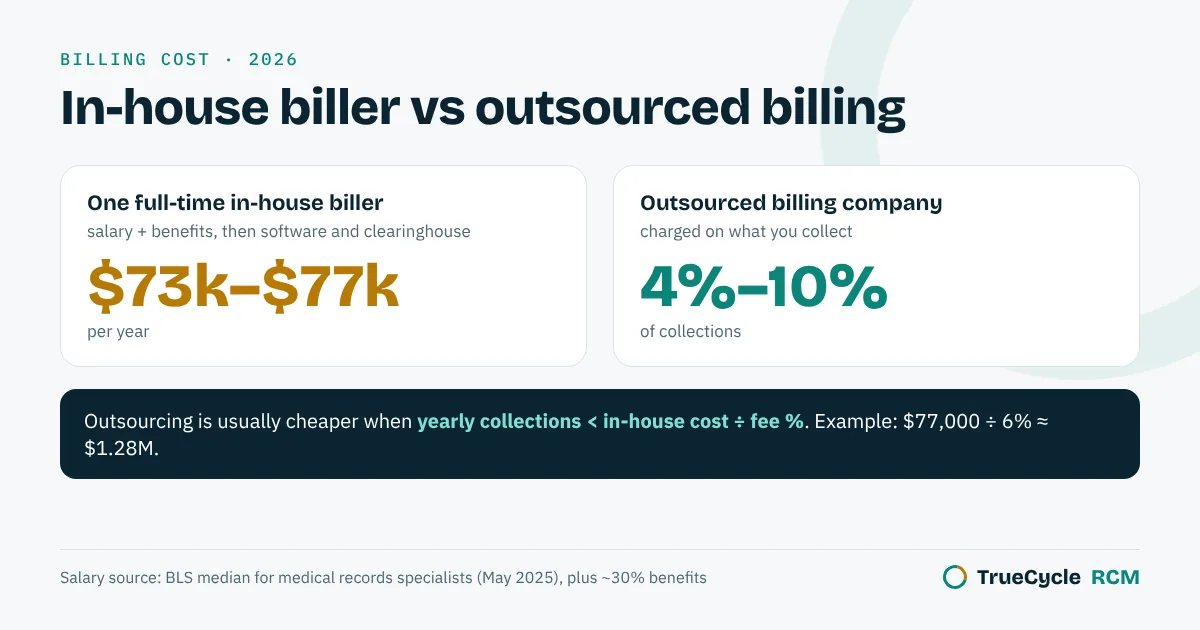
One full-time in-house biller costs a US practice about $73,000 a year once benefits are added, and closer to $77,000 with software and clearinghouse fees. Outsourced billing is usually charged as a percentage of collections, often 4% to 10%. If your yearly collections are below your in-house cost divided by that percentage, outsourcing is usually cheaper.
A fair warning first: we are a billing company, so we have an obvious interest in this question. That is exactly why this page shows the math instead of a sales pitch. Put your own numbers into the calculator below. If in-house comes out cheaper for you, it probably is.
Most "cost of medical billing" articles give a range and stop there. The range is not the hard part. The hard part is knowing what your own in-house billing actually costs, because most practices only look at the salary.
What an in-house biller really costs
Start with the salary. The Bureau of Labor Statistics puts the median pay for medical records specialists, the job category that includes medical billers and coders, at $51,140 a year (May 2025), or about $24.59 an hour. In big cities and for certified coders it runs higher.
Then add benefits. In US private industry, benefits make up about 30% of what an employer spends on each worker, according to the BLS (June 2026): health insurance, paid leave, retirement, payroll taxes and the rest. Put the other way round, every $1 of wages costs the employer about $1.43.
| One full-time biller | Per year |
|---|---|
| Median wage (BLS, May 2025) | $51,140 |
| Benefits and payroll costs (about 30% of total pay) | $21,917 |
| Wage plus benefits | $73,057 |
| Billing software and clearinghouse, example of $300 a month | $3,600 |
| Total, before training, turnover and denials | $76,657 |
The $300 a month for software and clearinghouse is only an example. Some practice management systems include claims, others charge per claim or per provider. Use the number from your own invoices.
A small practice may not need a full-time biller. Plenty of solo practices have a front-desk person who does billing part of the day. That is cheaper on paper, but it is still part of a salary, and billing is usually the part that slips when the phones are busy.
What billing companies charge
Most billing companies charge a percentage of what they collect for you. You pay nothing on claims that never get paid, which is the point: the company only earns when you do.
The percentage depends mostly on how much each claim pays. Physicians Practice described the usual pattern as 4% to 5% for higher-paying specialties and 8% to 10% for primary care, where claims are smaller and the work per dollar is higher. That article is from 2010, so treat the exact numbers as a guide, not a price list. The logic behind them has not changed. Other models you will see:
- Flat fee per claim. Predictable, but you pay for claims that are denied or never collected.
- Monthly flat fee. Common for very small practices. Check what happens when your volume grows.
- Hourly or dedicated staff. You pay for a biller's time, usually through an offshore or white-label team. This is how many billing companies add capacity themselves.
The headline percentage tells you less than you would think. "5% of collections" can be cheaper or more expensive than "7%" depending on what each one includes. More on that below.
In-house vs outsourced billing calculator
Change any number. The defaults are the national figures from this page.
Send us the list: payer, date of service, denial code and amount. No patient names needed. We will tell you which claims can still be fixed, which need an appeal, and which deadlines are close. Free, usually within 2 business days. Want the full picture? Get a free 90-day denial audit from your ERA files.
Run a billing company? Add a trained biller from $8/hour, first 25 claims free.
The break-even point, worked out
There is one simple way to see where you stand. Take your full yearly in-house cost and divide it by the percentage you are quoted. The answer is the level of collections where both options cost the same.
With one biller at $76,657 a year:
| Outsourced fee | Break-even collections | What it means |
|---|---|---|
| 4% | $1.92 million | Below this, outsourcing costs less |
| 6% | $1.28 million | Below this, outsourcing costs less |
| 8% | $958,000 | Below this, outsourcing costs less |
| 10% | $767,000 | Below this, outsourcing costs less |
An example. A family medicine practice collects $600,000 a year and pays one full-time biller. In-house billing costs it about $76,700. At 6% an outside company would cost $36,000, and even at 10% it would be $60,000.
Now a bigger practice collecting $2.5 million with one biller. At 6% outsourcing costs $150,000 a year, about twice the in-house cost. But a practice that size rarely gets by with one biller, so count the real headcount before you decide.
The break-even number is only half the story. A cheaper option that collects less is not cheaper. Which brings us to the costs that never show up on an invoice.
Costs nobody puts on the invoice
Denials that never get worked
In Experian Health's 2025 State of Claims survey of 250 healthcare billing and finance leaders, 41% said at least one in ten of their claims is denied, and 54% said claim errors are increasing. Every denied claim needs someone to read the code, fix the problem and resubmit before the filing window closes. When that someone is also answering phones, the denials pile up. Our guide to 7 common denial codes shows how much of this is preventable.
Vacation, sick days and turnover
One biller means one person who knows your payers. When they take two weeks off, claims wait. When they leave, the new person needs months to learn your payer mix. In the same Experian survey, 43% of providers said they are understaffed.
Keeping up with code and payer changes
190 new ICD-10 codes took effect on October 1 with no grace period (here is what changed), and Medicare is proposing big payment changes for 2027, including a 50% cut for some same-day visits. Somebody has to read all of it and update your system. That is training time and, often, paid courses.
Rising overhead
Nine in ten medical groups told MGMA their operating costs went up in 2025, by 11% on average. Billing staff wages are part of that.
None of this means in-house billing is wrong. A practice with an experienced biller who has been there for years, a clean payer mix and low denials may be better off keeping them. The point is to compare the full cost, not just the salary line.
Questions to ask before you sign
If you get quotes from billing companies, these questions decide what you will actually pay:
- A percentage of what? Net collections (what you receive) or gross charges? A percentage of charges can cost you far more for the same work.
- Is patient money included? Some companies take their percentage on patient payments collected at your front desk too.
- What is included? Claim submission, payment posting and denial follow-up should be. Ask about patient statements, credentialing, old A/R cleanup and coding reviews, which are often extra.
- Is there a setup fee or a monthly minimum? A minimum fee changes the math for small practices.
- How long is the contract, and how do you leave? Ask about the notice period and what happens to claims still in progress when you go.
- Who owns your data? Your claims and reports should stay in your own practice management system, not theirs.
- Will they sign a Business Associate Agreement? Under HIPAA they need one before they touch patient data. If a company hesitates, walk away.
- What reports do you get? At minimum: collections, denials by reason and A/R by age, every month. Weekly is better.
- Can you try before you sign? A short trial on a batch of real claims tells you more than any sales call.
How we price, for comparison: TrueCycle charges from 4% of collections for full revenue cycle work, with no setup fee and month-to-month terms. We sign a BAA first and work inside your existing system. You can test us on 25 claims for free before you decide.
Questions
How much does medical billing cost per year?
For an in-house biller, the BLS median wage for medical records specialists was $51,140 in May 2025. Benefits are about 30% of total pay in US private industry, which brings the real cost to roughly $73,000 a year before software, clearinghouse fees and training. Outsourced billing is usually priced as a percentage of what the practice collects.
What percentage do medical billing companies charge?
Most charge a percentage of collections. Published ranges run from about 4% to 5% for higher-paying specialties to 8% to 10% for primary care, where each claim pays less. Always ask whether the percentage is taken from net collections or from charges, and what it includes.
Is it cheaper to outsource medical billing?
It depends on your collections. Divide your full in-house cost by the percentage you are quoted. If your yearly collections are below that number, outsourcing usually costs less. With one biller at about $76,700 a year all-in and a 6% fee, the break-even point is about $1.28 million in collections.
What does outsourced medical billing include?
It varies by company. Claim submission, payment posting and denial follow-up are normally included. Patient statements, credentialing, old A/R cleanup and coding audits are often extra. Get the list in writing before you sign.
What should I ask a medical billing company before signing?
Ask what the percentage is calculated on, whether there is a minimum monthly fee or setup fee, how long the contract runs and how much notice you must give to leave, who owns the data, whether they sign a Business Associate Agreement, and what reports you get each month.
Want to see your own numbers?
Send us 25 claims, denied or aging ones work best. We will work them for free and show you what we collected, so you can compare against what billing costs you today.
Start the free 25-claim trialFiling limits, appeal windows and claim addresses change quietly. Get one short email a month with what changed and the free tools we add.
One email a month. No spam. Unsubscribe any time.Related: 7 common claim denials · Timely filing limits by payer · Denial code lookup · All free tools
More guides from our blog
- E/M downcoding: how to spot 99214 and 99215 cuts and get paid
- Corrected claim timely filing limits for 2026, payer by payer
- Aetna timely filing limit for 2026: new claims, corrected claims, appeals and Medicare
- Cigna and HealthSpring timely filing limit for 2026: new claims, corrected claims, appeals
- 7 common claim denial codes, and how to stop each one before it happens
- HealthSpring timely filing limit for 2026: claims, corrected claims and appeals
- Humana timely filing limit for 2026: claims, corrected claims and appeals
- 190 new ICD-10 codes went live on October 1. Here's what breaks first on your claims.
- Modifier 25 in 2027: what Medicare’s proposed 50% cut looks like in dollars
- Provider credentialing in medical billing: timelines, documents and CAQH in 2026
- Timely filing limits by payer for 2026, checked against each payer’s own manual
- UnitedHealthcare timely filing limit for 2026: claims, corrected claims and appeals
Free tools
- Payer claim addresses and fax numbers
- Free 835 ERA reader
- Denial code lookup
- Timely filing calculator
- Credentialing timeline calculator
Sources, read October 10, 2026: U.S. Bureau of Labor Statistics, Occupational Outlook Handbook, "Medical Records Specialists" (median pay May 2025, page updated August 27, 2026); BLS, The Economics Daily, "Compensation costs for private industry workers averaged $46.89 per hour worked in June 2026" (September 17, 2026); Physicians Practice, "Outsourcing Your Billing" by Bruce Kleaveland; Experian Health, State of Claims 2025 survey (press release, September 22, 2025); MGMA Stat, "Patient balance collection: what's moving the numbers". Salary and fee figures vary by region, specialty and contract. General information, not financial advice.