Downcoding is when a health plan pays your E/M visit one level lower than you billed, often through claim-editing software and without reading the note. Cigna, Aetna, Anthem and several Blue plans now run programs aimed at 99204-99205, 99214-99215 and 99244-99245. Find them by comparing the billed code to the paid code on your 835. Appeal with the visit note and the AMA rule your level was based on: medical decision making or total time.
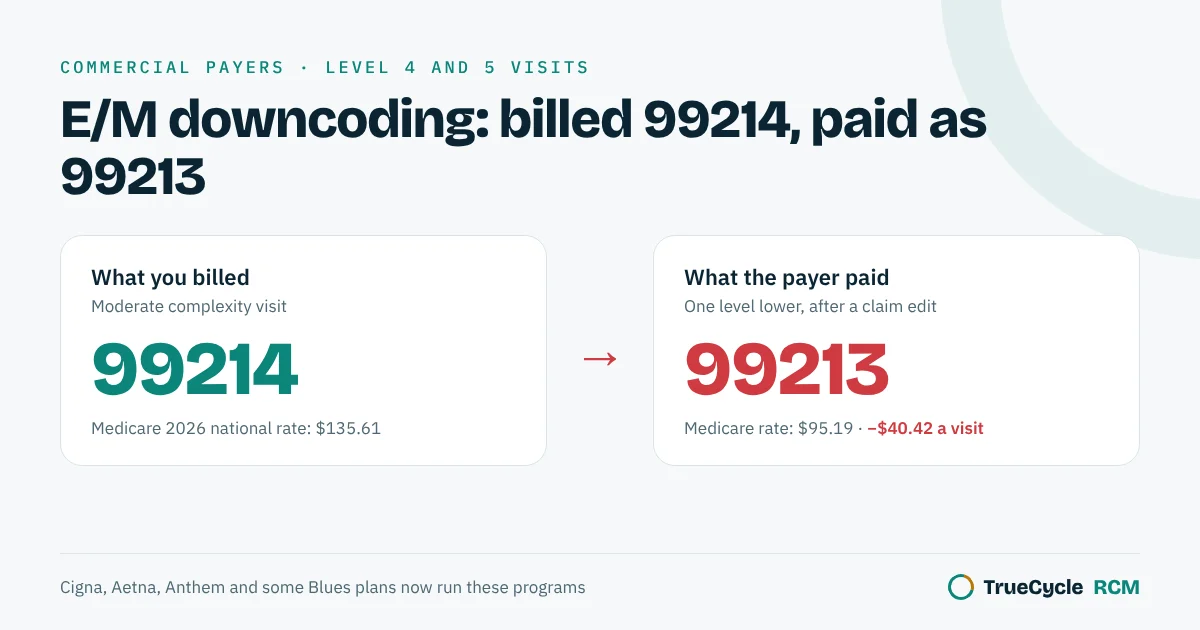
A downcoded claim does not look like a denial. It gets paid. The money just comes in a little short, the claim closes, and nobody in the office gets an alert. That is why so many practices miss it for months.
The gap per visit is not small. At the 2026 Medicare national rate, a 99214 pays $135.61 and a 99213 pays $95.19. Commercial rates vary by contract, but the gap between levels is usually in the same range. Lose $40 on ten visits a week and you are down about $19,000 a year, for care you already gave.
Who is doing it right now
These programs change fast, and some are paused in one state while live in the next. This is where things stood on November 1, 2026.
| Payer | Program | What it targets | Status to know |
|---|---|---|---|
| Cigna | E/M Coding Accuracy, policy R49, from October 1, 2025 | 99204-99205, 99214-99215, 99244-99245, reduced one level | Paused for some California products during state review. Maryland fined Cigna $80,000 in March 2026 and ordered it to stop there. |
| Aetna | E&M Program, part of its Claim and Code Review Program | Level 4 and 5 visits for select providers, reviewed by a vendor's coders | Expanded to all Aetna commercial states except Louisiana. |
| Anthem | E/M claim review, compares your levels with peers | Visits coded higher than peers with similar patients | Held off in California while regulators review it. Check your state's Anthem bulletin. |
| BCBS of Texas | E/M claims review policy | Visits where the billed services do not support the level | Started July 1, 2026. Pays at the lower level it decides is supported. |
| BCBS of Illinois | Tighter E/M editing and review | Visits leveled on medical decision making | Started in 2026. Illinois' new law against automated downcoding does not take effect until January 1, 2028. |
Cigna says its policy touches only about 1% of in-network physicians. If you are in that 1%, though, it hits almost every high-level visit you bill.
How downcoding shows up on your ERA
The AMA's advice is simple: watch your payment details, because nobody else will. In practice, check three things.
- The paid code is different from the billed code. When a payer changes your code, the 835 lists the code it paid and your original code on the same service line. Most practice systems show this as "paid as" or "adjudicated code." A 99214 that comes back as a 99213 is the clearest sign.
- Reason code 150. CARC 150 means the payer decided the information submitted does not support this level of service. It often comes with group code CO, which means you cannot bill the patient for it.
- Level 4 and 5 visits paid at the level 3 rate. Some plans keep your code and just pay less, or send only a remark code. Sort your paid visits by code and allowed amount. If your 99214s from one payer are paying like 99213s, you have found it.
You can open any 835 in our free 835 ERA reader to see the billed and paid codes side by side. It runs in your browser, so nothing is uploaded.
What downcoding costs you in a year
Use your own numbers. The default gap is the 2026 Medicare difference between 99214 and 99213.
Send us 90 days of ERA files. We will list every level 4 and 5 visit that was paid as a lower level, by payer, with the dollar total and which claims are still inside the appeal window. Free, usually within 2 business days. Start with our free 90-day denial audit.
How to appeal a downcoded visit
Most downcoded claims can be won back when the note supports the level. The work is in doing it the same way every time.
- Pull the note and check the level yourself first. Since 2021, office visit levels are chosen by medical decision making (MDM) or by total time on the date of the visit. Score the note honestly. If it does not support the level, take the reduction and fix the template instead.
- Write down how you picked the level. Say it in one or two lines: "Level 4 based on moderate MDM: two chronic illnesses with progression, prescription drug management." Or: "Level 4 based on 34 minutes of total time on the date of service." Reviewers respond to plain, specific facts.
- Use the payer's dispute path. Cigna asks for the medical record, usually by fax, through its reconsideration and appeal process. Aetna sends these through its standard dispute and appeal process. Send the note, the claim, the ERA page and your one-paragraph reason. The AMA publishes a free sample appeal letter for E/M downcoding you can adapt.
- Watch the deadline. Appeal clocks start from the payment date, not the date of service. Cigna gives 180 days to appeal. Aetna gives 180 days for a reconsideration and then 60 days for an appeal. See our Cigna and Aetna guides for the details.
- Batch them. If one payer downcodes the same provider again and again, ask your provider rep for a review of the whole pattern instead of fighting claim by claim. Cigna's FAQs say providers with five or more downcoded claims who believe they code to AMA guidelines can ask to be taken out of the policy.
- Use your state if your plan is fully insured. Maryland, Indiana and Illinois have acted on downcoding, and other states are looking at it. A complaint to your state insurance department can help, but it usually covers fully insured plans only. Self-funded employer plans fall under federal ERISA rules.
How to stop the next one
Cigna has said its edit looks at the primary diagnosis and other claim data, not the note. So part of the fix lives on the claim itself.
- Code every problem you addressed. A 99214 with one routine diagnosis looks like a 99213 to an algorithm. If you managed diabetes, adjusted blood pressure meds and reviewed kidney labs, all of those diagnoses belong on the claim, in a sensible order.
- Use specific ICD-10 codes. "Type 2 diabetes with diabetic chronic kidney disease" tells a different story than "type 2 diabetes without complications." Specific codes back up a higher level.
- Make the MDM easy to find. A short assessment and plan that names the problems, the data you reviewed and the risk of the treatment does more than three pages of copied history.
- Record time when you code by time. Write the total minutes for the date of service and what the time covered.
- Know your own pattern. Run your level 3, 4 and 5 mix by provider every quarter. A provider who bills far more 99215s than peers in the same specialty is the one payers will flag first. That is not proof of a problem, but it tells you where to audit.
- Do not code down out of fear. Billing a 99213 for a 99214 visit loses the same $40 the payer would have taken, with no chance of getting it back.
Common questions
What is E/M downcoding?
Downcoding is when a health plan pays an office visit at a lower level than the one you billed, for example paying a 99214 as a 99213. Many plans now do it with claim-editing software, often without reading the visit note first.
Which insurers downcode E/M visits?
Cigna (policy R49), Aetna (its E&M Claim and Code Review program), Anthem in some states and several Blue Cross Blue Shield plans, including Texas and Illinois, have announced programs that review level 4 and 5 visits and can pay them one level lower.
How do I know if a claim was downcoded?
Compare the code you billed with the code the payer paid on the 835 or EOB. When the payer changes the code, the 835 shows the paid code and your original code side by side. Also look for reason code 150 and for level 4 or 5 visits paid at the level 3 rate.
Can I bill the patient for the difference?
Usually not. If you are in network, the reduction is normally a contractual adjustment, and your contract will not let you balance bill the patient for it. Appeal the claim instead.
Is automatic downcoding legal?
It depends on the state and the plan. Maryland fined Cigna $80,000 in March 2026 and ordered it to stop. Indiana passed limits in 2026, and Illinois passed a ban that starts January 1, 2028. State laws usually cover fully insured plans, not self-funded employer plans, which fall under federal ERISA rules.
Should we bill lower levels to avoid downcoding?
No. Bill the level the visit supports, based on medical decision making or total time. Undercoding on purpose costs you money on every visit and does not fix a documentation problem.
Want to know how much downcoding is costing you?
Send us a de-identified ERA export. We will show every downcoded visit by payer and provider, what it cost you, and which claims we can still appeal. It is part of our free 90-day denial audit. No setup fee, month-to-month.
Get the free denial auditFiling limits, appeal windows and claim addresses change quietly. Get one short email a month with what changed and the free tools we add.
One email a month. No spam. Unsubscribe any time.Related: Most common denial codes in medical billing · Modifier 25 in 2027 · Free 835 ERA reader · Denial code lookup · Free denial audit
More guides from our blog
- Modifier 25 in 2027: what Medicare’s proposed 50% cut looks like in dollars
- Corrected claim timely filing limits for 2026, payer by payer
- Aetna timely filing limit for 2026: new claims, corrected claims, appeals and Medicare
- Cigna and HealthSpring timely filing limit for 2026: new claims, corrected claims, appeals
- 7 common claim denial codes, and how to stop each one before it happens
- HealthSpring timely filing limit for 2026: claims, corrected claims and appeals
- Humana timely filing limit for 2026: claims, corrected claims and appeals
- 190 new ICD-10 codes went live on October 1. Here's what breaks first on your claims.
- How much does medical billing cost in 2026? In-house vs outsourced, in real numbers
- Provider credentialing in medical billing: timelines, documents and CAQH in 2026
- Timely filing limits by payer for 2026, checked against each payer’s own manual
- UnitedHealthcare timely filing limit for 2026: claims, corrected claims and appeals
Free tools
- Payer claim addresses and fax numbers
- Free 835 ERA reader
- Denial code lookup
- Timely filing calculator
- Credentialing timeline calculator
Sources: AMA, how physicians can fight back against payer downcoding and its E/M downcoding resource (PDF) · AAFP on Cigna policy R49 · CMA, Cigna pause in California, October 1, 2025 · Becker's, Maryland fines Cigna, March 2026 · Becker's, payer downcoding programs · Aetna E&M Program Claim and Code Review overview (PDF) · BCBSTX E/M policy, July 1, 2026 · AASM, states challenge downcoding · Chicago Sun-Times on BCBS Illinois, August 26, 2026. Dollar figures use CY 2026 Medicare national non-facility amounts; check your own rates in the CMS fee schedule look-up tool. Payer policies change often; confirm the current version in your payer portal. This article is general information, not coding or legal advice.