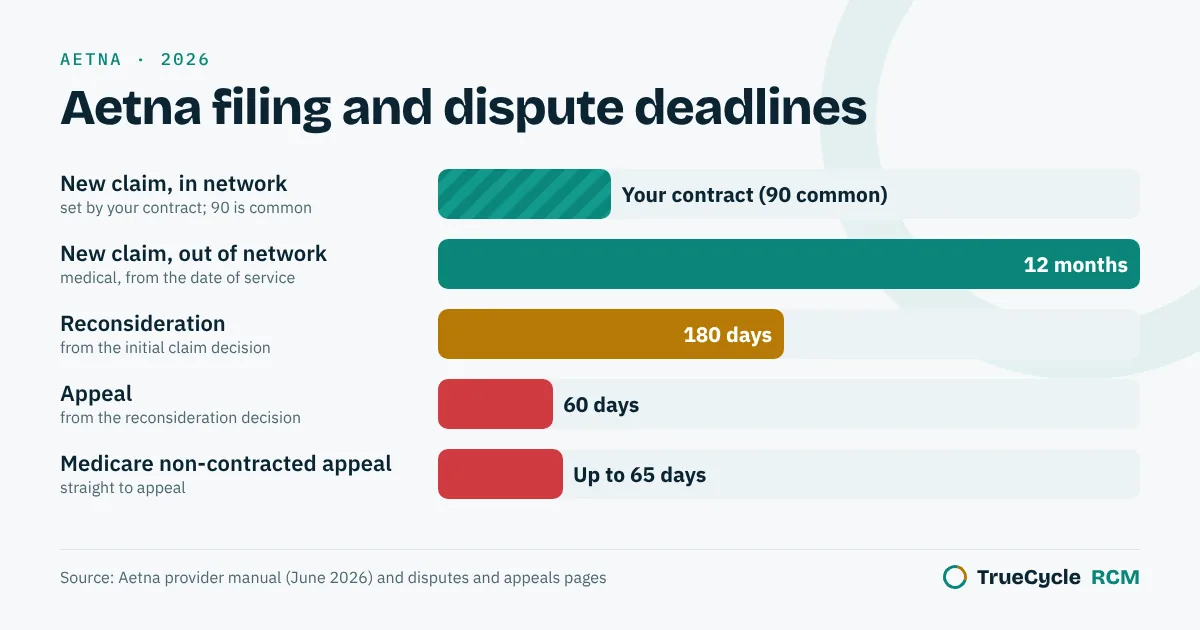
For in-network providers, Aetna's filing limit is whatever your provider agreement says. Aetna's manual does not print one number, and 90 days from the date of service is the term you will see quoted most. Out-of-network providers get 12 months. Disputes are due within 180 days of the claim decision, then 60 days for the appeal.
Search "Aetna timely filing limit" and you will get 90 days, 120 days, 180 days and a year, sometimes on the same page. They cannot all be right, and most of them do not say where the number came from.
So we went back to Aetna's own documents: the June 2026 provider manual, the August 2026 state supplement, the disputes and appeals pages, and Aetna's notice on out-of-network claims. Some answers are firm. One, the in-network limit, is not printed anywhere public, and it is better to know that than to plan around a guess.
What Aetna actually publishes
| Situation | Deadline | Where it comes from |
|---|---|---|
| New claim, in-network | Your contract 90 days is the common term | Provider manual: claims must be "received in a timely manner" |
| New claim, out-of-network (medical) | 12 months from the date of service | Aetna notice, effective January 1, 2022 |
| New claim, out-of-network dentist | 27 months | Same notice, dental kept the old limit |
| Reconsideration (first level dispute) | 180 calendar days | From the initial claim decision |
| Appeal after a reconsideration | 60 calendar days | From the reconsideration decision |
| Medicare non-contracted, straight to appeal | Up to 65 days | Aetna disputes and appeals page |
Two things can change the numbers. Your provider agreement is the first place to look for the in-network limit. And state law can give you more time for disputes in fully insured plans, which Aetna lists state by state.
Aetna deadline calculator
Pick what you are filing, then enter the date that starts the clock.
The in-network number, and why it is missing
Aetna's June 2026 provider manual defines a clean claim as one "received in a timely manner" and says disputes must be filed "within contractual timeframes." It never says how many days that is. The reason is simple: the number lives in each practice's participation agreement, and agreements are not all the same.
That is where the 90-day figure comes from. It is the figure billing teams and most guides quote for Aetna agreements, which is why you see it everywhere. But it is a common contract term, not an Aetna rule, and your agreement can say something different.
What to do with that:
- Find the clause. Search your Aetna agreement or its fee schedule exhibit for "timely" or "submission of claims." It is usually one sentence.
- Until you have it, work to 90 days. If your contract turns out to be longer, nothing is lost. If you plan on 180 and the contract says 90, every claim between day 91 and day 180 is a write-off.
- Write the number down where the billing team sees it. The contract sits in a drawer. The deadline should sit in the billing system.
Send us the list: payer, date of service, denial code and amount. No patient names needed. We will tell you which claims can still be fixed, which need an appeal, and which deadlines are close. Free, usually within 2 business days. Want the full picture? Get a free 90-day denial audit from your ERA files.
Run a billing company? Add a trained biller from $8/hour, first 25 claims free.
Out-of-network: 12 months
This one is firm. In 2021 Aetna told providers that non-participating providers would have 12 months from the date of service for medical claims, down from 27 months, starting with claims on and after January 1, 2022. Aetna said the change was to line up with CMS standards. Non-participating dentists kept 27 months.
Example: an out-of-network visit on February 3, 2026 is due by February 3, 2027. Twelve months sounds generous, but out-of-network claims tend to sit longer because the patient's coverage is harder to confirm. The clock does not care why.
Corrected claims
A lot of people search for an "Aetna corrected claim timely filing limit." For commercial plans, Aetna does not publish a separate one. The manual tells you to send corrected and voided claims electronically, the same way as new claims, and nothing more.
In practice:
- Inside your filing window, send the corrected claim electronically as a replacement (frequency code 7) of the original, or a void (code 8) if the claim should not have gone out at all. Reference the original claim number.
- Outside your filing window, a new corrected claim can come back as a timely filing denial even though the first claim was on time. At that point use a reconsideration instead, and attach proof of when the original was accepted.
Aetna Better Health Medicaid plans are the exception. They set their own resubmission windows by state. Pennsylvania's Aetna Better Health guide, for example, allows 365 days from the remittance date to resubmit a claim that was first filed within 180 days. Check your state plan's manual before relying on that.
Aetna appeal timely filing limit: reconsiderations and appeals
Aetna runs a two-step process for claim disputes, and both windows are in calendar days.
- Reconsideration: within 180 calendar days of the initial claim decision. This is where most timely filing disputes belong. Send the claim ID, member ID, dates of service, billed amounts, the codes in dispute and your supporting documents. Availity's Dispute Claim button works only once the claim is in Finalized status.
- Appeal: within 60 calendar days of the reconsideration decision. Include why you disagree, the denial letter or EOB, the original claim and your documents.
Some issues skip reconsideration and go straight to appeal: up to 180 days for Medicare and commercial, and up to 65 days for Medicare non-contracted providers. Disputes based on medical necessity or experimental coverage get 180 calendar days.
A late-filing denial normally shows on the remittance as CO-29, "the time limit for filing has expired." It is a contractual adjustment, so for an in-network claim the loss is the practice's, not the patient's. The appeals that win are the ones with proof: a clearinghouse or payer acceptance report showing the claim was received inside the window. Save it with every claim.
Where to send Aetna reconsiderations and appeals
New paper claims go to one of two boxes, by the state your office is in: PO Box 14079, Lexington or PO Box 981106, El Paso (also all Medicare claims). Reconsiderations and appeals go elsewhere:
Use Availity first when you can. It is faster and you get a time-stamped record. For paper, Aetna lists these addresses on its disputes and appeals page:
| What you are sending | Fax | |
|---|---|---|
| Reconsideration | The address on the denial letter or EOB. If none: Aetna Provider Resolution Team, PO Box 14079, Lexington, KY 40512-4079 (listed states) or PO Box 981106, El Paso, TX 79998-1106 (other states) | Not listed |
| Appeal, commercial plans | Aetna Provider Resolution Team, PO Box 14020, Lexington, KY 40512 | 859-455-8650 |
| Appeal, Medicare, contracted provider | Medicare Provider Appeals, PO Box 14835, Lexington, KY 40512 | 860-900-7995 |
| Appeal, Medicare, non-contracted provider | Medicare Non-Contracted Provider Appeals, PO Box 14067, Lexington, KY 40512 | 724-741-4953 |
Claim status by phone: 888-632-3862 for commercial plans and 800-624-0756 for Medicare plans. Aetna's commercial payer ID for electronic claims is 60054.
How long Aetna takes to answer
- Reconsideration: most answers come as a new EOB or a letter within about 30 business days.
- Appeal: a written decision within 60 calendar days of receiving the appeal or the extra information Aetna asked for.
- Post-service appeals are never expedited, so do not wait until day 59 to file.
Is there a second-level appeal with Aetna?
For providers, Aetna describes two steps, not more: the reconsideration, then the appeal. The appeal is in effect your second level. Aetna's page does not list a further internal provider appeal after that. What comes next depends on your contract and your state, so check the dispute section of your agreement before you give up on a large claim.
When Aetna is the secondary payer
Aetna does not publish a separate filing window for secondary claims. Send the claim to Aetna with the primary payer's EOB as soon as the primary pays, and keep the date the primary paid. If your contract gives a secondary window, it will be in the claims section of the agreement.
States that give you longer
For members in fully insured plans, Aetna follows state rules where they give providers more time to dispute a payment. A few from Aetna's own list:
| State | Time to dispute an initial claim payment |
|---|---|
| Georgia | 24 months from the date of service or discharge |
| Indiana, North Carolina | 2 years from the claim payment date |
| Ohio, Oklahoma | 2 years |
| Washington | 24 months from denial or payment, on written request |
| Oregon, Rhode Island | 18 months |
| Tennessee | 15 months |
| Arizona, Colorado, Florida, Maryland | 12 months or 365 days |
| Texas | 4 years for claims and non-claims issues |
These are dispute windows, not filing windows. They do not rescue a claim that was never filed on time. Self-funded employer plans usually do not follow state law, so check the member's card for "fully insured" before relying on them.
Rhode Island has one rule worth knowing: if another carrier denied the claim and it was filed with that carrier within 180 days of the date of service, you get 180 days from that carrier's denial to file with Aetna.
Medicare Advantage and Aetna Better Health
Aetna Medicare Advantage. Contracted providers follow their Aetna Medicare agreement for filing. Disputes go to Aetna's Medicare provider appeals unit. Non-contracted providers use a separate Medicare non-contracted appeals address, and their straight-to-appeal window is up to 65 days. Do not apply Original Medicare's one-year rule to an Aetna Medicare claim without checking your agreement.
Aetna Better Health (Medicaid). Each state plan publishes its own limits, and they are often longer than commercial ones. Pennsylvania's guide lists 180 days from the date of service for new claims and 60 days from the denial notice for appeals, unless your contract says otherwise. Use your own state plan's current manual.
For other payers, see our timely filing limits by payer and the Cigna guide.
How to stay on the safe side
- Treat 90 days as the outer edge, not the plan. File Aetna claims within a week of the visit, so most of the window is left for fixing problems.
- Work clearinghouse rejections the same day. A rejected claim never reached Aetna, and the clock keeps running.
- Check eligibility and other coverage at every visit. Aetna is often secondary for patients with a spouse's plan, and nobody notices until the primary denies.
- Run a weekly Aetna aging report. Anything unbilled or unpaid past 45 days gets looked at that week.
- Keep the acceptance report. It is the only thing that wins a timely filing reconsideration.
If an Aetna claim does get denied, our denial code lookup explains the code and the usual fix.
Questions
Is there a second-level appeal with Aetna?
Aetna describes a two-step provider process: a reconsideration within 180 days of the claim decision, then an appeal within 60 days of the reconsideration decision. The appeal is the second level. Further steps depend on your contract and state.
Where do I mail an Aetna appeal?
Commercial appeals go to Aetna Provider Resolution Team, PO Box 14020, Lexington, KY 40512 (fax 859-455-8650). Medicare contracted provider appeals go to PO Box 14835, Lexington, KY 40512 (fax 860-900-7995). Use Availity when you can.
What is the Aetna timely filing limit for secondary claims?
Aetna does not publish a separate secondary-claim window. Send the claim with the primary EOB as soon as the primary pays, and check your provider agreement for any secondary rule.
What is Aetna's timely filing limit?
For in-network providers, the limit is the one written in your Aetna provider agreement. Aetna's 2026 provider manual says claims must be received in a timely manner but does not print one number. 90 days from the date of service is the term most often quoted, so it is the safe working target until you have checked your contract. Out-of-network providers have 12 months from the date of service for medical claims.
What is Aetna's timely filing limit for out-of-network providers?
12 months from the date of service for medical claims. Aetna cut it from 27 months to 12 months for claims on or after January 1, 2022, to line up with CMS. Dental claims from non-participating dentists kept the 27-month limit.
What is Aetna's timely filing limit for corrected claims?
Aetna does not publish a separate corrected-claim window for its commercial plans, so treat a corrected claim as subject to the filing limit in your agreement. Once that window has closed, use the dispute process with proof the original claim was filed on time. Aetna Better Health Medicaid plans are different and set their own resubmission windows by state.
What is the Aetna appeal timely filing limit?
Aetna gives 180 calendar days from the claim decision to ask for a reconsideration, then 60 calendar days from the reconsideration decision to file the appeal. Issues that go straight to appeal get up to 180 days, and Medicare non-contracted providers get up to 65 days.
How long do I have to dispute an Aetna claim?
A reconsideration is due within 180 calendar days of the initial claim decision. If you disagree with the reconsideration, the appeal is due within 60 calendar days of the reconsideration decision. Some states give providers longer, and Medicare non-contracted providers have up to 65 days for issues that go straight to appeal.
Can I bill the patient if Aetna denies a claim for timely filing?
For an in-network claim, generally no. A timely filing denial is usually a CO-29 adjustment, which is a contractual write-off for the provider. Check your agreement and state law.
What is the timely filing limit for Aetna Medicare Advantage?
For contracted providers it is set by your Aetna Medicare agreement. Medicare non-contracted providers dispute payment through Aetna's Medicare non-contracted appeals unit, with up to 65 days for issues that go straight to appeal. Original Medicare is separate: one calendar year from the date of service.
Not sure what your Aetna contract says?
Send us 25 claims. We will check how long each one took to get paid and flag any that are close to a filing deadline. Free, no setup fee, month-to-month.
Start the free 25-claim trialFiling limits, appeal windows and claim addresses change quietly. Get one short email a month with what changed and the free tools we add.
One email a month. No spam. Unsubscribe any time.Related: Corrected claim limits by payer · UnitedHealthcare timely filing limit · Cigna timely filing limit · Timely filing limits by payer · Timely filing calculator · Denial code lookup
More guides from our blog
- E/M downcoding: how to spot 99214 and 99215 cuts and get paid
- Corrected claim timely filing limits for 2026, payer by payer
- Cigna and HealthSpring timely filing limit for 2026: new claims, corrected claims, appeals
- 7 common claim denial codes, and how to stop each one before it happens
- HealthSpring timely filing limit for 2026: claims, corrected claims and appeals
- Humana timely filing limit for 2026: claims, corrected claims and appeals
- 190 new ICD-10 codes went live on October 1. Here's what breaks first on your claims.
- How much does medical billing cost in 2026? In-house vs outsourced, in real numbers
- Modifier 25 in 2027: what Medicare’s proposed 50% cut looks like in dollars
- Provider credentialing in medical billing: timelines, documents and CAQH in 2026
- Timely filing limits by payer for 2026, checked against each payer’s own manual
- UnitedHealthcare timely filing limit for 2026: claims, corrected claims and appeals
Free tools
- Payer claim addresses and fax numbers
- Free 835 ERA reader
- Denial code lookup
- Timely filing calculator
- Credentialing timeline calculator
Aetna "Provider disputes and appeals overview" (aetna.com, read October 28, 2026). Sources, read October 12, 2026: Aetna Provider Manual (8102800-01-01, 6/26), sections on clean claims, claim submissions and claim disputes; Aetna Provider Manual State Supplement (August 2026); Aetna, "Disputes and appeals overview" and "Provider appeals" state exceptions pages; Aetna's 2021 notice on the non-participating provider timely filing change, as reported by XiFin (September 14, 2021); Aetna Better Health of Pennsylvania provider timely submission guide. Your provider agreement and state law can change these limits, so confirm against your own contract. General information, not legal or contractual advice.