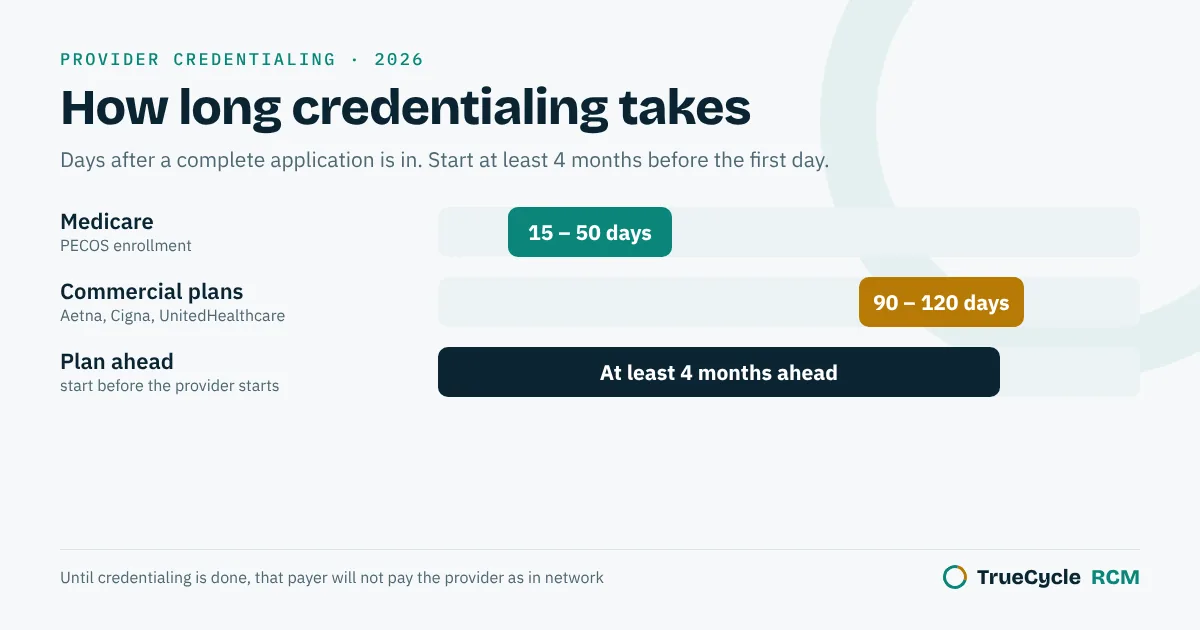
Credentialing is how an insurance company checks a provider's license, training and history before letting them into its network. Until it is done, that payer will not pay the provider as in-network. Medicare usually finishes in 15 to 50 days once a complete application is in. Commercial plans such as Aetna, Cigna and UnitedHealthcare usually take 60 to 120 days from submission to being loaded in the plan's system. Start at least four months before the provider's first day.
Most practices find out about credentialing the hard way. A new physician joins in March, the schedule fills up, claims go out, and in May the remits come back denied because the provider was never enrolled with that plan. The visits happened. The money does not come.
The fix is not complicated, but it is slow and it punishes small errors. This guide walks through it in the order a billing office actually does it.
What credentialing means (and what it is not)
Three words get used as if they were one thing. They are not, and mixing them up is how applications stall.
- Credentialing is the background check. The payer verifies the license, education, board certification, malpractice history and work history directly with the source. That is called primary source verification.
- Contracting is the business agreement: the fee schedule, the filing limits, the terms. A provider can pass credentialing and still not be in network if the contract is not signed.
- Enrollment is the payer loading the provider into its claims system with an effective date. Claims only pay from that date.
In billing, all three have to be finished before a claim for that provider will process as in-network. When people say "we're credentialed with Aetna," check that they mean all three.
How long it takes, payer by payer
| Payer | Typical time after a complete application | What drives it |
|---|---|---|
| Medicare | 15 to 50 days | CMS sets processing standards for its contractors. A site visit or fingerprinting can push it to 85 days. |
| Medicaid | 45 to 120 days | Each state runs its own enrollment. Managed Medicaid plans may then credential separately. |
| Aetna, Cigna, UnitedHealthcare, Humana | 60 to 120 days | Verification, a credentialing committee that meets on a fixed schedule, then contract loading. UnitedHealthcare, for example, credentials within about 14 days of a complete file but allows up to 60 days to load the contract. |
| Blue Cross Blue Shield | 60 to 120 days | Each state plan is different. Anthem publishes about 45 days from a complete CAQH application, and some panels are closed in some specialties. |
The committee is the part nobody can speed up. If a file misses one meeting, it waits for the next one, which can be a month away. That is why a complete file on day one matters more than anything you do later.
Put your own dates in and see the expected approvals, your CAQH due date and the revenue at stake: free credentialing timeline calculator →
Send us the list: payer, date of service, denial code and amount. No patient names needed. We will tell you which claims can still be fixed, which need an appeal, and which deadlines are close. Free, usually within 2 business days. Want the full picture? Get a free 90-day denial audit from your ERA files.
Run a billing company? Add a trained biller from $8/hour, first 25 claims free.
The process, step by step
1. Get the NPIs right
Every provider needs an individual (Type 1) NPI from NPPES. A group that bills under its own name also needs an organizational (Type 2) NPI. Check that the name, address and taxonomy code in NPPES match what you will put on every application. A mismatch here causes rejections later that look unrelated.
2. Build and attest the CAQH ProView profile
CAQH ProView (renamed the DataSpring Provider Data Portal in June 2026) is a single online profile that most commercial plans read instead of sending you their own forms. It is free for providers. Fill every section, upload the documents, attest, and then grant each payer access to the profile. Forgetting that last step is common, and the payer simply cannot see the file.
3. Enroll in Medicare through PECOS
Medicare does not use CAQH. Individual providers enroll with form CMS-855I in PECOS. Reassigning payments to a group is part of the same 855I; the separate CMS-855R was retired in 2023. Individual physicians and practitioners do not pay an application fee.
4. Send the payer applications, all at once
Submit to every payer the practice needs at the same time. Ask each one first whether its panel is open for your specialty in your area. A closed panel can hold an application for months without a formal "no".
5. Follow up on a schedule
Call or check the portal two weeks after submitting, then every 7 to 10 days. Write down the reference number, the name of the person and the date every time. When a payer asks for more information, answer within two business days.
6. Sign the contract and confirm the effective date
Get the effective date in writing. Ask whether the payer will pay for services between the submission date and the effective date. Many commercial plans will not. Medicare's effective date is the later of the date it received an application it then approved, or the date the provider started at that location. Medicare will pay for services up to 30 days before that date when circumstances prevented earlier enrollment.
7. Load it into your billing system, then send one test claim
Add the provider's payer IDs and effective dates in the practice management system. Send one clean claim and wait for the payment before releasing the backlog. If the setup is wrong, you find out on one claim instead of forty.
Documents to have ready
- Individual NPI, and group NPI if billing as a group
- Active state medical license with its expiry date
- DEA registration and state controlled-substance certificate, if the provider prescribes
- Board certification, or proof of residency completion
- Malpractice insurance face sheet and five years of claims history
- CV showing month and year for every position, with a written note for any gap
- Medical school, residency and fellowship details
- Hospital privileges, or a written admitting arrangement
- W-9 and the practice's Tax ID
Check expiry dates before you submit. A license or malpractice certificate that expires while the application is in review sends that item back for re-verification.
CAQH: the 120-day rule
CAQH asks providers to review and re-attest their profile every 120 days (every 180 days for providers practicing in Illinois). CAQH sends reminders, but they go to whoever set up the account, and that person has often left the practice.
When the attestation lapses, payers reading the profile see it as out of date. Applications that were moving can stop, and the payer will not tell you why unless you ask. Put the re-attestation date on a calendar the day you attest. The calculator works it out for you.
What happens if a provider is not credentialed
Claims for that provider with that payer deny, often with codes such as CO-185 (rendering provider not eligible) or a provider-not-enrolled remark. For an in-network patient, the visit may be treated as out of network, which means a smaller payment or none, depending on the plan.
The tempting shortcut is to bill the visits under a credentialed colleague's NPI. Do not. Billing a service under a provider who did not perform it misstates who gave the care. Medicare's "incident to" rules allow it only in narrow, supervised situations, and commercial plans set their own rules. The safer path is to schedule the new provider with patients from plans that are already active, and hold the rest until approval.
The cost of waiting adds up quickly. A provider seeing 18 patients a day at $110 a visit, 20 clinic days a month, generates about $39,600 a month. A 120-day delay holds back more than $150,000.
Re-credentialing and Medicare revalidation
Credentialing is not one and done. Plans that follow NCQA standards re-credential every 36 months. Medicare asks most providers to revalidate their enrollment every five years, and posts each provider's due date on its revalidation lookup. Miss a revalidation and Medicare can deactivate billing privileges, which stops payment until it is fixed.
Keep one sheet per provider with every payer, the effective date, the next re-credentialing date and the CAQH attestation date. It is dull work, and it is the work that keeps claims paying.
Questions
How long does credentialing take?
Medicare usually finishes within 15 to 50 days of a complete application. Commercial plans, Blue Cross plans included, usually take 60 to 120 days from submission to being loaded. Medicaid varies by state, roughly 45 to 120 days.
Does Medicare use CAQH?
No. Medicare enrollment goes through PECOS with form CMS-855I. CAQH is used by most commercial plans and many Medicaid managed care plans.
What happens if my CAQH attestation expires?
Payers see your profile as out of date, and credentialing that depends on it can stall until you re-attest. Re-attest every 120 days, or every 180 days in Illinois.
Is credentialing the same as contracting?
No. Credentialing verifies the provider. Contracting sets the payment terms. You need both, plus enrollment in the payer's system with an effective date, before claims pay in network.
Can a new provider bill under another doctor's NPI while waiting?
Not as a workaround. A claim should name the provider who performed the service. Medicare's incident-to rules are narrow and require supervision of an established plan of care. Check each payer's policy before relying on any exception.
How often do providers have to re-credential?
Every 36 months for plans that follow NCQA standards. Medicare revalidation is generally every five years.
Adding a provider, or stuck in a payer queue?
We handle payer enrollment and CAQH set-up for $149 per insurance plan, charged only after the plan approves you, with a tracker you can see. Check the exact forms, logins and price for your state first.
Check my requirements and priceFiling limits, appeal windows and claim addresses change quietly. Get one short email a month with what changed and the free tools we add.
One email a month. No spam. Unsubscribe any time.Related: Credentialing cost and requirements checker · What credentialing costs · Credentialing timeline calculator · CO-185 denial code · Timely filing limits by payer · What medical billing costs
More guides from our blog
- E/M downcoding: how to spot 99214 and 99215 cuts and get paid
- Corrected claim timely filing limits for 2026, payer by payer
- Aetna timely filing limit for 2026: new claims, corrected claims, appeals and Medicare
- Cigna and HealthSpring timely filing limit for 2026: new claims, corrected claims, appeals
- 7 common claim denial codes, and how to stop each one before it happens
- HealthSpring timely filing limit for 2026: claims, corrected claims and appeals
- Humana timely filing limit for 2026: claims, corrected claims and appeals
- 190 new ICD-10 codes went live on October 1. Here's what breaks first on your claims.
- How much does medical billing cost in 2026? In-house vs outsourced, in real numbers
- Modifier 25 in 2027: what Medicare’s proposed 50% cut looks like in dollars
- Timely filing limits by payer for 2026, checked against each payer’s own manual
- UnitedHealthcare timely filing limit for 2026: claims, corrected claims and appeals
Free tools
- Payer claim addresses and fax numbers
- Free 835 ERA reader
- Denial code lookup
- Timely filing calculator
- Credentialing timeline calculator
Sources, read October 17, 2026: First Coast Service Options, "CMS-855 enrollment application processing timeframes" (February 18, 2026); 42 CFR 424.520(d) and 424.521(a)(1), as quoted in HHS Departmental Appeals Board decision DAB 3017; CAQH ProView QuickRef published by BCBS of Illinois; NCQA credentialing standards summary (Neolytix); commercial timelines and the revenue example from Assured, "How long does provider credentialing take?" (August 2026). Timelines are typical ranges, not payer guarantees. General information, not legal advice.