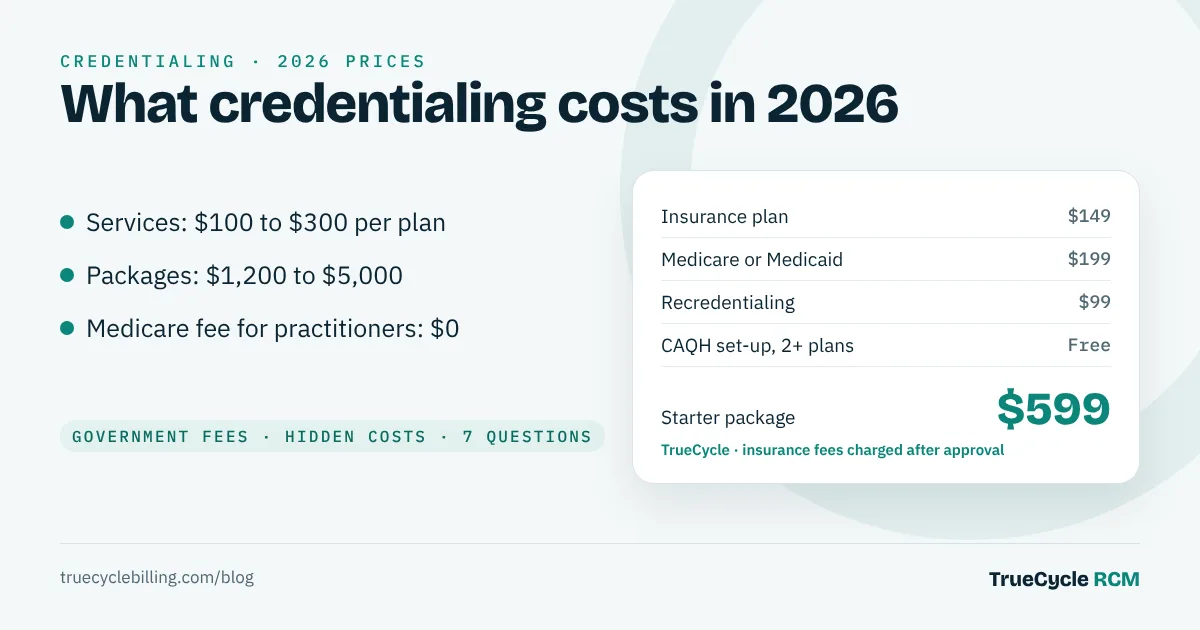
Credentialing services usually charge $100 to $300 per insurance plan, per provider. Packages run about $1,200 to $5,000 per provider, and ongoing upkeep runs $30 to $200 a month. Medicare charges physicians, practitioners and their groups no application fee. Institutional providers, such as home health agencies, pay CMS $750 in 2026. At TrueCycle it is $149 per insurance plan, charged only after the plan approves you.
Want your own number? The credentialing cost and requirements checker builds the full plan for your state, license and plans in about a minute: forms, logins, wait times and the exact price.
What credentialing services charge
Prices are quoted a few different ways. Compare them on the same basis: one provider, the same list of plans.
| Pricing model | Typical range | Watch for |
|---|---|---|
| Per plan, per provider | $100 to $300 each | Whether you pay up front or only when the plan approves you. |
| Package per provider | $1,200 to $5,000 | How many plans are included, and whether Medicare and Medicaid count as plans. |
| Monthly upkeep | $30 to $200 per provider | Whether it covers CAQH re-attestation, recredentialing and revalidation, or only tracking. |
| Set-up fee | $0 to $350 per provider | Some services add it on top of the per-plan fee. |
Behavioral health platforms are a separate case. Some credential therapists for free or for a monthly fee, but you join the platform's own contracts and bill through it, at the rates it negotiated. That can be a good start. It is not the same as your own contract with the plan.
Government and application fees
- Medicare, physicians and practitioners: no application fee, for individuals or their group practices.
- Medicare, institutional providers: $750 for 2026, paid to CMS with a new enrollment, a revalidation or a new location. This covers home health agencies, hospices and similar organizations.
- Medicaid: set by each state. Several states charge institutional providers a fee, and many accept the Medicare fee instead of charging their own.
- CAQH (now DataSpring): free for providers. The plans pay for it.
- Commercial plans: no application fee.
So for most physicians and practitioners, every dollar of credentialing cost is labor: yours, your staff's, or a service's.
Doing it yourself: free, but not cheap
A first-time enrollment means a CAQH profile with every document uploaded, a PECOS application, a state Medicaid portal account, a separate request to each commercial plan, and follow-up calls every week or two until each one is loaded. The work itself is not hard. The problem is that small mistakes are expensive:
- A taxonomy on the NPI that does not match the license, or a W-9 name that does not match IRS records, sends the file back.
- A CAQH attestation older than 120 days stalls the plans that read it. Cigna looks for one within 100 days.
- A request for more information that sits for 30 days usually closes the file, and the clock starts again.
- Approval is not the finish line. Claims sent before the contract is loaded deny, even though the plan said yes.
If someone on your team has done this before and has the hours, doing it in-house is reasonable. If not, the first mistake usually costs more than the service would have.
The cost nobody quotes: waiting
Medicare usually finishes a complete online application in 15 to 50 days. Commercial plans usually take 60 to 120 days from submission to being loaded. Medicaid takes 45 to 120 days in most states, and managed care plans start only after the state enrolls you.
Visits during that time are the real price. A provider who sees 8 patients a day from one plan, at $110 a visit, 5 days a week, is holding back about $26,000 over a 120-day wait for that plan. Medicare lets you bill up to 30 days before your effective date. Most commercial plans pay nothing in network before the date in your contract.
That is why the cheapest quote is not always the cheapest outcome. A service that submits a complete file in the first week and follows up on schedule can be worth several times its fee.
TrueCycle pricing
| Service | Price | When you pay |
|---|---|---|
| Insurance plan enrollment (UnitedHealthcare, Aetna, Cigna, Blue Cross, Humana, Medicaid managed care and others) | $149 per plan, per provider | Only after the plan approves you |
| Medicare enrollment (PECOS, CMS-855I, CMS-588) | $199 per provider | One-time |
| State Medicaid enrollment | $199 per provider | One-time |
| Starter package: CAQH set-up, Medicare and 3 insurance plans | $599 per provider | Saves $47 against single prices |
| New group Medicare enrollment (CMS-855B and reassignments) | $149 per group | One-time |
| CAQH set-up or clean-up | Free with 2 or more applications, $99 alone | One-time |
| Recredentialing or revalidation | $99 per plan | When due |
Home health agencies, hospices and other facilities are quoted after a short call, because accreditation, surveys and high-risk screening change the work a lot.
Pick your state, license type and the plans you want. The checker lists every form, login and document, the usual wait for each plan, the problems to watch for, and the total. Free, no sign-up.
Seven questions to ask before you sign
- Do I pay before or after approval? Paying on approval puts the risk on the service, where it belongs.
- Which plans count? Some packages count Medicare, Medicaid and CAQH as three of the "plans".
- Who owns the logins? CAQH, PECOS and portal accounts should be in your name, with access shared, not owned by the service.
- Can I see status any time? Ask for a tracker with submitted dates, reference numbers and the last call note for each plan.
- What happens when a panel is closed? A good service tells you up front and does not bill you for a plan that was never going to say yes.
- Is upkeep included? CAQH must be re-attested every 120 days, and plans recredential about every 3 years.
- How do you collect my SSN and documents? The answer should be a secure, encrypted upload, never email or a web form.
Questions
How much does credentialing cost per provider?
Usually $100 to $300 per insurance plan, so a provider joining Medicare and four commercial plans typically pays $500 to $1,500 through a service. Packages run $1,200 to $5,000.
Does Medicare charge an application fee?
Not for physicians, non-physician practitioners or their group practices. Institutional providers pay $750 in 2026.
Is CAQH free?
Yes, for providers. CAQH, now called DataSpring, is paid for by the health plans that use it.
Can I credential myself?
Yes. Every step can be done by the provider or practice staff. The cost is time, and the risk is a mistake that restarts a 90-day clock.
How long does it take?
Medicare usually takes 15 to 50 days, commercial plans 60 to 120 days, and Medicaid 45 to 120 days in most states. The timeline calculator works out dates for your plans.
Want someone to run it for you?
We file every application, keep CAQH current and chase each plan until you are loaded and billing. $149 per insurance plan, charged only after approval.
Check my requirements and priceRelated: Credentialing cost and requirements checker · Provider credentialing, step by step · Credentialing timeline calculator · What medical billing costs
Sources, read November 1, 2026: Federal Register, December 3, 2025 (CY2026 Medicare application fee, $750, institutional providers); 42 CFR 424.502 and 424.514 (who pays the fee); 42 CFR 424.520(d) and 424.521(a) (effective date, 30-day retroactive billing); DataSpring Provider Data Portal quick reference (120-day re-attestation); Cigna Healthcare join-our-network page (CAQH attestation within 100 days); UnitedHealthcare credentialing FAQ, October 2026; published price pages from MedSole RCM, JotCred, Physician Practice Specialists, Medwave and SimplePractice. Market ranges are typical, not quotes. General information, not legal advice.