1. Expected approval dates
No patient information is asked for. Nothing you type is saved or sent anywhere; the math runs in your browser.
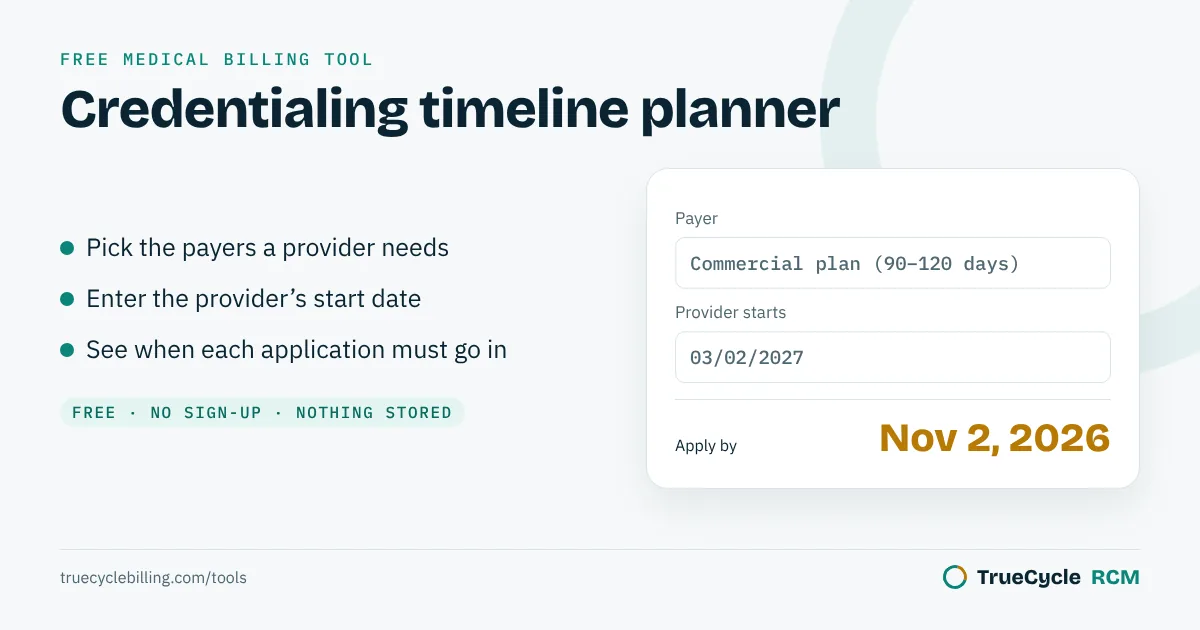
| Payer | Typical wait | Likely approved between |
|---|
2. CAQH re-attestation date
Send us the list: payer, date of service, denial code and amount. No patient names needed. We will tell you which claims can still be fixed, which need an appeal, and which deadlines are close. Free, usually within 2 business days. Want the full picture? Get a free 90-day denial audit from your ERA files.
Run a billing company? Add a trained biller from $8/hour, first 25 claims free.
3. Revenue waiting on enrollment
4. Document checklist
Have these current before you submit. An expired item is the most common reason a file restarts.
Where the ranges come from
| Payer type | Typical wait | Basis |
|---|---|---|
| Medicare (PECOS / CMS-855I) | 15 to 50 days | CMS contractor processing standards: 95% within 15 days and all within 50, when no site visit or fingerprinting is needed. With a site visit, up to 85 days. |
| Medicaid | 45 to 120 days | Set by each state. Some states also require a separate managed care plan enrollment. |
| Commercial (Aetna, Cigna, UnitedHealthcare, Humana) | 60 to 120 days | From submission to being loaded in the plan's system. UnitedHealthcare, for example, credentials within about 14 days of a complete file and allows up to 60 days to load the contract. |
| Blue Cross Blue Shield | 60 to 120 days | Varies by state plan. Anthem, for example, publishes about 45 days from a complete CAQH application, plus time to load the contract. |
Medicare does not use CAQH. It enrolls you through PECOS. Most commercial plans and many Medicaid managed care plans read your CAQH ProView profile instead of asking for paper forms, which is why a lapsed attestation slows them down.
Read the full guide: provider credentialing in medical billing, step by step →
Three things that add months
- Submitting before the file is complete. Payers do not hold a place in line for an incomplete application. They return it, and the clock starts again.
- Waiting for one payer before starting the next. Applications can run in parallel. Doing them one at a time is the slowest way to get in network.
- No follow-up. Check status two weeks after submitting, then every 7 to 10 days, and answer requests for more information within two business days.
Want someone else to chase the payers?
We handle payer enrollment and CAQH set-up for practices: $149 per insurance plan, charged only after approval, with a tracker you can see. See the exact forms, logins and price for your state in one minute.
Check my requirements and priceFiling limits, appeal windows and claim addresses change quietly. Get one short email a month with what changed and the free tools we add.
One email a month. No spam. Unsubscribe any time.More free tools: Timely filing calculator · Denial code lookup · 835 ERA reader · Place of service codes
Sources, read October 17, 2026: First Coast Service Options, "CMS-855 enrollment application processing timeframes" (February 18, 2026); 42 CFR 424.520(d) and 424.521(a); CAQH ProView QuickRef (re-attestation every 120 days, 180 days in Illinois); NCQA credentialing standards (recredentialing every 36 months); commercial timelines from published credentialing benchmarks. Typical ranges only; your payer's own notice is what counts. General information, not legal advice.