Find a POS code
Type a number or a word, like 11, telehealth, urgent or hospital.
A pharmacy where drugs are dispensed and health services such as vaccines or screenings may be given.
A telehealth visit where the patient is not at home, for example at a clinic, school or workplace site.
A school or college, for services given to students on campus.
A shelter that provides temporary housing to people experiencing homelessness.
A stand-alone IHS facility serving American Indians and Alaska Natives.
An IHS facility that is part of a hospital.
A stand-alone facility run by a tribe under a 638 agreement.
A tribal 638 facility that is part of a hospital.
A prison, jail or detention center.
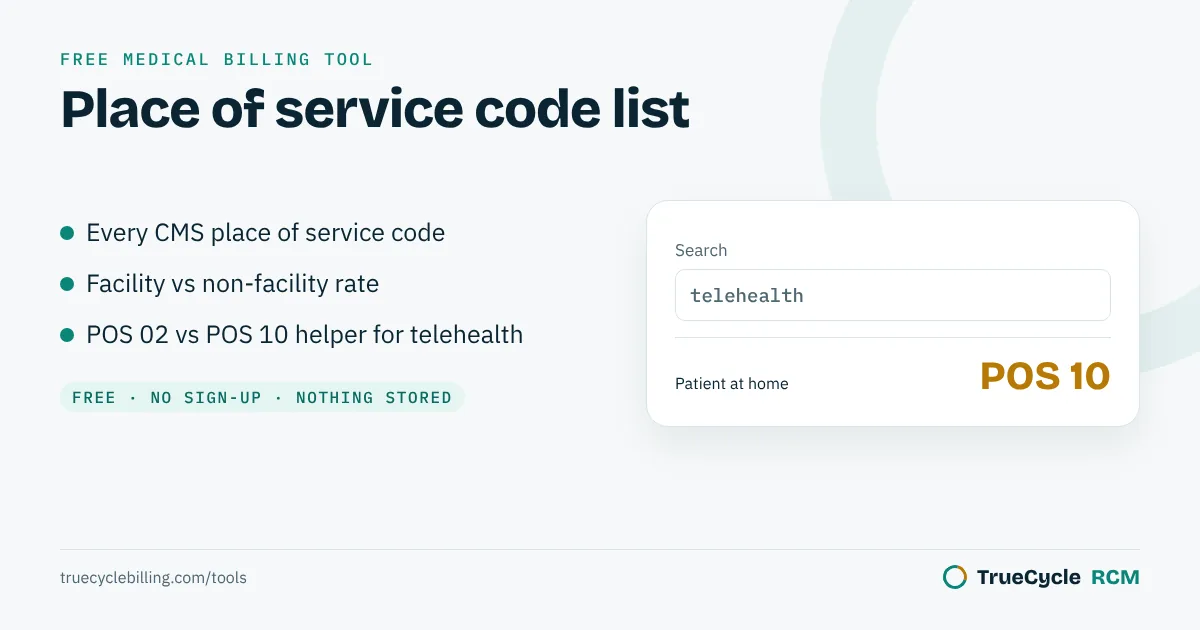
A telehealth visit where the patient is at home or another private residence.
A physician's or other provider's office or clinic that is not part of a hospital. The most used code on professional claims.
The patient's home or private residence, for in-person home visits.
Residential care with personal support, but not a nursing facility.
A residence with shared living and supervision.
A van or vehicle that travels to provide care, such as mobile imaging or screening.
A hotel, campground or similar short-stay lodging.
A walk-in clinic inside a retail store or pharmacy, not an urgent care center.
A workplace where the employer provides health services to staff.
A hospital outpatient department located away from the main hospital campus.
A stand-alone urgent care center for unscheduled walk-in care.
A hospital stay where the patient has been admitted as an inpatient.
A hospital outpatient department on the main hospital campus.
A hospital emergency department.
A free-standing surgery center for same-day procedures.
A non-hospital facility for labor, delivery and immediate postpartum care.
A facility run by the uniformed services.
A non-permanent location on the street or in a public space, used for outreach care.
A skilled nursing facility. Facility rate applies to Part A residents.
A nursing facility, and SNF patients who are Part B residents.
A facility giving room, board and personal care, without skilled nursing.
A hospice facility. Facility rate applies to inpatient hospice care.
A land ambulance.
An air or water ambulance.
A clinic that is not hospital-based and not a physician's office, giving preventive or primary care.
An FQHC.
A psychiatric hospital stay.
A psychiatric partial hospitalization program.
A community mental health center.
An ICF/IID.
A residential addiction treatment facility.
A residential psychiatric treatment center.
An outpatient addiction treatment program.
An opioid treatment program that does not house patients.
A location set up for mass vaccination, such as a flu clinic.
An inpatient rehabilitation facility.
An outpatient rehabilitation facility (CORF).
A dialysis facility.
A PACE center.
A state or local public health clinic.
A certified rural health clinic.
A lab that is not part of a hospital or a physician's office.
Any setting that no other code describes.
No code matches that. Try a shorter word, or see the unassigned numbers below.
Telehealth: POS 02 or POS 10?
Where was the patient during the video or audio visit?
Send us the list: payer, date of service, denial code and amount. No patient names needed. We will tell you which claims can still be fixed, which need an appeal, and which deadlines are close. Free, usually within 2 business days. Want the full picture? Get a free 90-day denial audit from your ERA files.
Run a billing company? Add a trained biller from $8/hour, first 25 claims free.
Why the place of service changes the payment
Many services on the Medicare Physician Fee Schedule have two prices. When the service happens in a facility, like a hospital or surgery center, the facility bills Medicare separately for the room, staff and supplies, so the physician gets the lower facility rate. In an office or other non-facility setting, the physician carries those costs, so the non-facility rate is higher.
That is why a wrong POS code is not a small typo. Billing POS 11 for a visit that took place in a hospital outpatient department (POS 19 or 22) overstates the payment, and payers look for exactly that. Billing 22 for an office visit leaves money on the table.
The facility and non-facility tags above follow the CMS list in the Medicare Claims Processing Manual. Codes tagged "check payer" are not on either list there, so confirm how your payer treats them.
Codes that get mixed up
- 11 vs 22 vs 19. An office that is owned by a hospital and billed as a hospital outpatient department is 22 (on campus) or 19 (off campus), not 11. Check how the location is enrolled.
- 02 vs 10. It depends on where the patient is, not the provider. Patient at home is 10.
- 20 vs 11 vs 17. A stand-alone urgent care center is 20. A walk-in clinic inside a retail store is 17. A regular clinic with set appointments is 11.
- 31 vs 32. The same building can be both. A skilled nursing patient in a Part A stay is 31. A resident whose stay is not covered by Part A is 32.
- 21 vs 22. A patient kept in the hospital under observation is still an outpatient, so it is 22 (or 19 off campus), not 21. Use 21 only after a formal inpatient admission.
Commercial payers and Medicaid plans mostly use the same codes, but some have their own telehealth rules, for example asking for a modifier as well. Check the payer's telehealth policy before you rely on Medicare's.
Unassigned numbers
These POS numbers are not in use: 28-30, 35-40, 43-48, 59, 63-64, 67-70, 73-80, 82-98. A claim with one of them will normally be rejected. For a setting that no code describes, use 99, Other Place of Service.
Questions
What is POS 11?
POS 11 is Office: a physician's or other provider's office or clinic that is not part of a hospital. Under the Medicare Physician Fee Schedule it is paid at the non-facility rate.
What is the difference between POS 02 and POS 10?
Both are telehealth codes. POS 10 is used when the patient is at home or another private residence during the telehealth visit. POS 02 is used when the patient is somewhere other than home. Medicare pays POS 10 at the non-facility rate and POS 02 at the facility rate.
What is the difference between POS 19 and POS 22?
Both are hospital outpatient departments. POS 22 is on the main hospital campus. POS 19 is an outpatient department located off campus. Both are paid at the facility rate under the Medicare Physician Fee Schedule.
What is POS 20 used for?
POS 20 is Urgent Care Facility, a location that diagnoses and treats illness or injury for unscheduled walk-in patients. Medicare pays physician services there at the non-facility rate.
Why does the place of service change the payment?
The Medicare Physician Fee Schedule has two rates for many services. In facility settings such as hospitals, the facility bills its own costs, so the physician gets the lower facility rate. In non-facility settings such as an office, the physician's rate includes practice expenses and is higher.
Who maintains the place of service codes?
The Centers for Medicare & Medicaid Services (CMS) maintains the POS code set. The codes are used on professional claims by Medicare, Medicaid and most commercial payers.
Getting denials over place of service?
We review 25 of your claims free and flag POS and modifier mismatches before payers do. No setup fee, month-to-month.
Start the free 25-claim trialFiling limits, appeal windows and claim addresses change quietly. Get one short email a month with what changed and the free tools we add.
One email a month. No spam. Unsubscribe any time.More free tools: Denial code lookup · Timely filing calculator · Modifier 25 exposure calculator
Read next: UnitedHealthcare timely filing limit · Common claim denials and how to prevent them
Code names from the CMS Place of Service Code Set (cms.gov), read October 14, 2026. Facility and non-facility settings from CMS Transmittal 12823 (CR 13744), Medicare Claims Processing Manual, Pub. 100-04. Plain-English descriptions are our own summaries, not CMS text. Payers can apply their own rules, so check the payer's policy before relying on any of this. General information, not legal or billing advice.