What this reader shows you
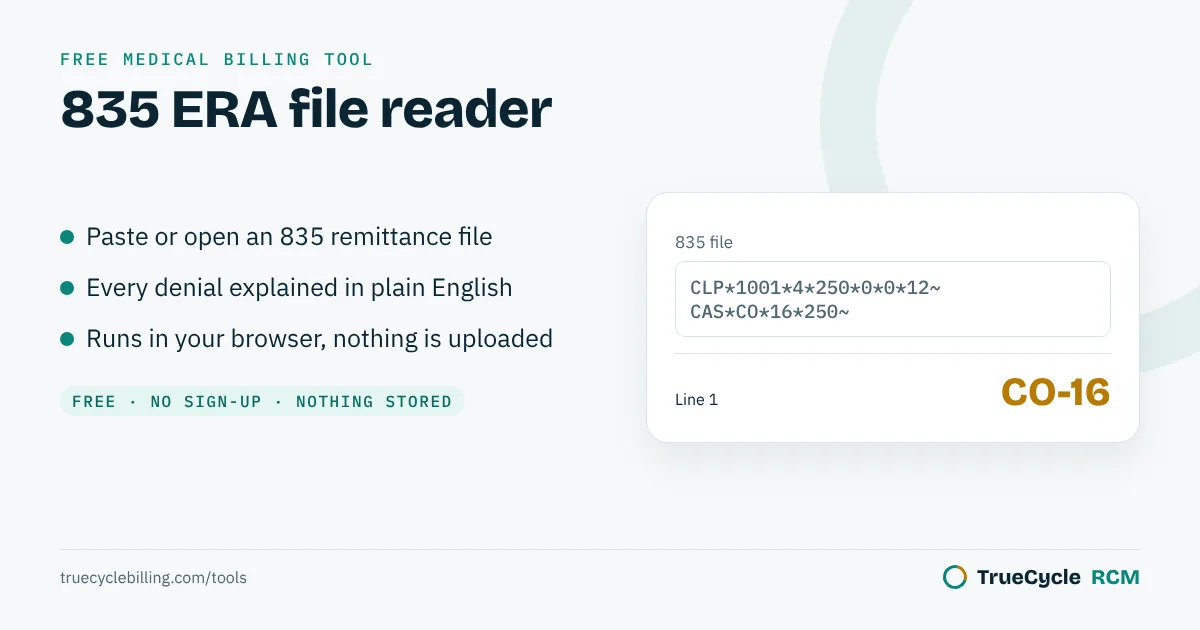
An 835 is built for computers, not people. A line like CAS*CO*97*180~ hides the fact that a whole procedure went unpaid because the payer bundled it into the visit. This page turns the file into four things a biller can act on:
- Payment summary. Payer, check or EFT number, date, and whether the claim totals and provider adjustments add up to the payment.
- Every reason money was held back, grouped by code and sorted by dollars, split into what's expected (contract write-offs), what's the patient's to pay, and what needs work.
- Each claim and line, with the billed, allowed and paid amounts, the adjustment codes, remark codes and a short next step.
- A worklist download (CSV) of only the lines that need follow-up, ready for your team or your spreadsheet.
How to read an 835 by hand
If you ever need to check the raw file, these are the segments that matter. Elements are split by * and each segment ends with ~.
| Segment | What it tells you |
|---|---|
| BPR | The payment: BPR02 is the total amount, BPR04 the method (ACH, CHK, NON for zero pay), BPR16 the payment date. |
| TRN | TRN02 is the check or EFT trace number you match to the bank deposit. |
| N1*PR / N1*PE | The payer and the payee (your practice, with its NPI or tax ID). |
| CLP | One claim. CLP01 your account number, CLP02 status, CLP03 billed, CLP04 paid, CLP05 patient responsibility, CLP07 the payer's claim number. |
| NM1*QC | The patient's name and member ID. |
| SVC | One service line: the CPT or HCPCS with modifiers, billed amount, paid amount and units. |
| CAS | Adjustments: a group code, then reason code and amount pairs. This is where denials live. |
| LQ*HE / MOA | Remark codes (RARCs) that give the detail behind a reason code, at line or claim level. |
| AMT*B6 | The allowed amount for a line. |
| PLB | Provider-level adjustments not tied to one claim, such as recoupments (WO), interest (L6) or forward balances (FB). |
Group codes in one line each
- CO, contractual obligation. The provider absorbs it. Don't bill the patient.
- PR, patient responsibility. Deductible, coinsurance, copay or a non-covered service the patient agreed to. You can bill the patient.
- OA, other adjustment. Neither of the above, often the primary payer's adjustment on a secondary claim.
- PI, payer-initiated reduction. The payer reduced it without a contract basis you agreed to. Worth a look.
- CR, correction or reversal of an earlier claim.
Claim status codes (CLP02)
| Code | Meaning |
|---|---|
| 1, 2, 3 | Processed as primary, secondary or tertiary |
| 4 | Denied |
| 19, 20, 21 | Processed, and forwarded to another payer |
| 22 | Reversal of a previous payment |
| 23 | Not our claim, forwarded to another payer |
| 25 | Predetermination pricing only, no payment |
Questions billers ask
What is an 835 file?
An 835 is the electronic remittance advice (ERA) a health plan sends with a payment. It is an X12 EDI file that lists every claim in the payment, what was paid, and the reason codes for anything that wasn't.
Is it safe to open an 835 with this tool?
The file is read by JavaScript inside your own browser tab. It is not uploaded, sent or stored anywhere, and it is gone when you close the tab. You can load the page, turn off your internet, and the reader still works.
How do I read the CAS segment in an 835?
CAS is the adjustment segment. The first element is the group code (CO, PR, OA, PI or CR), followed by pairs of reason code and amount. CAS*CO*45*82.40 means a contractual obligation, reason 45, for $82.40.
What does claim status 4 mean in an 835?
CLP02 = 4 means the claim was denied. Status 1, 2 and 3 mean it was processed as primary, secondary or tertiary, and 22 means a reversal of an earlier payment.
What is the PLB segment?
PLB is a provider-level adjustment. It changes the total payment but is not tied to one claim, for example an overpayment recovery (WO), interest (L6) or a forward balance (FB).
Where do I get my 835 files?
From your clearinghouse or the payer's portal, usually in the ERA or remittance section. Files often end in .835, .txt, .edi or .era.
Send us the list: payer, date of service, denial code and amount. No patient names needed. We will tell you which claims can still be fixed, which need an appeal, and which deadlines are close. Free, usually within 2 business days. Want the full picture? Get a free 90-day denial audit from your ERA files.
Run a billing company? Add a trained biller from $8/hour, first 25 claims free.
Too many denials to work through?
Send us a recent ERA and we'll tell you which denials are worth chasing and how much they add up to. Free, no contract.
Get a free claim reviewFiling limits, appeal windows and claim addresses change quietly. Get one short email a month with what changed and the free tools we add.
One email a month. No spam. Unsubscribe any time.Related: Denial code lookup · Timely filing calculator · Place of service codes. Code meanings are our own plain-English summaries of the official X12 CARC and RARC lists; for any code not explained here, check the CARC list and RARC list. The sample file is made up. General information, not legal or billing advice.