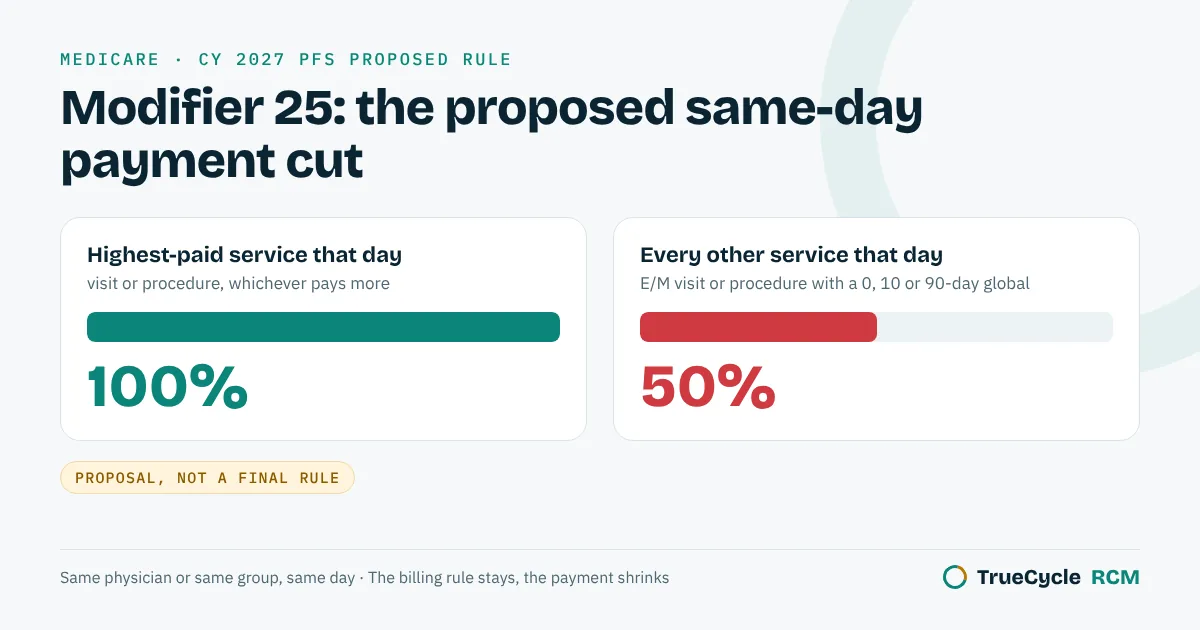
Medicare has proposed, not finalized, a cut for 2027: when an E/M visit with modifier 25 and a procedure with a global period are billed the same day, the higher-paid service gets 100% and the other gets 50%. The billing rule does not change. The payment does. The final rule is expected around November 1.
Status on October 7, 2026: this is a proposal, not a rule. The comment period closed on September 14. The AMA expects the final rule by November 1, and we will update this page the day it comes out.
If your practice sees Medicare patients, you bill this combination all the time. A patient comes in for knee pain, you evaluate them and inject the knee. A child has warts, you examine and freeze them. Today Medicare pays the visit and the procedure in full, as long as the visit is separately identifiable and carries modifier 25.
The CY 2027 Physician Fee Schedule proposed rule would change the payment for that day. The billing rule stays the same. The check gets smaller.
What CMS actually proposed
The wording in the rule is short. When a separately identifiable office or outpatient E/M visit is billed on the same day as a procedure with a 0-day, 10-day or 90-day global period, by the same physician or another physician in the same group practice:
- the highest-paid service that day is paid at 100%
- every other procedure or E/M visit that day is paid at 50%
Two details get lost in most summaries.
The cut does not always land on the visit. It lands on whatever pays less. If the procedure is worth more than the visit, the visit is halved. If the visit is worth more, the procedure is halved.
The 50% applies to the whole payment for that line. In CMS’s own example, a shave removal (11301) stays at full value, while a second shave removal (11300) and a 99212 visit both drop to half of their total RVUs.
CMS’s reasoning is that the two services share work: check-in, history, the exam room, staff time. It says Medicare is "likely duplicating payment" today. CMS floated the same idea for 2019 and dropped it after pushback.
Three everyday examples, in dollars
These use 2026 national Medicare amounts for services in the office (conversion factor $33.4009). Your locality will be a little higher or lower, and 2027 rates will shift again, but the proportions hold.
| Same-day visit | Paid today | Under the proposal | Difference |
|---|---|---|---|
| 99214 + 20610 knee injection Visit $135.61, injection $68.81. Injection is halved. | $204.42 | $170.02 | −$34.40 |
| 99213 + 17110 wart destruction Visit $95.19, destruction $111.22. Visit is halved. | $206.41 | $158.82 | −$47.59 |
| 99213 + 69210 earwax removal Visit $95.19, removal $47.76. Removal is halved. | $142.95 | $119.07 | −$23.88 |
That is 17% to 23% off the day’s payment, for the same work and the same documentation. One claim does not hurt much. The volume does. A practice with 40 of these Medicare visits a month, losing about $34 on each, is down roughly $16,500 over a year.
Estimate your own exposure
Use your own Medicare numbers. The lower-paid service is the one that gets reduced.
Open this calculator on its own page →
Send us the list: payer, date of service, denial code and amount. No patient names needed. We will tell you which claims can still be fixed, which need an appeal, and which deadlines are close. Free, usually within 2 business days. Want the full picture? Get a free 90-day denial audit from your ERA files.
Run a billing company? Add a trained biller from $8/hour, first 25 claims free.
Who feels it most
CMS names otolaryngology, dermatology and podiatry as the specialties with the biggest hit, followed by hand surgery, physician assistants and colon and rectal surgery. An outside analysis by Milliman, using 2024 claims, puts the total at about $969 million a year, with dermatology carrying roughly $291 million of it.
Primary care is not on CMS’s list, and there is a reason. The money taken out is spread back across the rest of the fee schedule, so specialties that mostly bill visits come out slightly ahead on paper. That is an average. A family medicine, pediatric or urgent care office that does a lot of injections, lesion work, earwax removals and laceration repairs will not look like the average.
What does not change
- Modifier 25 still goes on the claim. The proposal does not touch the billing or documentation rules. The visit still has to be significant and separately identifiable from the procedure.
- Only global-period procedures are named. The rule text covers procedures with 0-, 10- and 90-day globals. It does not mention services without a global period, such as an EKG, an X-ray or an injection administration code. CMS does not list exclusions either, so treat that as a reading of the text until the final rule confirms it.
- This is Medicare Part B. Commercial plans and Medicare Advantage plans set their own policies. Contracts written as a percentage of Medicare deserve a careful read.
Five things to do before January 1
- Count your exposure. Pull 12 months of Medicare claims where an office visit with modifier 25 shares a date of service with a 0-, 10- or 90-day global procedure. Group them by code pair.
- Price your top five pairs both ways. For each pair, find which line pays less and take half of it. Five pairs usually cover most of the money.
- Tighten modifier 25 documentation now. When payment for a code changes, audits tend to follow. The note should show a problem that was evaluated beyond the usual pre-procedure work.
- Do not reschedule procedures just to protect payment. Bringing a patient back on another day only to bill both services in full is a compliance risk and a burden on the patient. Let the clinical need decide the schedule.
- Read your payer contracts. Look for any language that ties rates or payment policy to Medicare, and ask your larger payers whether they plan to follow CMS.
What could still change
CMS asked for comments on a smaller reduction, "such as 25 percent", and on whether to extend the policy to other visits, such as inpatient E/M. The AMA and most specialty societies asked CMS to drop the proposal entirely, arguing there is no evidence for a cut this size. So the final rule could be 50%, 25%, a narrower version, or nothing.
That uncertainty is the reason to run your numbers now. If it is finalized, you will have about two months between the final rule and the first affected claim.
Common questions
Is the modifier 25 cut final?
No. It is a proposal in the CY 2027 Medicare Physician Fee Schedule proposed rule (CMS-1848-P), published July 16, 2026. The comment period closed September 14, 2026. The AMA expects the final rule by November 1. CMS can finalize it, change it or drop it.
Does the 50% always come off the office visit?
No. Medicare would pay the highest-paid service at 100% and the others at 50%. If the procedure pays more than the visit, the visit is the one that gets halved.
Which procedures are included?
Procedures with a 0-day, 10-day or 90-day global period, when the same physician or another physician in the same group practice also bills a separately identifiable office or outpatient E/M visit that day.
Do I still need modifier 25 and the same documentation?
Yes. The proposal changes the payment, not the billing rule. The visit still has to be significant and separately identifiable, and it is still reported with modifier 25.
Does this apply to commercial insurance?
The proposal is for Medicare Part B. Commercial plans and Medicare Advantage plans set their own payment policies, and some contracts are tied to Medicare rates, so check your contract language.
Want your modifier 25 exposure counted for you?
Send us a de-identified claims export and we will show your top code pairs and what each would pay under the proposal. It is part of our free 25-claim review. No setup fee, month-to-month.
Start the free 25-claim trialFiling limits, appeal windows and claim addresses change quietly. Get one short email a month with what changed and the free tools we add.
One email a month. No spam. Unsubscribe any time.Related: 7 common claim denial codes and how to prevent them · All free tools · Denial code lookup · FY 2027 ICD-10 changes · Timely filing limits by payer
More guides from our blog
- E/M downcoding: how to spot 99214 and 99215 cuts and get paid
- Corrected claim timely filing limits for 2026, payer by payer
- Aetna timely filing limit for 2026: new claims, corrected claims, appeals and Medicare
- Cigna and HealthSpring timely filing limit for 2026: new claims, corrected claims, appeals
- 7 common claim denial codes, and how to stop each one before it happens
- HealthSpring timely filing limit for 2026: claims, corrected claims and appeals
- Humana timely filing limit for 2026: claims, corrected claims and appeals
- 190 new ICD-10 codes went live on October 1. Here's what breaks first on your claims.
- How much does medical billing cost in 2026? In-house vs outsourced, in real numbers
- Provider credentialing in medical billing: timelines, documents and CAQH in 2026
- Timely filing limits by payer for 2026, checked against each payer’s own manual
- UnitedHealthcare timely filing limit for 2026: claims, corrected claims and appeals
Free tools
- Payer claim addresses and fax numbers
- Free 835 ERA reader
- Denial code lookup
- Timely filing calculator
- Credentialing timeline calculator
Sources: CMS, CY 2027 Physician Fee Schedule proposed rule (CMS-1848-P), Federal Register, July 16, 2026 · CMS fact sheet, July 14, 2026 · AMA summary · Milliman impact analysis, September 14, 2026. Dollar examples use CY 2026 national non-facility amounts; check your own rates in the CMS fee schedule look-up tool. This article is general information, not coding or legal advice.