Medicare gives you 12 months from the date of service. Commercial and Medicaid plans range from about 90 days to a year, and your contract or state law can change the number. Each payer's published limit is below with a link to its document, plus a calculator for your last filing date.
A claim filed one day late is usually money you cannot bill to anyone. The payer denies it with CO-29, and because "CO" means contractual obligation, the patient cannot be charged for it either.
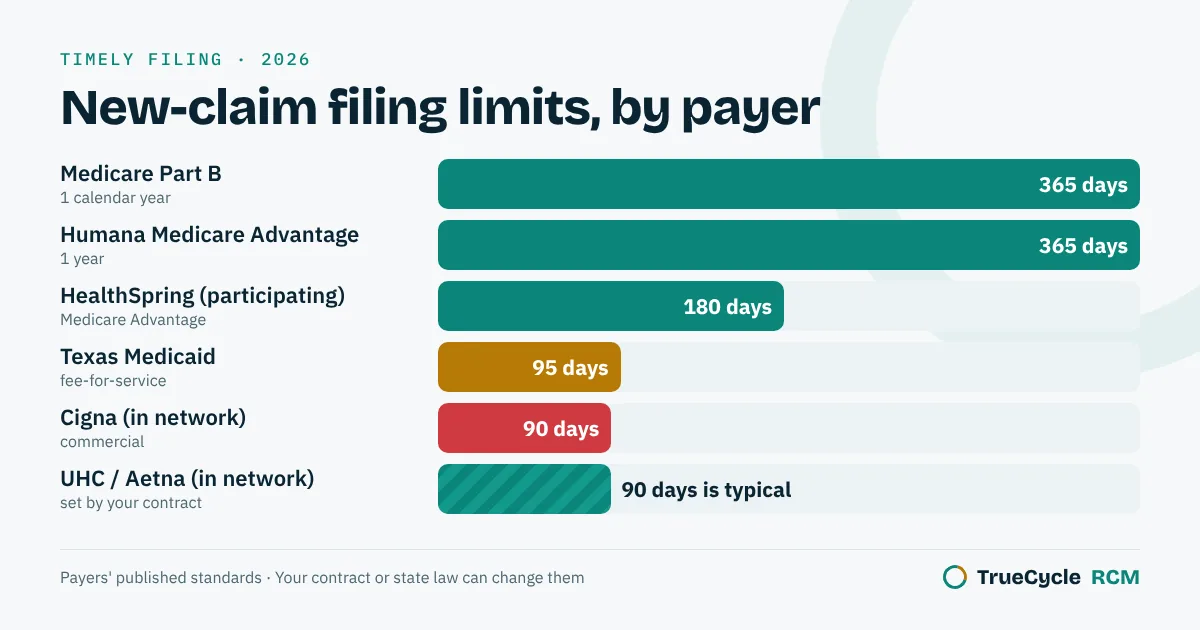
The hard part is that every payer has its own clock, and some have a different clock for each state or each contract. Below is what each payer actually says in writing, with a link to the document, followed by a calculator that works out your last filing date.
Read this first: the limits below are the payers’ published standards. Your provider agreement or your state’s law can make the limit longer or shorter, and when they differ, the contract or the law wins. Use this page to find the document, then confirm against your own agreement.
Filing deadline calculator
Pick a payer or type your own contract limit, then enter the date of service.
Open this calculator on its own page →
Government payers
| Payer | Initial claim | First appeal | Source |
|---|---|---|---|
| Medicare Part B Original Medicare | 1 calendar year after the date of service | Redetermination within 120 days of receiving the initial determination | 42 CFR 424.44 |
| Medicaid Federal ceiling | States must require claims within 12 months of the date of service. Many states set less. | Set by each state | 42 CFR 447.45(d) |
| Texas Medicaid Fee-for-service | 95 days from each date of service | 120 days from the date of the last denial | 1 TAC §354.1003 |
| New York Medicaid Fee-for-service | 90 days from the date of service | Resubmit within 60 days of notification | eMedNY General Billing |
| California Medi-Cal Fee-for-service | Within six months following the month of service. Later claims are paid at 75% (months 7 to 9), 50% (months 10 to 12), then denied. | See manual | Medi-Cal claim submission manual |
| Florida Medicaid Fee-for-service | 12 months from the date of service | See handbook | CMS-1500 Reimbursement Handbook |
| TRICARE East Humana Military | 1 year after the date of service | See TRICARE manual | Timely filing waiver form |
| TRICARE West TriWest | 1 year after the service, or 1 year from discharge | Reconsideration within 90 days of the remittance | TriWest claims guidelines |
| VA Community Care TriWest regions | 180 days from the date of service | Reconsideration within 90 days of the claim processed date | TriWest provider handbook |
Two Medicare details matter. If the one-year date falls on a weekend or federal holiday, the deadline moves to the next working day. And the exceptions are narrow: an administrative error by Medicare, retroactive entitlement, a Medicaid recovery, or retroactive disenrollment from a Medicare Advantage plan. "We were short-staffed" is not on the list.
Commercial and Medicare Advantage plans
| Payer | Initial claim | First appeal or dispute | Source |
|---|---|---|---|
| Cigna Healthcare Full Cigna guide → | Participating: 90 days. Out-of-network: 180 days. | 180 calendar days from the payment or denial notice | Cigna: When to File |
| HealthSpring (formerly Cigna Medicare) Full HealthSpring guide → | Participating: 180 days. Out-of-network: 365 days. | 65 days from the original decision (appeal); 180 days from payment (reconsideration) | HealthSpring 2026 provider manual |
| Anthem Blue Cross / BCBS California and Ohio notices, professional claims | 90 days from the date of service, for contracts covered by the 2019 change | See your state’s manual | Anthem Provider News |
| BCBS of Texas Blue Choice PPO | 365 days from the date of service | See manual | PPO provider manual, Section F |
| BCBS of Illinois Commercial non-HMO and Medicare Advantage | 180 days from the date of service or discharge | See manual | BCBSIL notice |
| Humana Medicare Advantage | 1 year from the date of service | Disputes within 18 months of the notice | 2026 Humana provider manual |
| WellCare Medicare Advantage | 180 days from the date of service, or as your contract states | Disputes within 90 calendar days of the EOP date | WellCare claims guide |
| Molina Healthcare Kentucky (Passport) | 365 calendar days from the date of service | Appeals within 60 calendar days of the adverse determination | Molina timely filing policy |
| Kaiser Permanente Washington | Commercial: 12 months from the date of service | See manual | KP Washington provider manual |
| Oscar Health Florida | 180 calendar days from the last date of service. Other states follow their own supplement. | See state supplement | Oscar Florida supplement |
Send us the list: payer, date of service, denial code and amount. No patient names needed. We will tell you which claims can still be fixed, which need an appeal, and which deadlines are close. Free, usually within 2 business days. Want the full picture? Get a free 90-day denial audit from your ERA files.
Run a billing company? Add a trained biller from $8/hour, first 25 claims free.
Three big payers that do not publish one number
This is where most online lists go wrong. For these three, we could not find a single standard limit in the payer’s own current documents, so we are not going to print one as fact.
UnitedHealthcare
The 2026 Care Provider Administrative Guide tells providers to check their Participation Agreement for the filing limit, and the agreement controls. Further in, the guide says UnitedHealthcare allows at least 90 days for participating providers, up to 180 days from the date of service for non-participating providers on commercial plans, and 365 days for non-contracted providers on Medicare Advantage. A corrected claim has the same limit as the original, counted from the date of service, and you have 12 months from the original EOB for reconsideration and appeal together. 2026 UHC Administrative Guide
Aetna
Full Aetna guide: out-of-network, corrected claims, disputes and state exceptions →
Aetna’s provider manual does not give one filing limit for initial claims. Figures of 90 to 120 days are widely repeated online. Your contract is the only reliable source. Aetna does publish its dispute windows: reconsideration within 180 calendar days of the initial claim decision, then an appeal within 60 calendar days of the reconsideration decision, with state exceptions. Aetna disputes and appeals
Humana commercial
Full Humana guide: Medicare Advantage, corrected claims, disputes and appeals →
Humana’s 2026 manual states one year for Medicare lines of business and gives no commercial limit. Humana has also left the employer group commercial medical market, so most commercial claims you see now are older ones. For those, check your agreement and state law.
If you only remember one thing from this page: for any commercial plan, the filing limit is a contract term. Find the clause, write the number down next to the payer in your billing system, and stop relying on memory or a list.
What starts the clock, and what does not stop it
- The clock usually starts on the date of service. For inpatient stays it is the discharge date. For a run of consecutive days, Cigna counts from the last date.
- Secondary claims start later. Cigna, Anthem, BCBS of Illinois, Molina and Kaiser Washington all count from the primary payer’s EOB, not the date of service. Keep the primary EOB, because it is your proof.
- A rejected claim does not stop the clock. A rejection at the clearinghouse or the payer’s front door means the claim was never accepted. The days keep running while it sits in your rejection queue.
- Payers count calendar days. None of the payers we checked uses business days.
Four habits that stop CO-29 denials
- Set an internal limit far shorter than the payer’s. If every claim goes out within 3 to 5 days of the visit, the payer’s limit never matters.
- Work rejections every day. Most late claims were sent on time, bounced for a small error, and were never fixed.
- Keep proof of timely filing. Save the clearinghouse acceptance report that shows the payer received the claim and the date. That report is what wins a timely filing appeal.
- Run an aging report on unbilled claims each week. Sort by days since the date of service and flag anything past 30 days, with the shortest-limit payers first.
Common questions
What is the timely filing limit for Medicare?
One calendar year after the date of service, under 42 CFR 424.44. If that date falls on a weekend or federal holiday, the deadline moves to the next working day.
What is the timely filing limit for UnitedHealthcare?
UnitedHealthcare’s 2026 administrative guide does not print one standard limit. It tells providers to check their Participation Agreement. Ninety days is a common contract term, but your agreement controls.
What is the timely filing limit for Aetna?
Aetna’s provider manual does not state one limit for initial claims, so check your contract. Aetna does publish a reconsideration window of 180 calendar days from the initial claim decision.
Does a rejected claim count as filed on time?
No. A rejected claim was never accepted by the payer, so the filing clock keeps running until a corrected claim is accepted.
Can I bill the patient for a claim denied for timely filing?
Generally no for in-network claims. A CO-29 denial is a contractual obligation, which means the provider writes it off. Check your contract and state rules for out-of-network situations.
How do I appeal a timely filing denial?
Send proof that the claim was received within the limit, usually the clearinghouse or payer acceptance report showing the receipt date, within the payer’s appeal window.
Not sure how many claims you are losing to filing limits?
We review 25 of your claims free, including anything stuck in rejections or sitting unbilled. No setup fee, month-to-month.
Start the free 25-claim trialFiling limits, appeal windows and claim addresses change quietly. Get one short email a month with what changed and the free tools we add.
One email a month. No spam. Unsubscribe any time.Related: Corrected claim limits by payer · All free tools · Denial code lookup · 7 common claim denial codes · Modifier 25 in 2027
More guides from our blog
- E/M downcoding: how to spot 99214 and 99215 cuts and get paid
- Corrected claim timely filing limits for 2026, payer by payer
- Aetna timely filing limit for 2026: new claims, corrected claims, appeals and Medicare
- Cigna and HealthSpring timely filing limit for 2026: new claims, corrected claims, appeals
- 7 common claim denial codes, and how to stop each one before it happens
- HealthSpring timely filing limit for 2026: claims, corrected claims and appeals
- Humana timely filing limit for 2026: claims, corrected claims and appeals
- 190 new ICD-10 codes went live on October 1. Here's what breaks first on your claims.
- How much does medical billing cost in 2026? In-house vs outsourced, in real numbers
- Modifier 25 in 2027: what Medicare’s proposed 50% cut looks like in dollars
- Provider credentialing in medical billing: timelines, documents and CAQH in 2026
- UnitedHealthcare timely filing limit for 2026: claims, corrected claims and appeals
Free tools
- Payer claim addresses and fax numbers
- Free 835 ERA reader
- Denial code lookup
- Timely filing calculator
- Credentialing timeline calculator
How we checked: each limit was read from the document linked beside it in October 2026. A few of those documents are older editions that the payer or state still publishes as current (for example Florida Medicaid’s handbook and Anthem’s 2019 notices). Payers change these policies and contracts override them, so confirm before you rely on any number here. This page is general information, not legal or contractual advice.