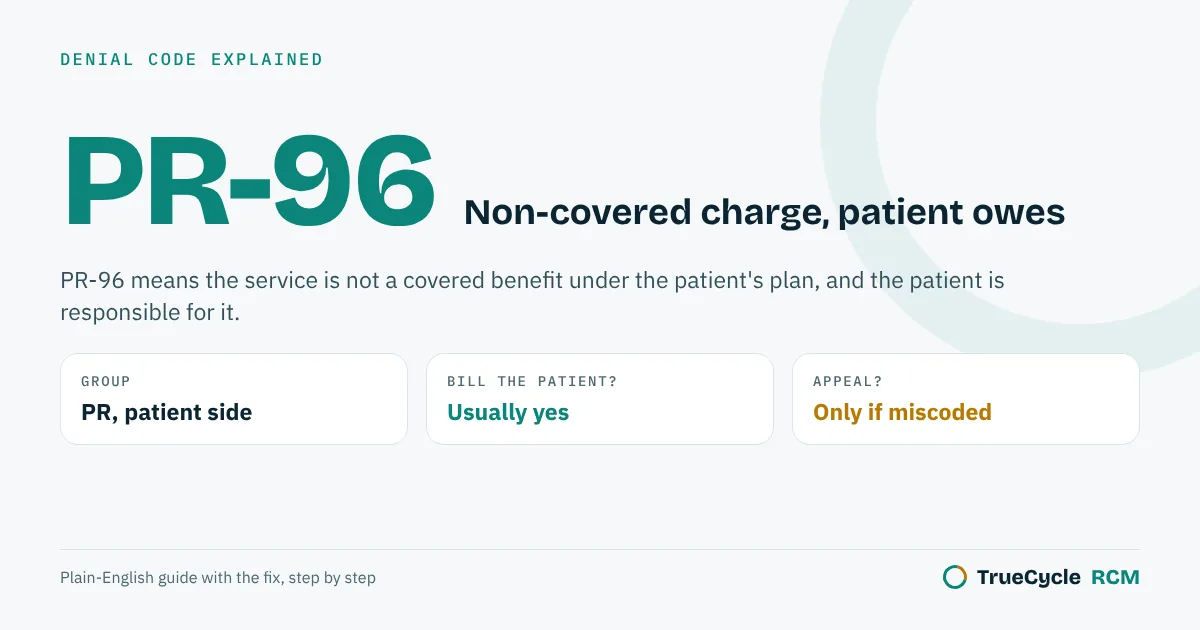
PR-96 means the service is not a covered benefit under the patient's plan, and the patient is responsible for it. Check the remark code first (N130 is common), because a wrong diagnosis or procedure code can make a covered service look non-covered. If it truly is excluded, you can bill the patient.
What PR-96 actually tells you
Reason code 96 is X12's "non-covered charge(s)." Like CO-16, it must come with at least one remark code that gives the detail. The group code in front decides who pays:
- PR-96: patient responsibility. The plan excludes the service and the patient owes it.
- CO-96: the service is still non-covered, but your contract puts the loss on you, often because a required waiver was not signed before the visit. Do not bill the patient for a CO-96.
Remark codes you will see with PR-96
| Remark | What it says | What to do |
|---|---|---|
| N130 | Consult plan benefit documents or guidelines for restrictions on this service | Check the patient's benefits for limits, exclusions or age and frequency rules |
| N425 | Statutorily excluded service | Medicare: the service is excluded by law. Confirm the code, then bill the patient. |
N130 is vague on purpose. It sends you to the plan documents because the reason is specific to that plan. A call to the payer with the claim number usually gets you the exact restriction in a few minutes.
Send us the list: payer, date of service, denial code and amount. No patient names needed. We will tell you which claims can still be fixed, which need an appeal, and which deadlines are close. Free, usually within 2 business days. Want the full picture? Get a free 90-day denial audit from your ERA files.
Run a billing company? Add a trained biller from $8/hour, first 25 claims free.
Common reasons for PR-96
- The plan excludes the service. Cosmetic procedures, some weight-loss services and certain therapies are excluded by many commercial plans.
- Medicare excludes it by law. Routine physicals (other than the Welcome to Medicare visit and the Annual Wellness Visit), hearing aids, most dental care, routine foot care and cosmetic surgery are not Medicare benefits.
- A coding error. A screening code where a diagnostic code was right, or a diagnosis that does not match the service, can turn a covered claim into a non-covered one.
- A benefit limit. Some plans cover a service only once a year or only at certain ages, and the remark points to that limit.
How to handle PR-96, step by step
- Read the remark code. It tells you whether this is a plan exclusion, a legal exclusion or a benefit limit.
- Rule out a coding error. If the record supports a covered diagnosis or a different code, correct the claim and resubmit only the corrected line, so you do not trigger a duplicate denial.
- If it is truly non-covered, bill the patient. Send a clear statement that says the plan does not cover the service. Patients pay faster when they understand why.
- Send it to secondary coverage if there is any. A secondary plan may cover what the primary excludes.
- Appeal only when the plan should have covered it. If the benefit documents show the service is covered, appeal with those pages and the medical record.
Medicare, the GY modifier and ABNs
For a service Medicare excludes by law, add the GY modifier to the line. It tells Medicare you know the service is statutorily excluded, and the claim processes quickly as patient responsibility.
An ABN (Advance Beneficiary Notice) is not required for services that are excluded by law. ABNs are for services Medicare usually covers but may deny as not medically necessary, which come back as a different denial (reason code 50). You can still give a voluntary written notice for excluded services, and it helps avoid surprise bills and complaints.
How to prevent PR-96 surprises
- Check benefits before elective or commonly excluded services, not just eligibility.
- Tell the patient the price before the service and get a signed financial responsibility form. Some commercial contracts require this before you can bill the patient.
- Use GY on Medicare claims for excluded services so they process cleanly.
A PR-96 line on the remittance
| Line on the remittance | Amount | What it means |
|---|---|---|
| Billed charge | $120.00 | Your price for the service |
| Allowed amount | $0.00 | The plan does not cover this service |
| PR-96 | $120.00 | Moved to the patient |
| Paid by payer | $0.00 | Nothing paid |
The full $120 moves to the patient. Before you send that bill, make sure the patient knew the service might not be covered. If a Medicare patient never signed an ABN for a service that needed one, the same line comes back as CO-96 and you cannot bill the patient.
PR-96 versus CO-96
| Code | Who absorbs it | What it usually means |
|---|---|---|
| PR-96 | The patient | The service is not covered and the patient can be billed (for Medicare, usually with a valid ABN or a statutorily excluded service). |
| CO-96 | Your practice | The service is not covered and you cannot bill the patient, often because a required waiver was missing. |
PR-96 checklist before you bill the patient
- ☐ The remark code confirms why it is not covered (for example N130 or N425).
- ☐ You have a signed waiver or ABN where one was needed.
- ☐ No secondary plan covers the service.
- ☐ The patient statement explains the reason in plain words.
Questions people ask about PR-96
Can I bill the patient for PR-96?
Usually yes. PR means patient responsibility. Check the remark code and rule out a coding error first, and follow any contract rule that requires a signed waiver or financial form before the service.
What does N130 mean with PR-96?
N130 tells you to check the plan's benefit documents for restrictions on the service. The plan has an exclusion or limit that applies, and the payer or the plan documents will name it.
Do I need an ABN for a PR-96 service with Medicare?
Not for services Medicare excludes by law, such as routine physicals or hearing aids. ABNs are for services that may be denied as not medically necessary. A voluntary notice for excluded services is still good practice.
What is the difference between PR-96 and CO-96?
Both mean the service is non-covered. With PR-96 the patient owes it. With CO-96 the provider absorbs it, often because a required waiver was not signed before the service, so you cannot bill the patient.
Can I appeal a PR-96 denial?
Yes, but it only works if the service should have been covered, for example when the claim was coded wrong or the plan documents show the benefit exists. If the service is truly excluded, an appeal will not change the result.
What does PR 96 mean?
PR-96 means the plan does not cover the service and the amount is the patient's responsibility.
Patients disputing non-covered bills?
We check benefits before the visit and flag excluded services so patients know the cost up front. Send us 25 claims and see where your non-covered denials come from. Free.
Start the free 25-claim trialFiling limits, appeal windows and claim addresses change quietly. Get one short email a month with what changed and the free tools we add.
One email a month. No spam. Unsubscribe any time.Other denial code guides
All denial code guides
PR-1 · PR-2 · PR-3 · CO-4 · CO-5 · CO-11 · CO-15 · CO-16 · OA-18 · CO-22 · OA-23 · CO-24 · CO-26 · CO-27 · CO-29 · CO-31 · CO-45 · CO-49 · CO-50 · CO-59 · PR-96 · CO-97 · CO-109 · CO-119 · CO-129 · CO-140 · CO-146 · CO-151 · CO-167 · CO-170 · CO-181 · CO-185 · CO-197 · CO-198 · PR-204 · CO-234 · CO-236 · CO-242 · CO-252 · CO-253 · CO-288 · CO-A1 · CO-B7 · MA130 · N130 · N23 · N290
Timely filing limits by payer: Cigna timely filing limit · HealthSpring timely filing limit · Aetna timely filing limit · UnitedHealthcare timely filing limit · Humana timely filing limit · corrected claim timely filing limits
Sources: X12 Claim Adjustment Reason Code list (code 96) and Remittance Advice Remark Code list (N130, N425); First Coast Service Options, tips to prevent CARC PR-96; CMS, Items and Services Not Covered Under Medicare; CMS Advance Beneficiary Notice of Noncoverage instructions. Last reviewed October 26, 2026. General information, not coding or legal advice. Payer rules differ, so check the remark code and the payer's own policy. Remark code wording from the X12 RARC list as published by claim.md, read October 26, 2026.