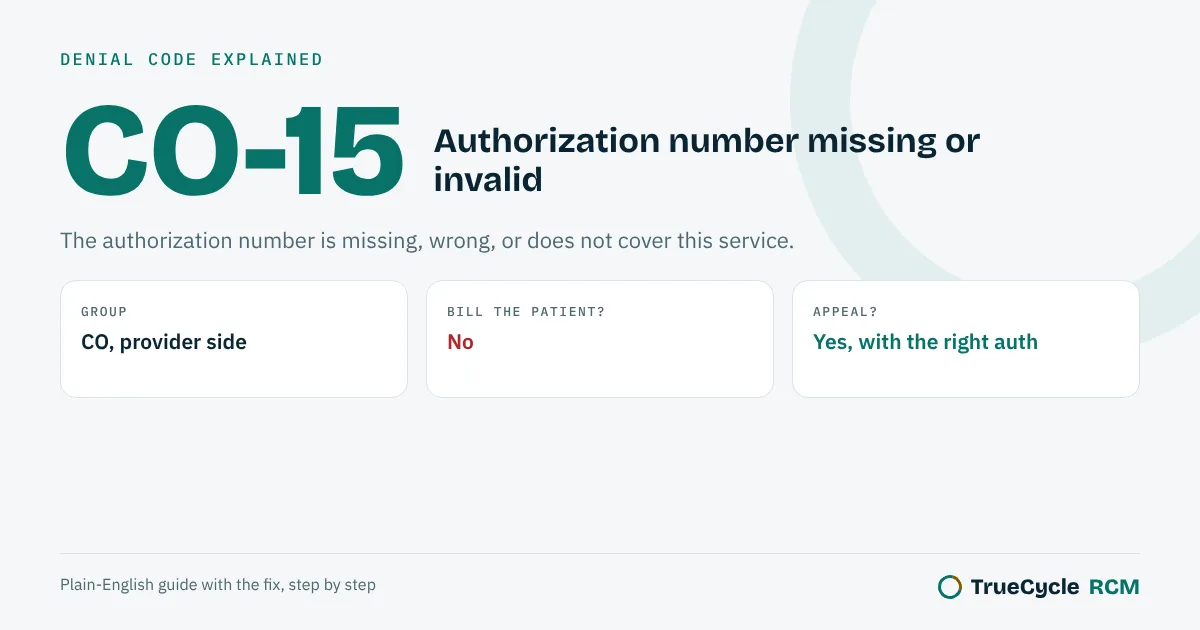
CO-15 means an authorization was needed and the number on the claim was missing, typed wrong, or does not cover this service, date or provider. If a valid authorization exists, add it and send a corrected claim.
The official wording
The X12 Claim Adjustment Reason Code list defines 15 as: "The authorization number is missing, invalid, or does not apply to the billed services or provider."
The letters in front are the group code. CO means contractual obligation (the provider absorbs it), PR means patient responsibility, and OA is other adjustment. The same reason code can come with different group codes, so always read both.
What CO-15 is telling you
CO-15 is about the authorization number on the claim, not about whether you got an authorization at all. If no authorization was ever obtained, payers usually deny with CO-197 instead.
On a paper CMS-1500 the prior authorization number goes in box 23. On an electronic 837P claim it goes in loop 2300, REF segment with qualifier G1. On a UB-04 it goes in form locator 63.
Send us the list: payer, date of service, denial code and amount. No patient names needed. We will tell you which claims can still be fixed, which need an appeal, and which deadlines are close. Free, usually within 2 business days. Want the full picture? Get a free 90-day denial audit from your ERA files.
Run a billing company? Add a trained biller from $8/hour, first 25 claims free.
Common causes
- The authorization number was not entered on the claim.
- A typo in the number, or a reference number from the call used instead of the actual authorization number.
- The authorization covers a different CPT code, fewer units, different dates, or a different rendering provider or location.
- The authorization expired before the date of service.
How to fix it
- Find the authorization in the payer portal or your records and compare it to the claim: number, CPT codes, units, dates, provider and location.
- If the number was missing or wrong, add the correct number and send a corrected claim (frequency code 7).
- If the service went beyond the authorization, ask the payer whether it can be updated or extended. Some payers allow this for a short time after the visit.
- If the payer still denies, appeal with the authorization letter and the visit note attached.
How to prevent it
- Store the authorization number, CPT codes, units and end date in the patient's account where the biller can see it.
- Add a claim edit that blocks claims for services that need an authorization when the number is empty.
- Track visits used against the authorized units, and request an extension before they run out.
One claim with an authorization for the wrong code
The payer approved an MRI of the lumbar spine without contrast (72148). The radiologist did the scan with contrast (72149).
| Item | On the claim | What it means |
|---|---|---|
| Auth on file | 72148, 1 unit | Approved code |
| Code billed | 72149 | Not the code on the authorization |
| Remittance | CO-15 | Auth does not apply to the billed service |
| Fix | Ask the payer to update the auth to 72149 | Then send a corrected claim with the same auth number |
The number was correct. The service was not the one approved. That is why CO-15 says the auth 'does not apply'.
What the payer compares on the authorization
Line up the claim with the auth letter field by field. One mismatch is enough for CO-15.
| Auth field | Claim field | Typical problem |
|---|---|---|
| Auth number | Box 23 / 2300 REF*G1 | Call reference number used instead of the auth number |
| CPT/HCPCS codes | Box 24D | A different code was done than approved |
| Units or visits | Box 24G | More units billed than approved |
| Dates | Box 24A | Service after the auth ended |
| Provider and location | Box 24J, 32 | Different rendering provider or facility |
CO-15 means an auth was there but did not match. CO-197 usually means there was no auth at all.
How to fix CO-15
- Pull the auth from the payer portal and compare number, codes, units, dates, provider and place.
- If the number was missing or typed wrong, add the correct number and send a corrected claim (frequency 7).
- If a different code was done, ask the payer to update the auth (many allow this within a few days of the service).
- If the auth expired, ask for retro authorization or an extension, then rebill.
- If nothing can be fixed, appeal with the notes showing why the service was needed.
CO-15 checklist
- ☐ Auth number copied from the approval letter, not the call reference.
- ☐ Billed codes and units match the auth.
- ☐ Service dates are inside the auth period.
- ☐ Auth updated the same week when the plan of care or code changes.
Questions people ask about CO-15
What is the difference between CO-15 and CO-197?
CO-15 means the authorization number on the claim is missing or does not match. CO-197 means the payer has no authorization for the service at all.
Can I bill the patient for CO-15?
No. It is a provider-side adjustment. Fix the claim or appeal.
Where does the authorization number go on the claim?
Box 23 on the CMS-1500, loop 2300 REF*G1 on an electronic 837P claim, and form locator 63 on the UB-04.
Can I add the auth number to a denied claim?
Yes. Send a corrected claim with the right number in box 23 / REF*G1 and the payer's claim number in box 22.
Does the auth number go on every line?
Usually once at claim level. Use the line level only when different lines have different auths.
Can a payer change an auth after the service?
Many will update the code or dates if you ask quickly. Call before you appeal.
Seeing CO-15 on your remittances?
Send us 25 claims and we will group your denials by reason and remark code and show you which fix removes the most of them. Free, no setup fee.
Start the free 25-claim trialFiling limits, appeal windows and claim addresses change quietly. Get one short email a month with what changed and the free tools we add.
One email a month. No spam. Unsubscribe any time.Other denial code guides
All denial code guides
PR-1 · PR-2 · PR-3 · CO-4 · CO-5 · CO-11 · CO-15 · CO-16 · OA-18 · CO-22 · OA-23 · CO-24 · CO-26 · CO-27 · CO-29 · CO-31 · CO-45 · CO-49 · CO-50 · CO-59 · PR-96 · CO-97 · CO-109 · CO-119 · CO-129 · CO-140 · CO-146 · CO-151 · CO-167 · CO-170 · CO-181 · CO-185 · CO-197 · CO-198 · PR-204 · CO-234 · CO-236 · CO-242 · CO-252 · CO-253 · CO-288 · CO-A1 · CO-B7 · MA130 · N130 · N23 · N290
Timely filing limits by payer: Cigna timely filing limit · HealthSpring timely filing limit · Aetna timely filing limit · UnitedHealthcare timely filing limit · Humana timely filing limit · corrected claim timely filing limits
Sources: X12 Claim Adjustment Reason Code list (15), read October 26, 2026; CMS Medicare guidance where Medicare rules are mentioned. Last reviewed October 26, 2026. General information, not coding or legal advice. Payer rules differ, so check the remark code and the payer's own policy.