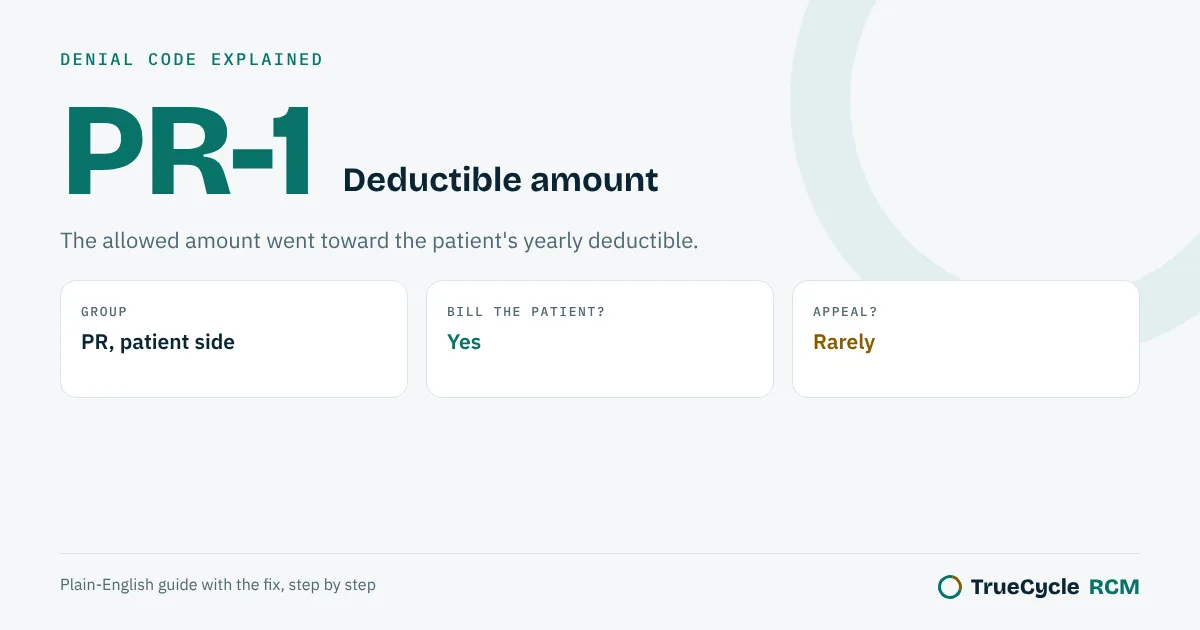
PR-1 is not really a denial. The payer processed the claim and put the allowed amount, or part of it, toward the patient's yearly deductible. The patient owes that amount, unless a secondary plan covers it.
The official wording
The X12 Claim Adjustment Reason Code list defines 1 as: "Deductible Amount"
The letters in front are the group code. CO means contractual obligation (the provider absorbs it), PR means patient responsibility, and OA is other adjustment. The same reason code can come with different group codes, so always read both.
What PR-1 is telling you
The patient's plan has a deductible, a set amount the patient pays each year before the plan starts paying. When a claim comes in early in the year, or before the patient has used much care, the payer applies the allowed amount to that deductible and pays nothing or very little.
Because the group code is PR, the balance is patient responsibility. You can bill it, but only the amount shown with PR-1, not your full charge if you are in network. The difference between your charge and the allowed amount usually comes back as CO-45.
Send us the list: payer, date of service, denial code and amount. No patient names needed. We will tell you which claims can still be fixed, which need an appeal, and which deadlines are close. Free, usually within 2 business days. Want the full picture? Get a free 90-day denial audit from your ERA files.
Run a billing company? Add a trained biller from $8/hour, first 25 claims free.
Common causes
- The patient has not met this year's deductible yet, which is very common in January to March.
- A high-deductible health plan, where the deductible can run into thousands of dollars.
- A family deductible where other family members' claims have not been counted yet.
- The service was applied to the deductible by mistake, for example a preventive visit that should be paid in full.
How to fix it
- Check the amount on the remittance. Bill the patient only the PR-1 amount, not your full charge.
- Look for secondary insurance. If the patient has a secondary plan or Medigap policy, send the claim with the primary EOB. Many secondary plans pay the primary deductible.
- Question it only if it looks wrong. If the service should have been covered in full, such as a preventive visit with the right codes, call the payer or request a reconsideration.
- Send the patient a clear statement that shows the payer applied the amount to the deductible.
How to prevent it
- Check eligibility before the visit and note how much deductible is left.
- Give the patient a good-faith cost estimate when the deductible is high.
- Collect a deposit at check-in for high-deductible patients, as your policy allows.
One claim, line by line
A patient has a $1,500 deductible and has already paid $1,400 of it this year. They have a visit with a $250 charge and an allowed amount of $150. The plan pays 80% after the deductible.
| Line on the remittance | Amount | How it was worked out |
|---|---|---|
| Billed charge | $250.00 | Your charge |
| CO-45 | $100.00 | $250 billed minus $150 allowed. Write off. |
| PR-1 | $100.00 | The $100 left on the deductible |
| PR-2 | $10.00 | 20% coinsurance on the remaining $50 |
| Paid by payer | $40.00 | 80% of the remaining $50 |
Check: $40 paid + $100 PR-1 + $10 PR-2 = $150 allowed. The patient owes $110. If the PR-1 and PR-2 do not add up to the allowed amount minus the payment, something else is on the remittance.
PR-1 vs PR-2 vs PR-3
| Code | Name | What it is |
|---|---|---|
| PR-1 | Deductible | The amount the patient pays each year before the plan starts paying |
| PR-2 | Coinsurance | A percentage of the allowed amount, such as 20%. See our PR-2 guide. |
| PR-3 | Co-payment | A fixed amount per visit, such as $30. See our PR-3 guide. |
All three are patient responsibility. None of them is an error.
When PR-1 is wrong
- Preventive visits. Most plans must cover in-network preventive care in full. If a preventive visit went to the deductible, check the codes and modifiers before billing the patient.
- The deductible was already met. If the patient shows receipts from other providers, ask the payer to check the accumulator and reprocess.
- Wrong plan year. Some plans run on a fiscal year, not January to December.
How to post PR-1
- Post the payer payment.
- Post CO-45 as a contractual adjustment.
- Move the PR-1 amount to the secondary payer if there is one, otherwise to the patient.
- Send the patient a statement that says the payer applied it to their deductible.
- Track high-deductible patients and collect at check-in next time, as your policy allows.
PR-1 checklist
- ☐ Payment + adjustments + patient amounts equal the billed charge.
- ☐ A secondary plan has been billed if the patient has one.
- ☐ Preventive services were not wrongly applied to the deductible.
- ☐ The patient is billed only the PR amounts, never the CO-45.
Questions people ask about PR-1
Is PR-1 a denial?
Not in the usual sense. The claim was processed correctly and the amount was moved to the patient's deductible. The patient owes it.
Can I bill the patient for PR-1?
Yes, up to the PR-1 amount shown on the remittance. In network, you cannot bill more than the allowed amount.
Will a secondary plan pay PR-1?
Often yes. Send the claim to the secondary payer with the primary EOB. Medigap and many commercial secondary plans cover the primary deductible.
Why does PR-1 show up so often in January?
Most deductibles reset on January 1. Early in the year few patients have met theirs, so more claims go to the deductible.
Can I collect the deductible at the visit?
Yes, if your financial policy allows it and you check eligibility first. Collect an estimate, not the full charge, and refund any overpayment after the claim pays.
What is the difference between PR-1 and PR-2?
PR-1 is the deductible, paid before the plan starts paying. PR-2 is coinsurance, the patient's percentage after the deductible is met.
Seeing PR-1 on your remittances?
Send us 25 claims and we will group your denials by reason and remark code and show you which fix removes the most of them. Free, no setup fee.
Start the free 25-claim trialFiling limits, appeal windows and claim addresses change quietly. Get one short email a month with what changed and the free tools we add.
One email a month. No spam. Unsubscribe any time.Other denial code guides
All denial code guides
PR-1 · PR-2 · PR-3 · CO-4 · CO-5 · CO-11 · CO-15 · CO-16 · OA-18 · CO-22 · OA-23 · CO-24 · CO-26 · CO-27 · CO-29 · CO-31 · CO-45 · CO-49 · CO-50 · CO-59 · PR-96 · CO-97 · CO-109 · CO-119 · CO-129 · CO-140 · CO-146 · CO-151 · CO-167 · CO-170 · CO-181 · CO-185 · CO-197 · CO-198 · PR-204 · CO-234 · CO-236 · CO-242 · CO-252 · CO-253 · CO-288 · CO-A1 · CO-B7 · MA130 · N130 · N23 · N290
Timely filing limits by payer: Cigna timely filing limit · HealthSpring timely filing limit · Aetna timely filing limit · UnitedHealthcare timely filing limit · Humana timely filing limit · corrected claim timely filing limits
Sources: X12 Claim Adjustment Reason Code list (1), read October 26, 2026; CMS Medicare guidance where Medicare rules are mentioned; Patient share example uses a standard deductible and 80/20 coinsurance plan for illustration only. Last reviewed October 27, 2026. General information, not coding or legal advice. Payer rules differ, so check the remark code and the payer's own policy.