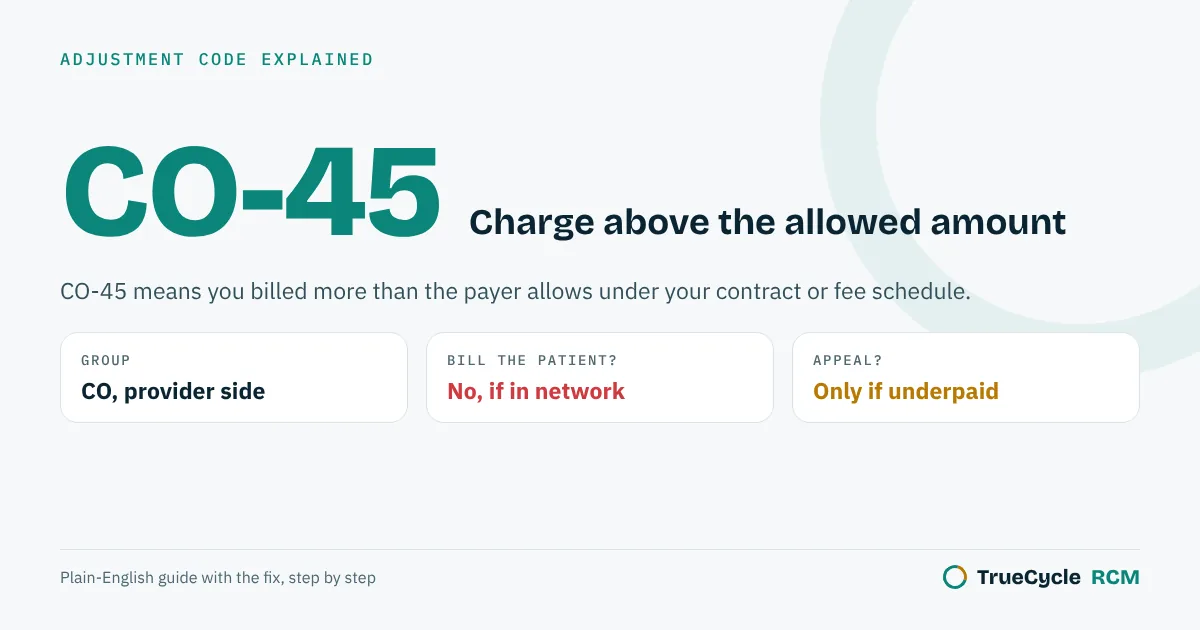
CO-45 means you billed more than the payer allows under your contract or fee schedule. The difference is a contractual write-off, not a denial, and you cannot bill it to the patient. The only real check is whether the allowed amount matches what your contract says it should be.
What CO-45 actually tells you
The X12 wording for reason code 45 is "charge exceeds fee schedule/maximum allowable or contracted/legislated fee arrangement." In plain terms, your practice charges a set price for each code, the payer has its own price, and when yours is higher the payer adjusts the gap away.
Because the group code is CO, that gap is the provider's to absorb. It is the price of being in network.
One claim, line by line
Here is how CO-45 sits next to the other adjustments on a normal paid claim.
| Line on the remittance | Amount | What it means |
|---|---|---|
| Billed charge | $200.00 | Your practice's price for the code |
| Allowed amount | $120.00 | The payer's contracted price |
| CO-45 | $80.00 | Write off. Billed minus allowed. |
| PR-2 | $24.00 | Patient's 20% coinsurance. Bill the patient. |
| Paid by payer | $96.00 | 80% of the allowed amount |
The payer paid $96 and the patient owes $24. Together that is the $120 allowed. The $80 is gone, and that is expected.
Send us the list: payer, date of service, denial code and amount. No patient names needed. We will tell you which claims can still be fixed, which need an appeal, and which deadlines are close. Free, usually within 2 business days. Want the full picture? Get a free 90-day denial audit from your ERA files.
Run a billing company? Add a trained biller from $8/hour, first 25 claims free.
When CO-45 is worth a second look
- The allowed amount is lower than your contract. This is the big one. If your contract pays 110% of Medicare and the allowed amount comes back at 100%, the extra gets labelled CO-45 and quietly written off. Compare allowed amounts to your fee schedule for your top 20 codes at least once a quarter.
- The payer used last year's rates. New fee schedules start in January for many contracts. Claims early in the year are where old rates slip through.
- A reduction was applied that should not have been, such as a multiple procedure reduction on a service that is exempt from it.
- You never see CO-45 on a code at all. This one surprises people. Medicare and most payers pay the lower of your charge or their allowed amount. If your charge is below the allowed amount, you are paid your charge and the rest is simply lost. A code with no CO-45 may be priced too low.
How to handle CO-45
- Post the adjustment as a contractual write-off. Keep it in its own adjustment category so you can report on it.
- Check the allowed amount against the contract. If it matches, you are done.
- If it is short, dispute it. Most payers have a payment dispute or reconsideration form. Attach the page of the contract or fee schedule that shows the correct rate.
- Review your charges once a year. Set each code's charge above the highest allowed amount you receive for it, so no payer ever pays you less than they would have allowed.
CO-45 versus PR-45
X12 allows reason code 45 with two groups. With CO, the provider writes off the difference. With PR, the plan has put the excess on the patient, which can happen with out-of-network care where balance billing is permitted. Before billing a patient for a PR-45, check your state's rules and the federal No Surprises Act, which bans balance billing in several out-of-network situations.
Remark codes that often come with CO-45
CO-45 often arrives on its own. When a remark code is attached, it is usually one of these:
| Remark code | Official wording | What to do |
|---|---|---|
| N381 | "Consult our contractual agreement for restrictions/billing/payment information related to these charges." | Pull the contract or fee schedule for that payer and check the allowed amount for the code and date. |
| MA01 | "If you do not agree with what we approved for these services, you may appeal our decision." | Medicare's standard appeal-rights notice. It does not mean anything is wrong. Act only if the allowed amount is below the fee schedule. |
How to post CO-45 in your billing system
- Post the payer payment to the line.
- Post the CO-45 amount as a contractual adjustment, in its own adjustment code, not as a bad-debt or small-balance write-off.
- Move any PR amounts (PR-1, PR-2, PR-3) to patient balance.
- Check that payment + contractual adjustment + patient amounts equal the billed charge. If they do not, something else is on the remittance.
- Run a monthly report of CO-45 by payer and code. A sudden jump on one code usually means a fee schedule changed.
CO-45 checklist before you write it off
- ☐ The allowed amount matches the contract or fee schedule for that date of service.
- ☐ No reduction was applied that the contract does not allow.
- ☐ The patient share is billed to the patient or the secondary plan.
- ☐ You are not billing the patient for the CO-45 amount.
Questions people ask about CO-45
Can I bill the patient for a CO-45 amount?
No, not when you are in network. The CO group means the difference between your charge and the allowed amount is a contractual write-off. Billing the patient for it is balance billing and usually breaks your payer contract.
Is CO-45 a denial?
Not really. It is an adjustment on a claim that was processed and usually paid. It only shows that your charge was higher than the payer's allowed amount.
Should I appeal CO-45?
Only when the allowed amount is lower than your contract says it should be. In that case file a payment dispute and attach the contract rate. If the allowed amount is correct, there is nothing to appeal.
Why does CO-45 appear on almost every claim?
Because practices set one charge per code for all payers, and that charge is normally above every payer's allowed amount. Seeing CO-45 on most paid lines is normal.
What does it mean if a code never gets CO-45?
It may mean your charge is lower than the payer's allowed amount. Most payers pay the lower of the two, so you could be collecting less than the payer would have allowed.
Can I resubmit a claim with CO-45?
Not to fix CO-45 itself. Resubmitting the same claim usually gets a duplicate denial. If the allowed amount is wrong, file a payment dispute or reconsideration instead.
Not sure your allowed amounts match your contracts?
Send us a de-identified remittance sample with your fee schedules and we will flag lines where CO-45 is covering an underpayment. It is part of our free 25-claim review.
Start the free 25-claim trialFiling limits, appeal windows and claim addresses change quietly. Get one short email a month with what changed and the free tools we add.
One email a month. No spam. Unsubscribe any time.Other denial code guides
All denial code guides
PR-1 · PR-2 · PR-3 · CO-4 · CO-5 · CO-11 · CO-15 · CO-16 · OA-18 · CO-22 · OA-23 · CO-24 · CO-26 · CO-27 · CO-29 · CO-31 · CO-45 · CO-49 · CO-50 · CO-59 · PR-96 · CO-97 · CO-109 · CO-119 · CO-129 · CO-140 · CO-146 · CO-151 · CO-167 · CO-170 · CO-181 · CO-185 · CO-197 · CO-198 · PR-204 · CO-234 · CO-236 · CO-242 · CO-252 · CO-253 · CO-288 · CO-A1 · CO-B7 · MA130 · N130 · N23 · N290
Timely filing limits by payer: Cigna timely filing limit · HealthSpring timely filing limit · Aetna timely filing limit · UnitedHealthcare timely filing limit · Humana timely filing limit · corrected claim timely filing limits
Sources: X12 Claim Adjustment Reason Code list (code 45 and group codes CO and PR); CMS Medicare Claims Processing Manual, Pub. 100-04, Chapter 12 (payment at the lower of the actual charge or the fee schedule amount); CMS overview of the No Surprises Act. Last reviewed October 26, 2026. General information, not coding or legal advice. Payer rules differ, so check the remark code and the payer's own policy. Remark code wording from the X12 RARC list as published by claim.md, read October 26, 2026.