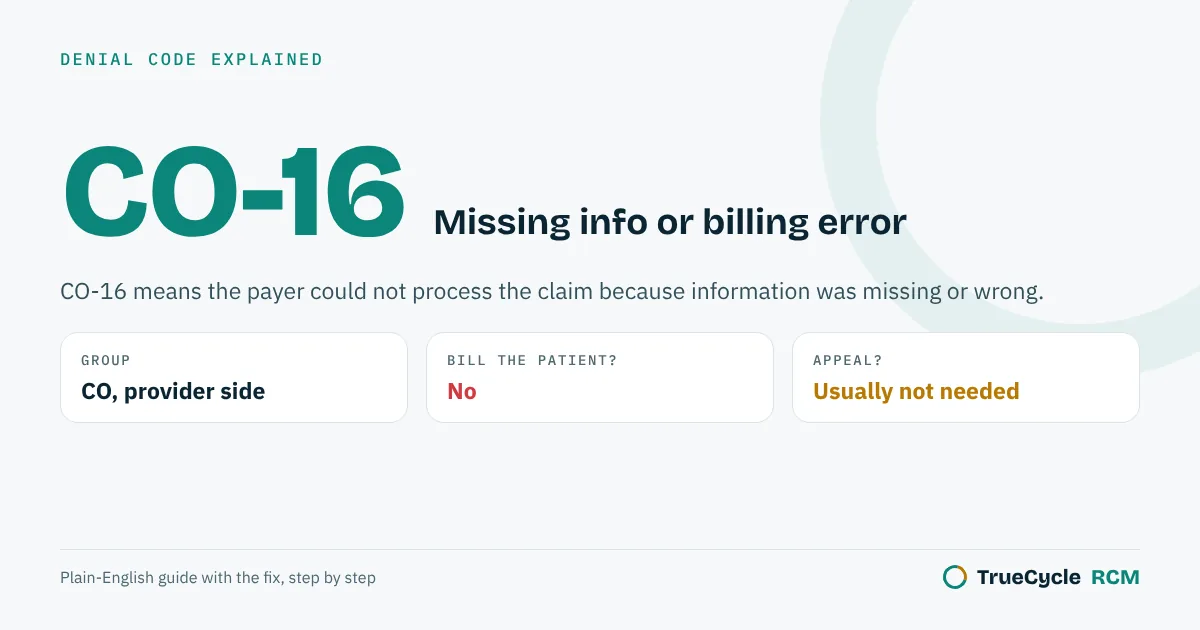
CO-16 means the payer could not process the claim because information was missing or wrong. The remark code (RARC) printed with it names the field. Fix that field and send the claim again. With Medicare it usually comes with remark MA130, which means there is nothing to appeal: you file a new, corrected claim.
What CO-16 actually tells you
The official X12 wording for reason code 16 is short: the claim or service "lacks information or has submission/billing error(s)." That covers dozens of possible problems, which is why X12 requires the payer to send at least one remark code with it. A CO-16 with no remark code is the payer's mistake, and worth a phone call.
The CO in front is the group code. It means contractual obligation: the balance sits with the provider, not the patient. In practice that matters less here, because a CO-16 is not a refusal to pay. It is a claim that never got far enough to be judged.
Remark codes you will see with CO-16
These are the pairings that come up most often on Medicare and commercial remittances. The remark tells you which part of the claim to open.
| Remark | What is wrong | Where to look |
|---|---|---|
| MA130 | Claim had incomplete or invalid information and is unprocessable. No appeal rights. | Read the other remark on the line, fix it, file a new claim |
| N290 | Rendering provider ID missing or invalid | Rendering NPI on the claim and in the payer's enrollment |
| N286 | Referring provider ID missing or invalid | Referring name and NPI, box 17 / loop 2310A |
| N265 | Ordering provider ID missing or invalid | Ordering NPI on labs, imaging and DME |
| M51 | Procedure code missing, incomplete or invalid | CPT/HCPCS valid for the date of service |
| M76 | Diagnosis missing, incomplete or invalid | ICD-10 code coded to the highest specificity |
| M77 | Place of service missing or invalid | POS code matches where the visit happened |
| N382 | Patient identifier missing or invalid | Member ID copied exactly from the card |
| MA04 | Secondary claim sent without primary payer details | Primary EOB amounts attached to the secondary claim |
| M119 | NDC missing, invalid or inactive | 11-digit NDC and units on drug lines |
If you see a remark that is not here, look it up on the remittance itself or in the payer's portal. Every one of them points to a field.
Send us the list: payer, date of service, denial code and amount. No patient names needed. We will tell you which claims can still be fixed, which need an appeal, and which deadlines are close. Free, usually within 2 business days. Want the full picture? Get a free 90-day denial audit from your ERA files.
Run a billing company? Add a trained biller from $8/hour, first 25 claims free.
How to fix a CO-16, step by step
- Read the remark code first. Do not reopen the claim and guess. The remark narrows a vague denial down to one field.
- Find the bad data at its source. If the referring NPI is wrong, it is wrong in the referring provider record in your practice management system, not just on this claim. Check it against the card, the registration form or the NPI registry.
- Fix the source record, then the claim. Correcting only the claim means the next claim for that patient or provider goes out with the same error.
- Resubmit the right way for that payer. Medicare claims returned as unprocessable (MA130) are not appealable: you send a new claim with the correct information. Many commercial payers want a corrected claim instead, with frequency code 7 and the original claim number. Check the payer manual.
- Watch the filing deadline. An unprocessable claim does not stop the timely filing clock. If the deadline is close, resubmit today. Our timely filing calculator shows how many days you have left.
Why appealing a CO-16 usually wastes time
With Medicare, an appeal on an unprocessable claim just comes back with a letter telling you to refile. Meanwhile the timely filing window keeps running. The fastest route is almost always the plain one: correct the field and send it again.
The exception is when you are sure the information was correct and the payer misread it. Then call the payer, get a reference number, and ask them to reprocess.
How to stop seeing CO-16
- Run a claim scrubber before submission. Most CO-16 errors (missing NPI, invalid POS, missing NDC) can be caught before the claim leaves.
- Check eligibility at every visit, not just the first one. Member IDs change at plan renewal.
- Keep referring and ordering providers in a clean list with their NPIs, instead of typing them each time.
- Count CO-16 by remark code every week. One remark showing up again and again is a process problem, usually at the front desk or in a provider record, and fixing it once removes a whole group of denials.
A CO-16 line on the remittance
| Line on the remittance | Amount | What it means |
|---|---|---|
| Billed charge | $200.00 | Office visit |
| CO-16 with N290 | $200.00 | Rendering provider NPI missing or invalid |
| Paid by payer | $0.00 | Nothing paid yet |
Do not post the $200 as a write-off. It is not lost. Fix the NPI and send the claim again, and the payer pays it like any other clean claim.
How to post CO-16
- Post the zero payment and leave the full balance open on the claim.
- Use a "pending correction" status, not a write-off code.
- Note the remark code and the date, so you can show the timely filing trail later.
- Close the balance only when the corrected claim pays or you decide to stop.
CO-16 checklist before you resubmit
- ☐ You found the remark code and fixed exactly what it names.
- ☐ Patient name, ID and date of birth match the card.
- ☐ Rendering, billing and referring NPIs are on the claim.
- ☐ You know whether to send a new claim or a corrected claim (frequency code 7).
- ☐ The claim is still inside the timely filing limit.
Questions people ask about CO-16
Can I appeal a CO-16 denial?
Usually there is no need. With Medicare, claims returned as unprocessable (remark MA130) have no appeal rights, and the fix is to submit a new claim with the correct information. With commercial payers, a corrected claim is normally faster than an appeal.
Can I bill the patient for a CO-16?
No. CO means the balance is the provider's responsibility, and the claim has not been judged yet. Fix the error and resubmit to the payer.
What is the difference between CO-16 and CO-252?
CO-252 means the payer wants an attachment or other documentation, such as records or an invoice. X12 says reason code 16 should not be used for attachments, so CO-16 points to data on the claim itself.
Does a CO-16 give me extra time to refile?
No. The payer's timely filing limit still counts from the date of service or the date set in your contract. Resubmit as soon as the error is fixed.
Is CO-16 the same as a clearinghouse rejection?
No. A clearinghouse rejection never reached the payer. A CO-16 shows up on the payer's remittance, which means the payer received the claim and could not process it.
What is the CO 16 denial code description?
"Claim/service lacks information or has submission/billing error(s)." The remark code that comes with it names the missing or wrong item.
Seeing CO-16 on the same claims every week?
Send us 25 claims and we will group your denials by remark code and show you which front-end fix removes the most of them. Free, no setup fee.
Start the free 25-claim trialFiling limits, appeal windows and claim addresses change quietly. Get one short email a month with what changed and the free tools we add.
One email a month. No spam. Unsubscribe any time.Other denial code guides
All denial code guides
PR-1 · PR-2 · PR-3 · CO-4 · CO-5 · CO-11 · CO-15 · CO-16 · OA-18 · CO-22 · OA-23 · CO-24 · CO-26 · CO-27 · CO-29 · CO-31 · CO-45 · CO-49 · CO-50 · CO-59 · PR-96 · CO-97 · CO-109 · CO-119 · CO-129 · CO-140 · CO-146 · CO-151 · CO-167 · CO-170 · CO-181 · CO-185 · CO-197 · CO-198 · PR-204 · CO-234 · CO-236 · CO-242 · CO-252 · CO-253 · CO-288 · CO-A1 · CO-B7 · MA130 · N130 · N23 · N290
Timely filing limits by payer: Cigna timely filing limit · HealthSpring timely filing limit · Aetna timely filing limit · UnitedHealthcare timely filing limit · Humana timely filing limit · corrected claim timely filing limits
Sources: X12 Claim Adjustment Reason Code list (code 16) and Remittance Advice Remark Code list; Medicare Claims Processing Manual, Pub. 100-04, Chapter 1, Section 80.3 (unprocessable claims); First Coast Service Options guidance on claims returned as unprocessable. Last reviewed October 26, 2026. General information, not coding or legal advice. Payer rules differ, so check the remark code and the payer's own policy. Remark code wording from the X12 RARC list as published by claim.md, read October 26, 2026.