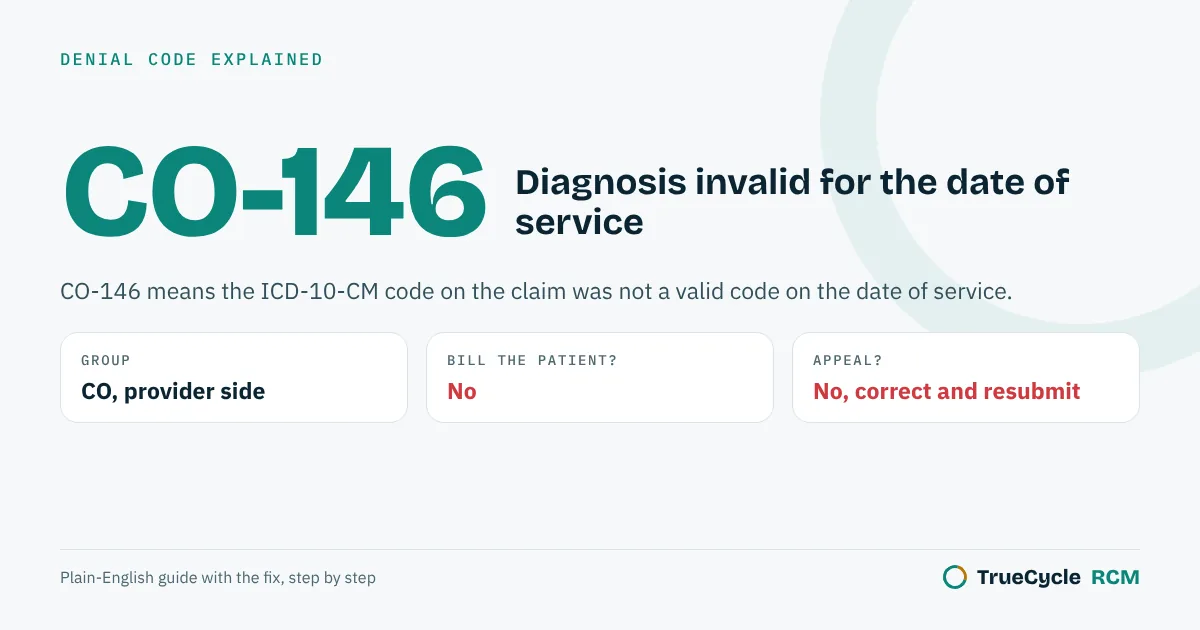
CO-146 means the ICD-10-CM code on the claim was not a valid code on the date of service. Usually a code was deleted or split into more specific codes in the yearly October 1 update, or a header code was used instead of a billable one. Pick the valid code and send a corrected claim.
The official wording
The X12 Claim Adjustment Reason Code list defines 146 as: "Diagnosis was invalid for the date(s) of service reported."
The letters in front are the group code. CO means contractual obligation (the provider absorbs it), PR means patient responsibility, and OA is other adjustment. The same reason code can come with different group codes, so always read both.
Common causes
- The annual ICD-10-CM update on October 1 split or deleted the code. There is no grace period. See our note on the FY 2027 code changes.
- A non-billable header code was used instead of the full code with all characters.
- An old code saved in the EHR's favorites list.
Send us the list: payer, date of service, denial code and amount. No patient names needed. We will tell you which claims can still be fixed, which need an appeal, and which deadlines are close. Free, usually within 2 business days. Want the full picture? Get a free 90-day denial audit from your ERA files.
Run a billing company? Add a trained biller from $8/hour, first 25 claims free.
How to fix it
- Look up the code in the code set for that date of service.
- Pick the valid, most specific code the note supports.
- Send a corrected claim.
How to prevent it
- Update EHR favorites and superbills every October 1.
- Let the scrubber reject invalid or truncated codes before submission.
One claim with a diagnosis that was not valid
A wrist fracture visit is coded with S52.501. That code needs a seventh character to show the encounter type.
| Item | On the claim | What it means |
|---|---|---|
| Diagnosis on claim | S52.501 | Not a complete code: the 7th character is missing |
| Correct code | S52.501A | Unspecified fracture of lower end of right radius, initial encounter |
| Remittance | CO-146 | Line or claim denied |
| Fix | Add the 7th character from the note | Send a corrected claim |
The second common cause is the yearly code update on October 1. A code that was valid in September can be invalid in October.
Why a diagnosis becomes invalid
CO-146 always means the code itself was not valid for that date. Check which of these happened.
| Cause | Example | Fix |
|---|---|---|
| Missing characters | S52.501 instead of S52.501A | Code to the full length |
| Header or category code | E11 instead of E11.9 | Pick the billable code under it |
| Code deleted or split on October 1 | An old code still saved in the EHR favorites | Use the new code for dates on or after Oct 1 |
| New code used too early | A new FY code used for a September date | Use the code valid on the date of service |
The date of service decides which code set applies, not the date you send the claim.
How to fix CO-146
- Look up the code for the exact date of service in the ICD-10-CM tables for that year.
- Find the complete, billable code that the note supports.
- Update the diagnosis and pointers, then send a corrected claim (frequency 7).
- Remove old codes from EHR favorites and templates after every October update.
CO-146 checklist
- ☐ Every diagnosis is billable to the last character.
- ☐ Codes are valid for the date of service, not just today.
- ☐ EHR favorites cleaned after the October 1 update.
- ☐ Claim scrubber has the current year's code set loaded.
Questions people ask about CO-146
Can I bill the patient for CO-146?
No. It is a coding error to correct.
Is there a grace period for new ICD-10 codes?
No. Codes deleted or expanded on October 1 are invalid for dates of service from that day.
Is CO-146 the same as CO-16?
No. CO-16 is missing or wrong information in general. CO-146 is specifically a diagnosis code that was not valid for that date.
When does the ICD-10 code set change?
Every October 1, with the new fiscal year code set. Some years also have an April update.
Do I need a new diagnosis from the doctor?
Only if the note does not support a complete code. Usually you just code it to the full length from the note.
Seeing CO-146 on your remittances?
Send us 25 claims and we will group your denials by reason and remark code and show you which fix removes the most of them. Free, no setup fee.
Start the free 25-claim trialFiling limits, appeal windows and claim addresses change quietly. Get one short email a month with what changed and the free tools we add.
One email a month. No spam. Unsubscribe any time.Other denial code guides
All denial code guides
PR-1 · PR-2 · PR-3 · CO-4 · CO-5 · CO-11 · CO-15 · CO-16 · OA-18 · CO-22 · OA-23 · CO-24 · CO-26 · CO-27 · CO-29 · CO-31 · CO-45 · CO-49 · CO-50 · CO-59 · PR-96 · CO-97 · CO-109 · CO-119 · CO-129 · CO-140 · CO-146 · CO-151 · CO-167 · CO-170 · CO-181 · CO-185 · CO-197 · CO-198 · PR-204 · CO-234 · CO-236 · CO-242 · CO-252 · CO-253 · CO-288 · CO-A1 · CO-B7 · MA130 · N130 · N23 · N290
Timely filing limits by payer: Cigna timely filing limit · HealthSpring timely filing limit · Aetna timely filing limit · UnitedHealthcare timely filing limit · Humana timely filing limit · corrected claim timely filing limits
Sources: X12 Claim Adjustment Reason Code list (146), read October 12, 2026; CMS Medicare guidance where Medicare rules are mentioned. Last reviewed October 12, 2026. General information, not coding or legal advice. Payer rules differ, so check the remark code and the payer's own policy.