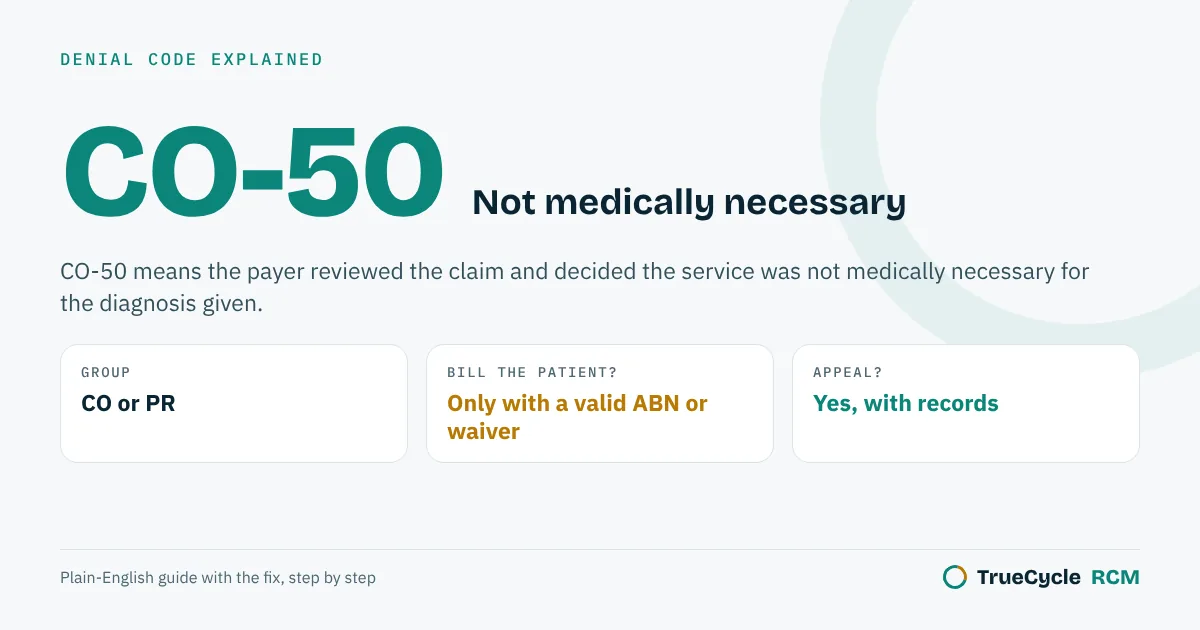
CO-50 means the payer reviewed the claim and decided the service was not medically necessary for the diagnosis given. Check the payer's coverage policy, then either correct the diagnosis link or appeal with the medical record. With CO, you cannot bill the patient unless a valid waiver was signed before the service.
The official wording
The X12 Claim Adjustment Reason Code list defines 50 as: "These are non-covered services because this is not deemed a 'medical necessity' by the payer."
The letters in front are the group code. CO means contractual obligation (the provider absorbs it), PR means patient responsibility, and OA is other adjustment. The same reason code can come with different group codes, so always read both.
What CO-50 is telling you
The payer has a policy (for Medicare, a National or Local Coverage Determination) listing when a service is covered. The diagnosis or documentation on your claim did not meet it.
For Medicare patients, the group code depends on the Advance Beneficiary Notice (ABN). With a valid ABN and modifier GA, the patient can be held liable (PR-50). Without one, the denial is CO-50 and the provider absorbs it.
Send us the list: payer, date of service, denial code and amount. No patient names needed. We will tell you which claims can still be fixed, which need an appeal, and which deadlines are close. Free, usually within 2 business days. Want the full picture? Get a free 90-day denial audit from your ERA files.
Run a billing company? Add a trained biller from $8/hour, first 25 claims free.
Common causes
- The diagnosis is not on the coverage policy's list for that service.
- Frequency limits, such as a test repeated sooner than the policy allows.
- The note does not explain why the service was needed.
- A screening service billed as diagnostic, or the reverse.
How to fix it
- Read the policy (LCD/NCD or the payer's medical policy) for the service.
- If the claim used the wrong diagnosis or pointer, send a corrected claim.
- If the service was necessary, appeal with the note, test results and the policy section that supports it.
- If it was not covered and the patient signed an ABN, rebill with the right modifier so the patient can be billed.
How to prevent it
- Check coverage policies before ordering high-cost tests and procedures.
- Use ABNs for Medicare services that may not be covered, signed before the service.
- Ask providers to write the reason for the service in the note, not just the code.
Remark codes that come with CO-50
| Remark code | Official wording | What to do |
|---|---|---|
| N115 | "This decision was based on a Local Coverage Determination (LCD)." | Find the Local Coverage Determination and check which diagnoses and documentation it requires. |
| N386 | "This decision was based on a National Coverage Determination (NCD)." | Find the National Coverage Determination and check its rules. |
| N130 | "Consult plan benefit documents/guidelines for information about restrictions for this service." | For commercial plans, read the plan's medical policy for this service. |
A CO-50 example
| Line on the remittance | Amount | What it means |
|---|---|---|
| Billed charge | $250.00 | A test |
| CO-50 with N115 | $250.00 | The diagnosis on the claim is not covered under the local policy |
| Paid by payer | $0.00 | Nothing paid |
Look up the LCD. If the patient's notes support a covered diagnosis that was left off the claim, correct the claim. If the test really was not covered and there was no ABN, you write it off.
CO-50 versus PR-50
| Code | What happened | Bill the patient? |
|---|---|---|
| CO-50 | Not medically necessary, and no valid ABN or waiver on file | No |
| PR-50 | Not medically necessary, and the patient signed a valid ABN (modifier GA on the claim) | Yes |
CO-50 checklist
- ☐ You read the LCD or NCD named in the remark code.
- ☐ All supporting diagnoses from the notes are on the claim.
- ☐ You know whether an ABN was signed.
- ☐ If you appeal, the letter quotes the policy and points to the notes.
Questions people ask about CO-50
Can I bill the patient for CO-50?
Not with a CO group code. For Medicare, you can bill the patient only if they signed a valid ABN before the service and the claim carried modifier GA, which turns it into PR-50.
What is the difference between CO-50 and CO-11?
CO-11 is a mismatch between diagnosis and procedure on the claim. CO-50 is a medical necessity decision, which usually needs records to overturn.
Is CO-50 the same as a medical necessity denial?
Yes. CO-50 says the payer does not consider the service medically necessary for this patient based on its coverage rules.
Seeing CO-50 on your remittances?
Send us 25 claims and we will group your denials by reason and remark code and show you which fix removes the most of them. Free, no setup fee.
Start the free 25-claim trialFiling limits, appeal windows and claim addresses change quietly. Get one short email a month with what changed and the free tools we add.
One email a month. No spam. Unsubscribe any time.Other denial code guides
All denial code guides
PR-1 · PR-2 · PR-3 · CO-4 · CO-5 · CO-11 · CO-15 · CO-16 · OA-18 · CO-22 · OA-23 · CO-24 · CO-26 · CO-27 · CO-29 · CO-31 · CO-45 · CO-49 · CO-50 · CO-59 · PR-96 · CO-97 · CO-109 · CO-119 · CO-129 · CO-140 · CO-146 · CO-151 · CO-167 · CO-170 · CO-181 · CO-185 · CO-197 · CO-198 · PR-204 · CO-234 · CO-236 · CO-242 · CO-252 · CO-253 · CO-288 · CO-A1 · CO-B7 · MA130 · N130 · N23 · N290
Timely filing limits by payer: Cigna timely filing limit · HealthSpring timely filing limit · Aetna timely filing limit · UnitedHealthcare timely filing limit · Humana timely filing limit · corrected claim timely filing limits
Sources: X12 Claim Adjustment Reason Code list (50), read October 12, 2026; CMS Medicare guidance where Medicare rules are mentioned. Last reviewed October 26, 2026. General information, not coding or legal advice. Payer rules differ, so check the remark code and the payer's own policy. Remark code wording from the X12 RARC list as published by claim.md, read October 26, 2026.