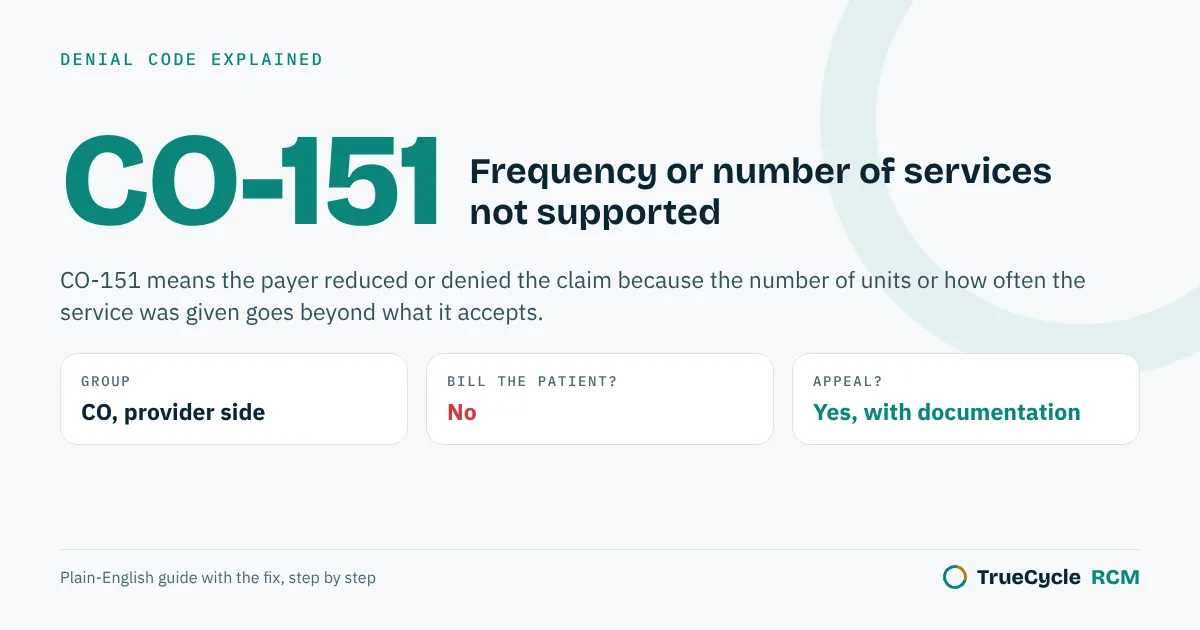
CO-151 means the payer reduced or denied the claim because the number of units or how often the service was given goes beyond what it accepts. Check units, frequency limits and Medicare MUEs. If the higher number was medically needed and documented, appeal with the records.
The official wording
The X12 Claim Adjustment Reason Code list defines 151 as: "Payment adjusted because the payer deems the information submitted does not support this many/frequency of services."
The letters in front are the group code. CO means contractual obligation (the provider absorbs it), PR means patient responsibility, and OA is other adjustment. The same reason code can come with different group codes, so always read both.
Common causes
- Units above the Medically Unlikely Edit (MUE) for the code.
- A test or visit repeated sooner than policy allows.
- A typo in units, such as minutes entered as units.
Send us the list: payer, date of service, denial code and amount. No patient names needed. We will tell you which claims can still be fixed, which need an appeal, and which deadlines are close. Free, usually within 2 business days. Want the full picture? Get a free 90-day denial audit from your ERA files.
Run a billing company? Add a trained biller from $8/hour, first 25 claims free.
How to fix it
- Check the units against the note. Fix any typo with a corrected claim.
- Check the MUE and the payer's frequency policy.
- If the extra units were needed, appeal with the records showing why.
One claim that hit an MUE
A physical therapy visit bills 97110 (therapeutic exercise) with 8 units. The note shows 38 minutes of that service.
| Item | On the claim | Problem |
|---|---|---|
| Units billed | 8 | 38 minutes supports about 3 units under the 8-minute rule |
| Payer check | Units compared to the note, the payer limit and the MUE | 8 units is far more than this visit supports |
| Remittance | CO-151 | Extra units denied or the line reduced |
| Fix | Correct the units to match the note | Send a corrected claim |
Most CO-151 denials are like this one: a units mistake, not a real medical need for more.
MUE adjudication indicators
Every MUE has an indicator (MAI). It tells you how the edit works and whether you can do anything about it.
| MAI | How the edit works | Can you get past it? |
|---|---|---|
| 1 | Applied per claim line | Yes, if units were really needed: split them on separate lines with an allowed modifier such as 76, 77 or an anatomic modifier |
| 2 | Applied per day, based on policy | Almost never. The limit comes from rules or anatomy. |
| 3 | Applied per day, based on clinical data | Only on appeal, with records showing the extra units were needed |
Look up the MUE value and MAI in the CMS MUE tables for your claim type. CMS updates them every quarter.
How to fix CO-151
- Count the units in the note. Fix any typo with a corrected claim.
- Check the MUE value and MAI for the code and date.
- For MAI 1, rebill extra units on separate lines with the right modifier if they were truly separate.
- For MAI 3, appeal with records that explain why more units were needed.
- For a frequency limit (a test repeated too soon), check the payer policy for the allowed interval.
CO-151 checklist
- ☐ Units match the time or quantity in the note.
- ☐ Units do not go over the MUE for the code.
- ☐ Repeat tests follow the payer's frequency limits.
- ☐ Your scrubber checks MUEs before the claim goes out.
Questions people ask about CO-151
Can I bill the patient for CO-151?
No, not with a CO group code.
What is an MUE?
A Medically Unlikely Edit is the maximum units of a code that Medicare expects for one patient on one date of service. Payers often use similar limits.
Can I appeal a CO-151 denial?
Yes. Medicare allows appeals for MUE denials. Send records that show why the extra units or visits were medically needed.
What is an MUE adjudication indicator?
It is the number (1, 2 or 3) that tells you whether the MUE applies per line or per day, and whether a modifier or an appeal can get past it.
How often do MUE values change?
CMS updates the MUE tables every quarter, so check the version for your date of service.
Seeing CO-151 on your remittances?
Send us 25 claims and we will group your denials by reason and remark code and show you which fix removes the most of them. Free, no setup fee.
Start the free 25-claim trialFiling limits, appeal windows and claim addresses change quietly. Get one short email a month with what changed and the free tools we add.
One email a month. No spam. Unsubscribe any time.Other denial code guides
All denial code guides
PR-1 · PR-2 · PR-3 · CO-4 · CO-5 · CO-11 · CO-15 · CO-16 · OA-18 · CO-22 · OA-23 · CO-24 · CO-26 · CO-27 · CO-29 · CO-31 · CO-45 · CO-49 · CO-50 · CO-59 · PR-96 · CO-97 · CO-109 · CO-119 · CO-129 · CO-140 · CO-146 · CO-151 · CO-167 · CO-170 · CO-181 · CO-185 · CO-197 · CO-198 · PR-204 · CO-234 · CO-236 · CO-242 · CO-252 · CO-253 · CO-288 · CO-A1 · CO-B7 · MA130 · N130 · N23 · N290
Timely filing limits by payer: Cigna timely filing limit · HealthSpring timely filing limit · Aetna timely filing limit · UnitedHealthcare timely filing limit · Humana timely filing limit · corrected claim timely filing limits
Sources: X12 Claim Adjustment Reason Code list (151), read October 27, 2026; CMS Medicare guidance where Medicare rules are mentioned; Noridian Medicare JE Part B reason code guidance, "Medical Unlikely Edit (MUE)" (CO-151), read October 27, 2026; CMS Medically Unlikely Edits overview. Last reviewed October 27, 2026. General information, not coding or legal advice. Payer rules differ, so check the remark code and the payer's own policy.