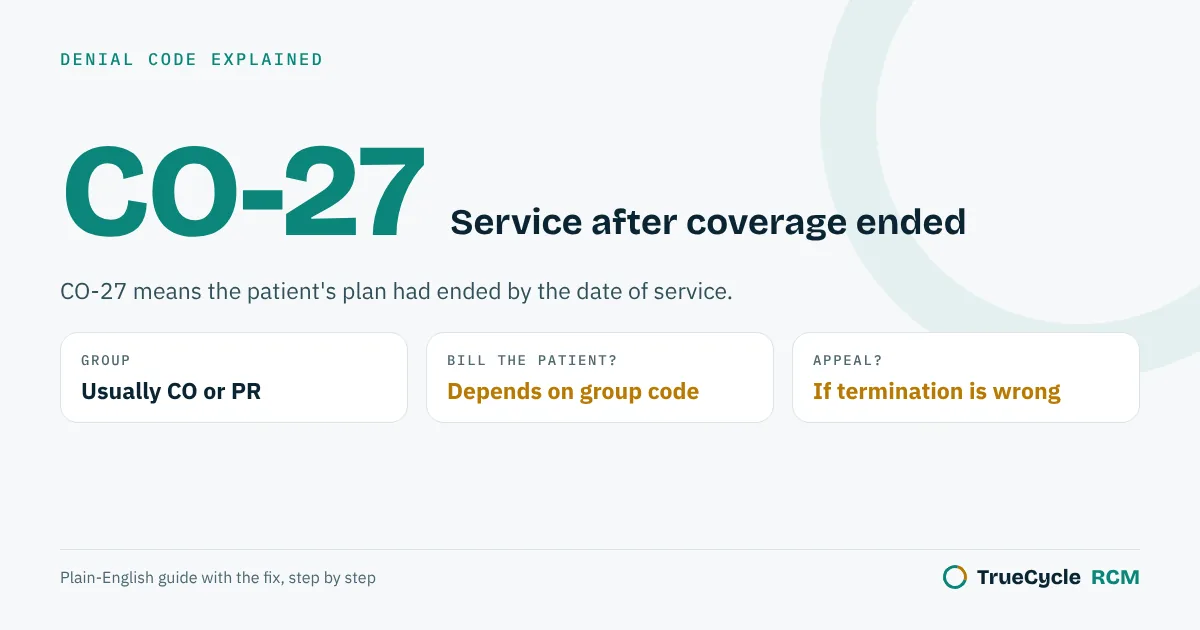
CO-27 means the patient's plan had ended by the date of service. Find out what coverage they had that day, usually a new employer plan, Medicaid or a marketplace plan, and bill it. Check eligibility for the date of service, not today.
The official wording
The X12 Claim Adjustment Reason Code list defines 27 as: "Expenses incurred after coverage terminated."
The letters in front are the group code. CO means contractual obligation (the provider absorbs it), PR means patient responsibility, and OA is other adjustment. The same reason code can come with different group codes, so always read both.
What CO-27 is telling you
The payer shows a termination date before the visit. Many CO-27 denials come from retroactive terminations: the employer ends coverage weeks later and back-dates it. Look at the group code too: PR-27 points to the patient; CO-27 means check your contract before billing them.
Send us the list: payer, date of service, denial code and amount. No patient names needed. We will tell you which claims can still be fixed, which need an appeal, and which deadlines are close. Free, usually within 2 business days. Want the full picture? Get a free 90-day denial audit from your ERA files.
Run a billing company? Add a trained biller from $8/hour, first 25 claims free.
Common causes
- The patient changed jobs and still showed the old card.
- A retroactive termination by the employer or plan.
- Marketplace coverage ended after unpaid premiums and a grace period.
- Medicaid redetermination ended the patient's eligibility.
How to fix it
- Ask the patient for current coverage and bill the plan active on the date of service.
- If the termination is wrong, the patient or employer has to get it reinstated, then you ask for reprocessing.
- If there is no coverage, follow your self-pay policy and the group code on the remittance.
How to prevent it
- Verify eligibility before every visit, and again on the day for high-cost services.
- Collect a new card copy at the first visit of each year.
One claim after coverage ended
A patient left their job on May 31. The employer plan ended that day. The patient came in on June 12 with the old card.
| Date | Event | Result |
|---|---|---|
| May 31 | Employer plan ends | |
| June 12 | Visit, billed to the old plan | |
| June 30 | Remittance | CO-27, $0 paid |
| Fix | Ask the patient about new coverage (COBRA, new job, marketplace, Medicaid) | Bill the plan active on June 12 |
Cases worth checking before you give up
- COBRA. A former employee has 60 days to elect COBRA, and coverage then goes back to the day the old plan ended. A claim denied with CO-27 can be paid after the patient elects it.
- Marketplace grace period. If a patient with premium tax credits is behind on premiums, the plan can hold claims during the grace period and then end coverage back to an earlier date.
- Medicaid. Eligibility can end after a renewal, and it can also be restored back to an earlier date.
CO-27 vs CO-26 vs CO-31
| Code | What the payer found | Fix |
|---|---|---|
| CO-27 | The member, but coverage had ended | Find the coverage active that day |
| CO-26 | The member, but coverage had not started | Find the coverage active that day. See our CO-26 guide. |
| CO-31 | No matching member at all | Fix the ID, name or date of birth. See our CO-31 guide. |
CO-27 checklist
- ☐ Eligibility was run for the date of service, not today.
- ☐ The patient was asked about COBRA, a new job, marketplace or Medicaid coverage.
- ☐ The new plan's filing limit is on your calendar.
- ☐ The patient is billed only if no coverage existed and your policy allows it.
Questions people ask about CO-27
Can I bill the patient for CO-27?
If the remittance shows PR-27, yes. If it shows CO-27, check your contract and first try to find the coverage that was active on the date of service.
What if the patient was retro-terminated?
Ask the patient or employer to confirm the dates. If the termination stands, look for the new coverage. If it was a mistake, ask the plan to reinstate and reprocess.
Can COBRA fix a CO-27 denial?
Yes, often. If the patient elects COBRA within the election period, coverage goes back to the day the old plan ended, and the claim can be resubmitted.
Should I bill the patient for CO-27?
Only after you confirm there was no other coverage that day. With PR-27 the payer says the patient owes it. With CO-27, check your contract first.
How do I prevent CO-27?
Run eligibility before every visit for the date of service, and ask patients at check-in if their insurance has changed.
Seeing CO-27 on your remittances?
Send us 25 claims and we will group your denials by reason and remark code and show you which fix removes the most of them. Free, no setup fee.
Start the free 25-claim trialFiling limits, appeal windows and claim addresses change quietly. Get one short email a month with what changed and the free tools we add.
One email a month. No spam. Unsubscribe any time.Other denial code guides
All denial code guides
PR-1 · PR-2 · PR-3 · CO-4 · CO-5 · CO-11 · CO-15 · CO-16 · OA-18 · CO-22 · OA-23 · CO-24 · CO-26 · CO-27 · CO-29 · CO-31 · CO-45 · CO-49 · CO-50 · CO-59 · PR-96 · CO-97 · CO-109 · CO-119 · CO-129 · CO-140 · CO-146 · CO-151 · CO-167 · CO-170 · CO-181 · CO-185 · CO-197 · CO-198 · PR-204 · CO-234 · CO-236 · CO-242 · CO-252 · CO-253 · CO-288 · CO-A1 · CO-B7 · MA130 · N130 · N23 · N290
Timely filing limits by payer: Cigna timely filing limit · HealthSpring timely filing limit · Aetna timely filing limit · UnitedHealthcare timely filing limit · Humana timely filing limit · corrected claim timely filing limits
Sources: X12 Claim Adjustment Reason Code list (27), read October 27, 2026; CMS Medicare guidance where Medicare rules are mentioned; U.S. Department of Labor COBRA guidance (election period); HealthCare.gov information on grace periods. Last reviewed October 27, 2026. General information, not coding or legal advice. Payer rules differ, so check the remark code and the payer's own policy.