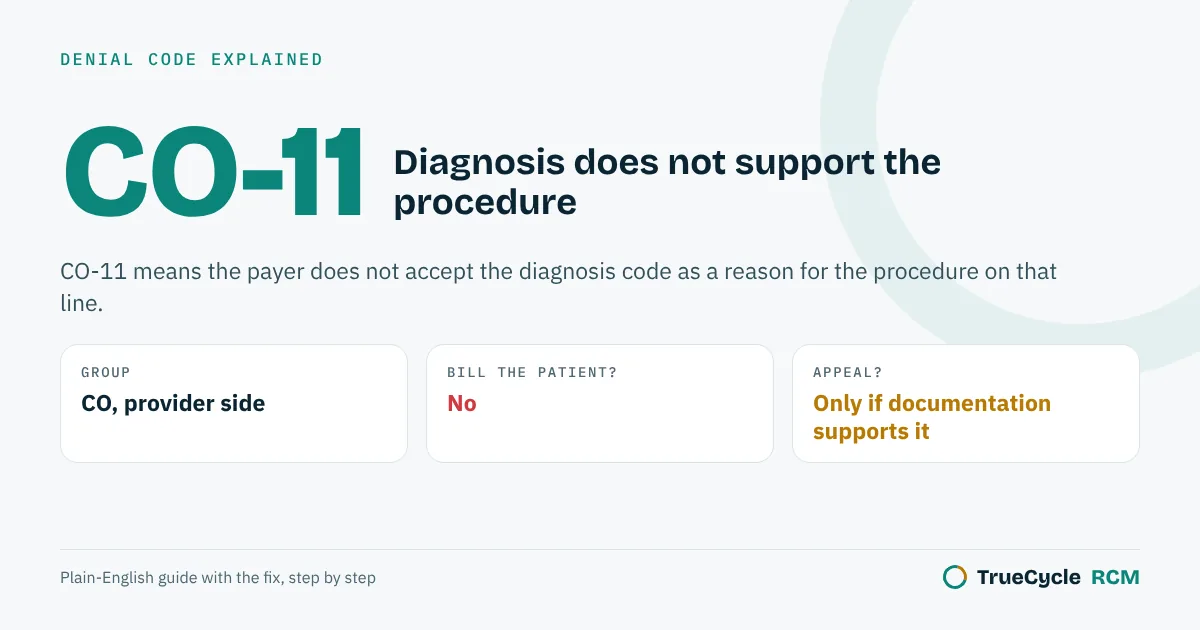
CO-11 means the payer does not accept the diagnosis code as a reason for the procedure on that line. Usually the diagnosis pointer is wrong or a more specific code is needed. Correct it and resubmit. Do not bill the patient.
The official wording
The X12 Claim Adjustment Reason Code list defines 11 as: "The diagnosis is inconsistent with the procedure."
The letters in front are the group code. CO means contractual obligation (the provider absorbs it), PR means patient responsibility, and OA is other adjustment. The same reason code can come with different group codes, so always read both.
What CO-11 is telling you
Every service line points to one or more diagnosis codes. The payer checked that link and decided the diagnosis does not justify the service. It is different from CO-50 (medical necessity): CO-11 is usually a mismatch on the claim itself, while CO-50 is a judgment that the service was not needed.
Send us the list: payer, date of service, denial code and amount. No patient names needed. We will tell you which claims can still be fixed, which need an appeal, and which deadlines are close. Free, usually within 2 business days. Want the full picture? Get a free 90-day denial audit from your ERA files.
Run a billing company? Add a trained biller from $8/hour, first 25 claims free.
Common causes
- Wrong diagnosis pointer. The line points to diagnosis A when it should point to diagnosis C.
- A non-specific or symptom code where the payer's policy lists specific covered diagnoses.
- A screening service billed with a problem diagnosis, or the reverse.
- A sex- or age-specific diagnosis that conflicts with the patient's details.
How to fix it
- Open the note and check what was actually treated.
- Fix the pointer or code to match the documentation. Never change a diagnosis that the note does not support.
- Check the payer's coverage policy (for Medicare, the LCD or NCD) for the diagnosis list.
- Send a corrected claim. If the original was right, appeal with the note and the policy section.
How to prevent it
- Have the scrubber check diagnosis-to-procedure edits before submission.
- Ask providers to rank diagnoses in the order they relate to each service.
- Keep LCD diagnosis lists handy for your top procedures.
One claim with a pointer mistake
A patient comes in for a sore throat and also has type 2 diabetes checked. The claim lists two diagnoses.
| Item | On the claim | Problem |
|---|---|---|
| Diagnosis A | J06.9 (acute upper respiratory infection) | |
| Diagnosis B | E11.9 (type 2 diabetes) | |
| Line 1: office visit | Points to A, B | Fine |
| Line 2: blood glucose test 82947 | Points to A only | Glucose test does not match a throat infection |
| Remittance, line 2 | CO-11 | Denied |
The fix is to point line 2 to diagnosis B and send a corrected claim. The note already supports it, so nothing changes clinically.
Remark codes that often come with CO-11
| Remark code | Official wording | What to do |
|---|---|---|
| M76 | "Missing/incomplete/invalid diagnosis or condition." | Check the code and the pointer. A truncated or invalid code also gets this. |
| N115 | "This decision was based on a Local Coverage Determination (LCD)." | Open the LCD for that service and check its list of covered diagnoses. |
CO-11 vs CO-50 vs CO-16
| Code | What the payer is saying | Usual fix |
|---|---|---|
| CO-11 | This diagnosis does not fit this procedure | Fix the pointer or code, send a corrected claim |
| CO-50 | The service was not medically necessary | Appeal with notes, or check for an ABN |
| CO-16 | The claim is missing data or has a billing error | Add the missing data, resubmit |
How to fix CO-11
- Open the note and list what was treated at that visit.
- Match each line to the right diagnosis. Put the main reason for that service first.
- Check the payer policy (for Medicare, the LCD or NCD) for that procedure's covered diagnoses.
- Send a corrected claim (frequency code 7, original claim number).
- Never add a diagnosis that the provider did not document.
CO-11 checklist
- ☐ Each line points to the diagnosis that supports it.
- ☐ Codes are coded to the highest specificity the note allows.
- ☐ Sex- and age-specific codes match the patient's details.
- ☐ The LCD or payer policy lists the diagnosis for that procedure.
Questions people ask about CO-11
What is the difference between CO-11 and CO-50?
CO-11 is a mismatch between the diagnosis and the procedure on the claim. CO-50 says the payer does not consider the service medically necessary. A CO-11 is often fixed with a corrected pointer; a CO-50 usually needs documentation.
Can I add a diagnosis to fix CO-11?
Only if the provider documented it for that visit. Adding a diagnosis that is not in the record is not a correction, it is a compliance problem.
What is a diagnosis pointer?
It is the letter in box 24E of the CMS-1500 (or the pointer in the electronic claim) that links each service line to one or more of the diagnoses listed in box 21.
How many diagnoses can one line point to?
Up to four on the CMS-1500. Put the main reason for that service first.
Is CO-11 a coding error or a coverage decision?
Most of the time it is a coding error on the claim, like a wrong pointer. When it comes with N115, the payer is applying an LCD diagnosis list.
Seeing CO-11 on your remittances?
Send us 25 claims and we will group your denials by reason and remark code and show you which fix removes the most of them. Free, no setup fee.
Start the free 25-claim trialFiling limits, appeal windows and claim addresses change quietly. Get one short email a month with what changed and the free tools we add.
One email a month. No spam. Unsubscribe any time.Other denial code guides
All denial code guides
PR-1 · PR-2 · PR-3 · CO-4 · CO-5 · CO-11 · CO-15 · CO-16 · OA-18 · CO-22 · OA-23 · CO-24 · CO-26 · CO-27 · CO-29 · CO-31 · CO-45 · CO-49 · CO-50 · CO-59 · PR-96 · CO-97 · CO-109 · CO-119 · CO-129 · CO-140 · CO-146 · CO-151 · CO-167 · CO-170 · CO-181 · CO-185 · CO-197 · CO-198 · PR-204 · CO-234 · CO-236 · CO-242 · CO-252 · CO-253 · CO-288 · CO-A1 · CO-B7 · MA130 · N130 · N23 · N290
Timely filing limits by payer: Cigna timely filing limit · HealthSpring timely filing limit · Aetna timely filing limit · UnitedHealthcare timely filing limit · Humana timely filing limit · corrected claim timely filing limits
Sources: X12 Claim Adjustment Reason Code list (11), read October 27, 2026; CMS Medicare guidance where Medicare rules are mentioned; X12 RARC list (M76, N115), read October 27, 2026; CMS-1500 claim form instructions (items 21 and 24E). Last reviewed October 27, 2026. General information, not coding or legal advice. Payer rules differ, so check the remark code and the payer's own policy.