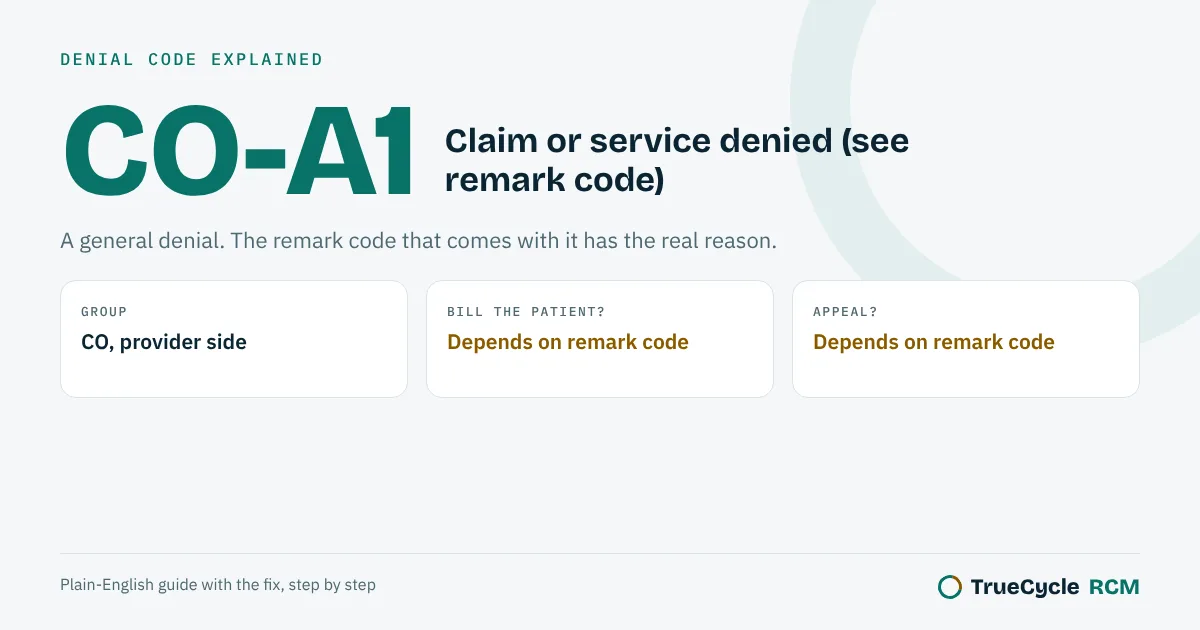
CO-A1 is a general "denied" code. Payers use it only when no more specific reason code fits, and it must come with a remark code. The remark code is the real reason, so look that up before you do anything else.
The official wording
The X12 Claim Adjustment Reason Code list defines A1 as: "Claim/Service denied. At least one Remark Code must be provided. Use this code only when a more specific Claim Adjustment Reason Code is not available."
The letters in front are the group code. CO means contractual obligation (the provider absorbs it), PR means patient responsibility, and OA is other adjustment. The same reason code can come with different group codes, so always read both.
What CO-A1 is telling you
A1 tells you almost nothing on its own. X12 says payers should use it only when no other reason code fits, and they must add at least one remark code (RARC) that explains the denial.
So the work is in the remark code. Look it up in our denial code lookup or our remark code guides, such as N290, N130 and MA130.
Send us the list: payer, date of service, denial code and amount. No patient names needed. We will tell you which claims can still be fixed, which need an appeal, and which deadlines are close. Free, usually within 2 business days. Want the full picture? Get a free 90-day denial audit from your ERA files.
Run a billing company? Add a trained biller from $8/hour, first 25 claims free.
Common causes
- A payer-specific policy that has no matching standard reason code.
- Missing documentation or a missing attachment the payer asked for.
- Provider enrollment or billing setup problems the payer describes in a remark code.
- A plan exclusion explained only in the remark code.
How to fix it
- Find the remark code on the 835 or the paper remittance.
- Look it up and read what it asks for.
- Fix the claim or send what is missing, then resubmit or appeal, depending on the remark code.
- If there is no remark code, call the payer. X12 requires one with A1, so ask them to tell you the reason.
How to prevent it
- Track your A1 denials by remark code each month. The same few remark codes usually repeat, and each one points to a fix.
- Keep the payer's policies and attachment rules for the services you bill most.
One claim, start to finish
A practice bills an unlisted procedure code. The payer denies it with CO-A1 and remark code N350. A new biller sees "A1, claim denied" and writes it off. That is $640 lost.
| Line on the remittance | Amount | What it means |
|---|---|---|
| Billed charge | $640.00 | Unlisted procedure |
| CO-A1 + N350 | $640.00 | Denied: the description for the unlisted code is missing |
| Paid by payer | $0.00 | Nothing paid yet |
N350 says: "Missing/incomplete/invalid description of service for a Not Otherwise Classified (NOC) code or for an Unlisted/By Report procedure." Add the description (box 19 or the line note in loop 2400) and the claim can be paid. The A1 told you nothing. The remark code told you everything.
Remark codes you will see with CO-A1, and what each one asks for
| Remark code | Official wording | What to do |
|---|---|---|
| N350 | "Missing/incomplete/invalid description of service for a Not Otherwise Classified (NOC) code or for an Unlisted/By Report procedure." | Add the service description and resubmit. |
| M127 | "Missing patient medical record for this service." | Send the visit note for this date of service. |
| N26 | "Missing itemized bill/statement." | Send an itemized bill, often needed for high-dollar or facility claims. |
| N3 | "Missing consent form." | Send the signed consent, common for sterilization and some procedures. |
| N130 | "Consult plan benefit documents/guidelines for information about restrictions for this service." | Check the plan's coverage rules. See our N130 guide. |
| N211 | "Alert: You may not appeal this decision." | Do not appeal. Fix the claim if you can, or write off. |
Why payers use A1 at all
X12 says A1 should be used "only when a more specific Claim Adjustment Reason Code is not available." In practice some payers use it more often than they should. That does not change your job: the remark code is the reason. If a payer sends A1 with no remark code, the remittance is incomplete, and you are right to call and ask.
How to work a CO-A1 denial
- Find every remark code on the line and at the claim level (the 835 can carry both).
- Look each one up. Use our denial code lookup.
- If the remark code asks for something missing, send it or send a corrected claim.
- If the remark code is a coverage rule, check the plan policy before you appeal.
- If there is no remark code, call the payer, note the rep name and call reference, and ask for the reason in writing.
- Track A1 denials by remark code each month. Fix the top two at the front desk or in charge entry.
CO-A1 checklist
- ☐ Remark code found and read, at line and claim level.
- ☐ Missing record, form or description sent.
- ☐ Appeal used only when the remark code allows it.
- ☐ Call reference saved when no remark code came back.
- ☐ Monthly count of A1 by remark code.
Questions people ask about CO-A1
Can I bill the patient for CO-A1?
Not with the CO group. Whether you can fix or appeal depends on the remark code that comes with it.
Why did the payer use A1 instead of a clear reason code?
Payers use A1 when no specific reason code fits their policy. The remark code with it carries the real reason.
What does CO-A1 mean?
CO-A1 means "claim or service denied" with the provider responsible. It is a general code. The remark code that comes with it gives the real reason.
What if CO-A1 comes with no remark code?
X12 requires at least one remark code with A1. Call the payer, ask for the specific reason, and save the call reference number.
Can I appeal a CO-A1 denial?
It depends on the remark code. If the remark code asks for a record or a missing detail, send it or a corrected claim instead of an appeal. If it is N211, the payer says the decision cannot be appealed.
Seeing CO-A1 on your remittances?
Send us 25 claims and we will group your denials by reason and remark code and show you which fix removes the most of them. Free, no setup fee.
Start the free 25-claim trialFiling limits, appeal windows and claim addresses change quietly. Get one short email a month with what changed and the free tools we add.
One email a month. No spam. Unsubscribe any time.Other denial code guides
All denial code guides
PR-1 · PR-2 · PR-3 · CO-4 · CO-5 · CO-11 · CO-15 · CO-16 · OA-18 · CO-22 · OA-23 · CO-24 · CO-26 · CO-27 · CO-29 · CO-31 · CO-45 · CO-49 · CO-50 · CO-59 · PR-96 · CO-97 · CO-109 · CO-119 · CO-129 · CO-140 · CO-146 · CO-151 · CO-167 · CO-170 · CO-181 · CO-185 · CO-197 · CO-198 · PR-204 · CO-234 · CO-236 · CO-242 · CO-252 · CO-253 · CO-288 · CO-A1 · CO-B7 · MA130 · N130 · N23 · N290
Timely filing limits by payer: Cigna timely filing limit · HealthSpring timely filing limit · Aetna timely filing limit · UnitedHealthcare timely filing limit · Humana timely filing limit · corrected claim timely filing limits
Sources: X12 Claim Adjustment Reason Code list (A1), read October 26, 2026; CMS Medicare guidance where Medicare rules are mentioned; X12 Claim Adjustment Reason Code A1 and Remittance Advice Remark Codes N350, M127, N26, N3, N130 and N211 (x12.org, read October 28, 2026). Last reviewed October 28, 2026. General information, not coding or legal advice. Payer rules differ, so check the remark code and the payer's own policy.