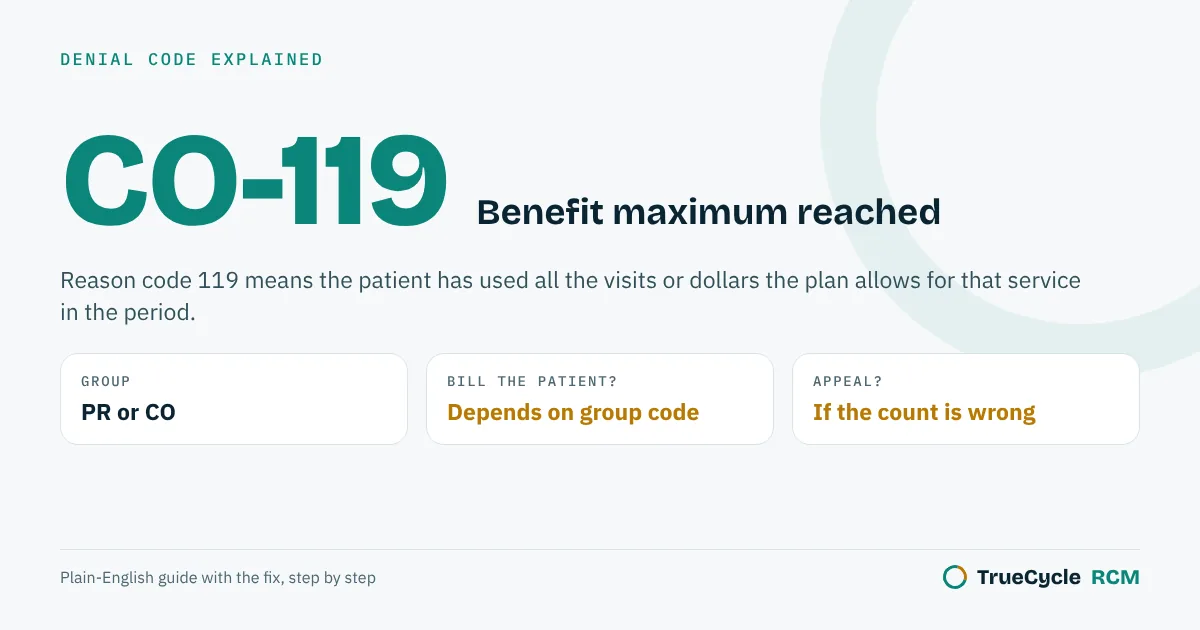
Reason code 119 means the patient has used all the visits or dollars the plan allows for that service in the period, often physical therapy, chiropractic or mental health visits. If the payer sends PR-119, the patient is responsible. If it sends CO-119, check your contract before billing them.
The official wording
The X12 Claim Adjustment Reason Code list defines 119 as: "Benefit maximum for this time period or occurrence has been reached."
The letters in front are the group code. CO means contractual obligation (the provider absorbs it), PR means patient responsibility, and OA is other adjustment. The same reason code can come with different group codes, so always read both.
Common causes
- Visit limits for therapy, chiropractic, acupuncture or similar services.
- Annual dollar limits on certain benefits.
- Visits counted from another provider the patient saw earlier in the year.
Send us the list: payer, date of service, denial code and amount. No patient names needed. We will tell you which claims can still be fixed, which need an appeal, and which deadlines are close. Free, usually within 2 business days. Want the full picture? Get a free 90-day denial audit from your ERA files.
Run a billing company? Add a trained biller from $8/hour, first 25 claims free.
How to handle it
- Check benefits to confirm the limit and how many visits the payer counted.
- If the count is wrong, ask the payer to reprocess with the correct visit history.
- If an exception process exists, such as a medical necessity extension, use it before more visits are given.
- If the group code is PR, bill the patient under your financial policy.
How to prevent it
- Check visit limits at the start of a plan of care and track the count.
- Tell the patient in writing when they are close to the limit.
One claim that hit a visit limit
A patient's commercial plan covers 20 physical therapy visits a year. She saw another clinic 6 times in spring. Your clinic bills visit 15 of its own plan of care.
| Item | On the claim | What it means |
|---|---|---|
| Visits used this year | 6 at the other clinic + 14 at yours | That is 20, so the limit is already used |
| Visit billed | 97110, 97140 on visit 15 | This is visit 21 for the plan |
| Remittance | PR-119 or CO-119 | No payment for this visit |
| Fix | Check the group code and the contract | PR: bill the patient. CO: write off or ask for an exception |
The clinic never knew about the other 6 visits. A benefits check at the start of care would have shown them.
Limits that often trigger CO-119
Benefit maximums show up most often on these services. The number and the period come from the patient's own plan, so always check.
| Service | Typical limit type | What to check |
|---|---|---|
| Physical, occupational and speech therapy | Visits per calendar or plan year | Visits used at any provider, and whether PT and OT share one limit |
| Chiropractic | Visits per year | Whether maintenance care counts toward the limit |
| Acupuncture and massage | Visits or dollars per year | If the benefit is a rider or not covered at all |
| Hearing aids, vision hardware | Dollar amount every 1 to 3 years | Date of the last purchase |
| Mental health visits (some plans) | Visits per year | Parity rules may limit how plans cap these |
Original Medicare has no hard cap on therapy. Above the yearly threshold you add the KX modifier to show the care is still needed.
How to fix CO-119
- Read the group code: PR means the patient can owe it, CO usually means you cannot bill the patient.
- Call or check the portal for the benefit limit and the visit count the payer has on file.
- If the payer counted visits wrongly (duplicates, another member), ask for a reprocess with the correct history.
- If the plan has an exception or medical necessity extension, request it with the plan of care and progress notes.
- For PR-119, send the patient a statement under your financial policy, ideally after telling them before the visit.
CO-119 checklist
- ☐ Benefit limit and visits used checked at the start of care.
- ☐ Visit count tracked on every visit in your system.
- ☐ Patient told in writing when only a few visits are left.
- ☐ Exception request sent before the limit is reached, not after.
Questions people ask about CO-119
Can I bill the patient for CO-119?
With PR-119, yes. With CO-119, check the contract first.
Does N130 come with CO-119?
Often. Remark N130 tells you to check the plan's benefit documents for the restriction.
Does CO-119 mean the claim was wrong?
No. The claim can be perfect. The patient simply used up the benefit for that period.
Can I appeal CO-119?
Only if the count is wrong or the plan allows an exception. A correct limit is not overturned on appeal.
Does Medicare use CO-119 for therapy?
Not as a hard cap. Original Medicare uses the KX modifier threshold and targeted review instead.
Seeing CO-119 on your remittances?
Send us 25 claims and we will group your denials by reason and remark code and show you which fix removes the most of them. Free, no setup fee.
Start the free 25-claim trialFiling limits, appeal windows and claim addresses change quietly. Get one short email a month with what changed and the free tools we add.
One email a month. No spam. Unsubscribe any time.Other denial code guides
All denial code guides
PR-1 · PR-2 · PR-3 · CO-4 · CO-5 · CO-11 · CO-15 · CO-16 · OA-18 · CO-22 · OA-23 · CO-24 · CO-26 · CO-27 · CO-29 · CO-31 · CO-45 · CO-49 · CO-50 · CO-59 · PR-96 · CO-97 · CO-109 · CO-119 · CO-129 · CO-140 · CO-146 · CO-151 · CO-167 · CO-170 · CO-181 · CO-185 · CO-197 · CO-198 · PR-204 · CO-234 · CO-236 · CO-242 · CO-252 · CO-253 · CO-288 · CO-A1 · CO-B7 · MA130 · N130 · N23 · N290
Timely filing limits by payer: Cigna timely filing limit · HealthSpring timely filing limit · Aetna timely filing limit · UnitedHealthcare timely filing limit · Humana timely filing limit · corrected claim timely filing limits
Sources: X12 Claim Adjustment Reason Code list (119), read October 12, 2026; CMS Medicare guidance where Medicare rules are mentioned. Last reviewed October 12, 2026. General information, not coding or legal advice. Payer rules differ, so check the remark code and the payer's own policy.