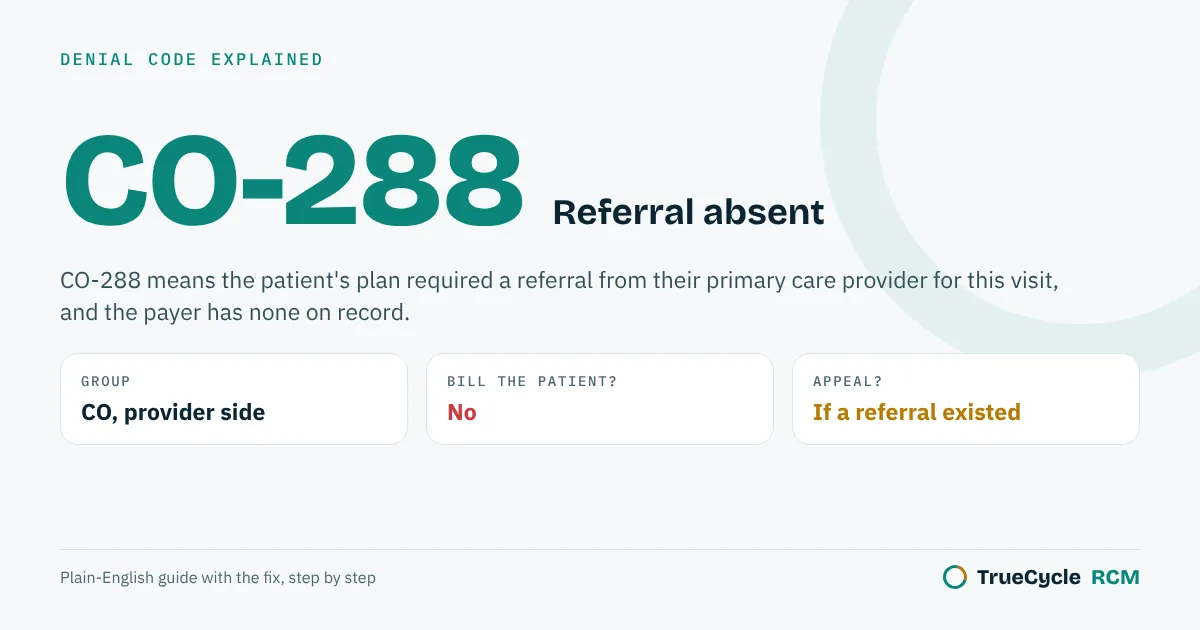
CO-288 means the patient's plan required a referral from their primary care provider for this visit, and the payer has none on record. Ask the PCP's office for the referral, add it to the claim, and resubmit. Check whether the plan accepts retro referrals.
The official wording
The X12 Claim Adjustment Reason Code list defines 288 as: "Referral absent"
The letters in front are the group code. CO means contractual obligation (the provider absorbs it), PR means patient responsibility, and OA is other adjustment. The same reason code can come with different group codes, so always read both.
Common causes
- HMO, POS or Medicaid managed care plans that need a PCP referral for specialists.
- The referral was issued but not sent to the payer, or was for a different provider.
- The referral expired or ran out of visits.
Send us the list: payer, date of service, denial code and amount. No patient names needed. We will tell you which claims can still be fixed, which need an appeal, and which deadlines are close. Free, usually within 2 business days. Want the full picture? Get a free 90-day denial audit from your ERA files.
Run a billing company? Add a trained biller from $8/hour, first 25 claims free.
How to fix it
- Ask the PCP's office whether a referral was issued and get the number.
- Add it to the claim and send a corrected claim.
- If none exists, ask whether the plan accepts retro referrals.
How to prevent it
- Check referral requirements when scheduling, from the eligibility response.
- Do not see referral-required patients until the referral is on file, except emergencies.
One specialist claim without a referral
An HMO patient books directly with a dermatologist. The PCP never sent a referral.
| Item | On the claim | What it means |
|---|---|---|
| Plan | HMO, referral needed for specialists | PCP must refer first |
| Referral on claim | None in box 17 / REF*9F | Payer has no referral on file |
| Remittance | CO-288 | Referral absent |
| Fix | Ask the PCP for a referral, retro if the plan allows | Then send a corrected claim with the referral number |
Some plans accept a retro referral within a short time. Ask right away, because the window is often only days.
Referral or authorization?
They are different, and a claim can need both.
| Referral | Prior authorization | |
|---|---|---|
| Who asks | Primary care provider | The provider doing the service |
| Who approves | PCP (sometimes the plan records it) | The payer |
| Typical plans | HMO, POS, Medicaid managed care | Most plans, for costly services |
| Where on the claim | Referral number: 2300 REF*9F; referring provider: box 17 / 2310A | Auth number: box 23 / 2300 REF*G1 |
| Denial if missing | CO-288 | CO-197 or CO-15 |
Check both at scheduling for HMO patients.
How to fix CO-288
- Check whether the plan needs a referral and whether one exists in the portal.
- If the referral exists, add the referral number and referring provider and send a corrected claim.
- If there is none, ask the PCP for a retro referral if the plan allows it.
- If no referral can be obtained, follow your policy (some plans let you bill the patient with a signed waiver).
- Next time, check for a referral before the first specialist visit.
CO-288 checklist
- ☐ Referral checked at scheduling for HMO, POS and Medicaid managed care patients.
- ☐ Referral number and referring NPI on the claim.
- ☐ Referral visit count and end date tracked.
- ☐ New referral requested before the old one runs out.
Questions people ask about CO-288
Can I bill the patient for CO-288?
Generally no for in-network services, unless your contract allows it and the patient agreed in writing beforehand.
What is the difference between a referral and an authorization?
A referral comes from the patient's primary care provider. An authorization comes from the payer. CO-288 is a missing referral; CO-197 is a missing authorization.
Where does the referral number go on the claim?
In loop 2300 REF*9F on the 837P. The referring provider goes in box 17 / loop 2310A.
Can I get a referral after the visit?
Some plans allow a retro referral within a few days. Many do not, so check before the visit.
Can I bill the patient for CO-288?
Not with a CO group code unless the patient signed a waiver the plan allows.
Seeing CO-288 on your remittances?
Send us 25 claims and we will group your denials by reason and remark code and show you which fix removes the most of them. Free, no setup fee.
Start the free 25-claim trialFiling limits, appeal windows and claim addresses change quietly. Get one short email a month with what changed and the free tools we add.
One email a month. No spam. Unsubscribe any time.Other denial code guides
All denial code guides
PR-1 · PR-2 · PR-3 · CO-4 · CO-5 · CO-11 · CO-15 · CO-16 · OA-18 · CO-22 · OA-23 · CO-24 · CO-26 · CO-27 · CO-29 · CO-31 · CO-45 · CO-49 · CO-50 · CO-59 · PR-96 · CO-97 · CO-109 · CO-119 · CO-129 · CO-140 · CO-146 · CO-151 · CO-167 · CO-170 · CO-181 · CO-185 · CO-197 · CO-198 · PR-204 · CO-234 · CO-236 · CO-242 · CO-252 · CO-253 · CO-288 · CO-A1 · CO-B7 · MA130 · N130 · N23 · N290
Timely filing limits by payer: Cigna timely filing limit · HealthSpring timely filing limit · Aetna timely filing limit · UnitedHealthcare timely filing limit · Humana timely filing limit · corrected claim timely filing limits
Sources: X12 Claim Adjustment Reason Code list (288), read October 12, 2026; CMS Medicare guidance where Medicare rules are mentioned. Last reviewed October 12, 2026. General information, not coding or legal advice. Payer rules differ, so check the remark code and the payer's own policy.