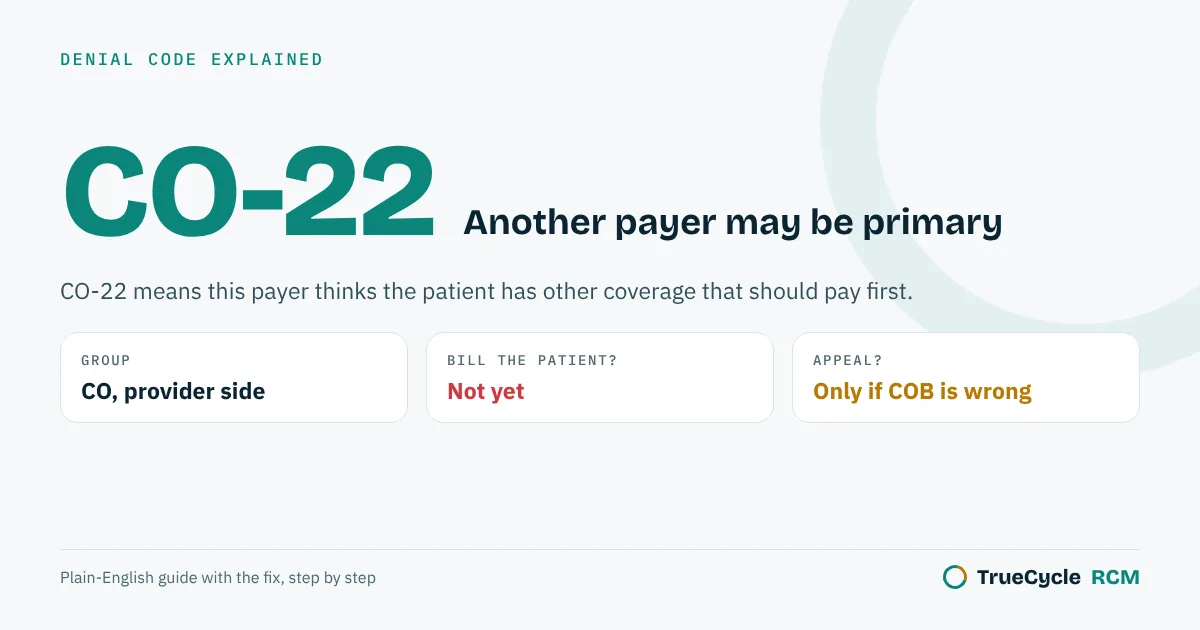
CO-22 means this payer thinks the patient has other coverage that should pay first. Find the primary insurance, bill it, then send this payer a secondary claim with the primary EOB. Often the patient also has to update their coordination of benefits record with the plan.
The official wording
The X12 Claim Adjustment Reason Code list defines 22 as: "This care may be covered by another payer per coordination of benefits."
The letters in front are the group code. CO means contractual obligation (the provider absorbs it), PR means patient responsibility, and OA is other adjustment. The same reason code can come with different group codes, so always read both.
What CO-22 is telling you
Coordination of benefits (COB) decides which plan pays first when a patient has two. The payer's records show another plan, so it refuses to pay as primary. Sometimes the record is right. Sometimes it is out of date, such as an old employer plan that ended.
Send us the list: payer, date of service, denial code and amount. No patient names needed. We will tell you which claims can still be fixed, which need an appeal, and which deadlines are close. Free, usually within 2 business days. Want the full picture? Get a free 90-day denial audit from your ERA files.
Run a billing company? Add a trained biller from $8/hour, first 25 claims free.
Common causes
- The patient has a spouse's or parent's plan that is primary under the birthday rule or employer rules.
- Medicare and an employer plan, where the employer plan is primary.
- The payer's COB file is stale and lists coverage that already ended.
- An accident or injury claim where auto or liability insurance may be primary.
How to fix it
- Ask the patient about all coverage and check eligibility for other payers.
- If another plan is primary, bill it first. Then send this payer a secondary claim with the primary payer's paid and adjusted amounts.
- If there is no other coverage, the patient usually has to call the plan and update COB. Many payers will not take that update from the provider.
- Resubmit or ask for reprocessing after the COB record is fixed.
- Watch both filing windows. Secondary deadlines often count from the primary EOB date. See our timely filing calculator.
How to prevent it
- Ask "do you have any other insurance?" at every visit, not just at registration.
- Run eligibility checks that return COB information before the visit.
- Send patients a short COB form once a year.
One claim, two payers
Here is a common CO-22 case. A 67-year-old patient still works and has an employer plan. The practice billed Medicare first.
| Step | What happens | Result |
|---|---|---|
| 1. Claim to Medicare | Medicare's records show the employer plan pays first | CO-22 with N598, $0 paid |
| 2. Claim to employer plan | Employer plan pays as primary | Allowed $120, paid $96, patient share $24 |
| 3. Secondary claim to Medicare | Sent with the primary payer's payment and adjustments | Medicare looks at the patient share and may pay some or all of it |
| 4. Patient bill | Only what is left after both payers | Often $0 or a small amount |
The fix was never an appeal. The claim simply had to go to the right payer first.
Remark codes that often come with CO-22
| Remark code | Official wording | What to do |
|---|---|---|
| N598 | "Health care policy coverage is primary." | The payer has another plan on file as primary. Bill that plan first. |
| MA04 | "Secondary payment cannot be considered without the identity of or payment information from the primary payer. The information was either not reported or was illegible." | You sent a secondary claim but left out the primary payer's details. Resend with them. |
| MA92 | "Missing plan information for other insurance." | The other plan's name, ID or group number is missing from the claim. |
| N4 | "Missing/Incomplete/Invalid prior Insurance Carrier(s) EOB." | Attach or report the primary EOB data. |
Who pays first: quick rules
| Situation | Usually primary |
|---|---|
| Patient has their own employer plan and a spouse's plan | The patient's own plan |
| Child covered by both parents (parents married) | The plan of the parent whose birthday comes first in the year |
| Medicare patient, still working, employer has 20+ employees | The employer plan |
| Medicare patient, retired, has a retiree plan | Medicare |
| Car accident or work injury | Auto, liability or workers' comp, depending on the case |
These are the common rules. Divorce orders, COBRA and small employers change the order, so confirm with the plans when in doubt.
How to send the secondary claim
- Wait for the primary payer's remittance.
- On an electronic claim, report the primary payer in loop 2320 and its paid amount (AMT*D). Report each line's payment and adjustments in loop 2430 (SVD and CAS segments).
- On paper, attach a copy of the primary EOB.
- Send it inside the secondary payer's filing window. Many count from the primary EOB date, not the date of service. Use our timely filing calculator.
CO-22 checklist
- ☐ You asked the patient about every plan, including a spouse's or parent's plan.
- ☐ Eligibility shows which plan is primary on the date of service.
- ☐ The primary EOB data is on the secondary claim.
- ☐ If the payer's COB record is wrong, the patient has called the plan to update it.
Questions people ask about CO-22
Can I bill the patient for CO-22?
Not as a final balance. CO-22 means the claim needs to go to the right payer first. If the patient will not update COB with their plan, your financial policy decides what happens next.
Who updates coordination of benefits?
Usually the patient, by calling the member services number on their card. Some payers accept a COB questionnaire from the provider, but most want it from the member.
What does N598 mean with CO-22?
N598 reads "Health care policy coverage is primary." The payer believes another health plan pays first. Bill that plan, then send this payer a secondary claim.
What if the other coverage ended?
The patient usually has to call the plan and update their coordination of benefits record. For Medicare, the patient can call the Benefits Coordination & Recovery Center at 1-855-798-2627. Then ask for the claim to be reprocessed.
Does CO-22 have its own filing deadline?
The normal filing limit still runs. Secondary claims often get a set number of days from the primary EOB date, so file as soon as the primary pays.
Seeing CO-22 on your remittances?
Send us 25 claims and we will group your denials by reason and remark code and show you which fix removes the most of them. Free, no setup fee.
Start the free 25-claim trialFiling limits, appeal windows and claim addresses change quietly. Get one short email a month with what changed and the free tools we add.
One email a month. No spam. Unsubscribe any time.Other denial code guides
All denial code guides
PR-1 · PR-2 · PR-3 · CO-4 · CO-5 · CO-11 · CO-15 · CO-16 · OA-18 · CO-22 · OA-23 · CO-24 · CO-26 · CO-27 · CO-29 · CO-31 · CO-45 · CO-49 · CO-50 · CO-59 · PR-96 · CO-97 · CO-109 · CO-119 · CO-129 · CO-140 · CO-146 · CO-151 · CO-167 · CO-170 · CO-181 · CO-185 · CO-197 · CO-198 · PR-204 · CO-234 · CO-236 · CO-242 · CO-252 · CO-253 · CO-288 · CO-A1 · CO-B7 · MA130 · N130 · N23 · N290
Timely filing limits by payer: Cigna timely filing limit · HealthSpring timely filing limit · Aetna timely filing limit · UnitedHealthcare timely filing limit · Humana timely filing limit · corrected claim timely filing limits
Sources: X12 Claim Adjustment Reason Code list (22), read October 27, 2026; CMS Medicare guidance where Medicare rules are mentioned; Noridian Medicare JE Part B reason code guidance, "Coordination of Benefits" (CO-22 with N598), read October 27, 2026; X12 RARC list (MA04, MA92, N4). Last reviewed October 27, 2026. General information, not coding or legal advice. Payer rules differ, so check the remark code and the payer's own policy.