No. CMS deleted the NCCI edit between 97140 and 97530 after December 31, 2019, and the October 2026 files have no edit for this pair. Bill both with GP and no 59. The same goes for 97110 with 97140 and 97530 with a PT evaluation. Modifier 59 or XS is still needed for pairs such as 97150 group therapy with one-on-one codes and 97760 orthotic training with 97110 or 97140.
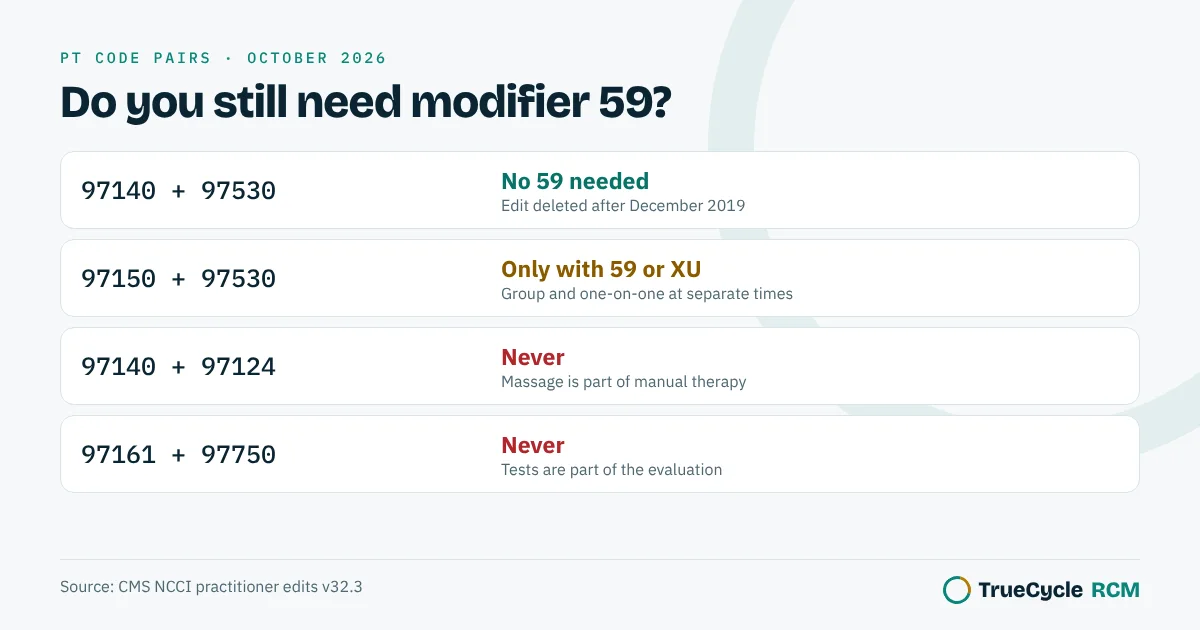
The 97140 and 97530 rule is gone
In January 2020, CMS added a batch of therapy edits, including one that blocked 97530 with the evaluation codes. Therapy groups pushed back and CMS removed them. At the same time, the long-running edit between 97140 and 97530 ended: in the current file it shows a deletion date of December 31, 2019. Nothing has replaced it since.
So for Medicare claims after 2019, 97140 and 97530 on the same day need no 59 and no X modifier. Putting 59 on a pair that has no edit doesn't help, and it can draw attention in an audit because it says the services needed to be split when they didn't.
PT code pairs at a glance
Each NCCI edit pairs a column 1 code with a column 2 code for the same patient, same provider, same day. Indicator 0 means never. Indicator 1 means only with a modifier when the services were truly separate.
| Codes | Same day? | What to do |
|---|---|---|
| 97140 + 97530 | Allowed, no 59 | Edit deleted after 2019. GP only. |
| 97110 + 97140 | Allowed, no 59 | No edit. Document minutes for each. |
| 97530 + 97161 / 97162 / 97163 | Allowed, no 59 | Edit added and removed in 2020. No edit now. |
| 97530 + 97535 | Allowed, no 59 | Edit ended December 31, 2021. |
| 97150 + 97110 / 97140 / 97530 | Only with 59/X | Group and one-on-one at separate times. 59 or XU on the column 2 code. |
| 97760 + 97110 / 97112 / 97140 | Only with 59/X | Orthotic training plus other work, separate minutes. 59 or XU. |
| 97012 + 97140 | Only with 59/X | Traction and manual therapy on separate regions: XS. |
| 98940 + 97140 | Only with 59/X | Chiropractic manipulation plus manual therapy on a different region: XS. |
| 97140 + 97124 | Never | Massage is part of manual therapy. Bill one. |
| 97161 + 97750 / 97763 | Never | Bill the evaluation. Tests and follow-up are part of it. |
| 97161 + 97164 | Never | An evaluation and a re-evaluation can't be on the same day. |
| 97760 + 97763 | Never | Initial orthotic training or the follow-up code, not both. |
| 20560 + 20561 | Never | Dry needling: one code per day based on muscle count. |
Check any two PT codes
Pick two codes billed on the same day by the same provider. The answer comes from the October 2026 CMS practitioner edit file and the daily unit limits (MUEs).
Where 59, XS and XU still matter
- 97150 group therapy pairs with almost every one-on-one code at indicator 1. If the patient had a group session and a separate one-on-one session, bill both with 59 or XU on the column 2 code, and keep the times apart in the note.
- 97760 and 97763 orthotic codes pair with 97110, 97112, 97116, 97124 and 97140. Use a modifier only when the other service was separate from the orthotic training.
- Traction (97012) with manual therapy, and chiropractic manipulation (98940 to 98942) with 97140, need XS when they were done on different body regions.
- Attended and unattended e-stim (97032 and G0283) on the same day need a modifier and two separate areas or times.
CMS asks for the X modifiers where they fit: XS for a separate body structure, XU for an unusual non-overlapping service and XE for a separate encounter. Some payers still only take 59. Never use any of them on an indicator 0 pair.
Pairs that are never paid together
- 97140 and 97124: massage is part of manual therapy.
- An evaluation with 97750 or 97763: physical performance tests and orthotic follow-up done during the evaluation are part of it.
- Two evaluations, or an evaluation and a re-evaluation, on the same day.
- 97150 with 97750: a performance test can't be billed with group therapy.
- Chiropractic manipulation with a PT evaluation by the same provider.
Daily unit limits (MUEs) for PT codes
MUEs cap how many units of a code Medicare pays for one patient on one day. The timed-code units still have to follow the 8-minute rule.
| Code | Service | Units per day |
|---|---|---|
| 97110 | Therapeutic exercise | 6 |
| 97112 | Neuromuscular re-education | 4 |
| 97116 | Gait training | 4 |
| 97140 | Manual therapy | 6 |
| 97530 | Therapeutic activities | 6 |
| 97535 | Self-care or home management training | 8 |
| 97113 | Aquatic therapy | 6 |
| 97124 | Massage | 4 |
| 97150 | Group therapy | 1 |
| 97161 | PT evaluation, low complexity | 1 |
| 97164 | PT re-evaluation | 1 |
| 97750 | Physical performance test | 8 |
| 97760 | Orthotic management and training | 6 |
| 97763 | Orthotic or prosthetic follow-up | 6 |
| 97032 | Attended e-stim | 4 |
| 97035 | Ultrasound | 2 |
| G0283 | Unattended e-stim (Medicare) | 1 |
| 97010 | Hot or cold packs | 0 |
| 97014 | Unattended e-stim (non-Medicare) | 0 |
A limit of 0 means Medicare doesn't pay the code at all. 97010 is bundled into other services, and Medicare uses G0283 instead of 97014 for unattended e-stim. Most of the other limits are clinical date-of-service limits, so extra units can be paid on appeal when the records clearly support them.
Send us 90 days of ERA files. We will show you every bundled or capped line, what it cost and which ones you can still fix. Free, in two business days, with a BAA first.
If a therapy line was already denied
- CO-97 or CO-236: the line was bundled into another code. Look up the pair above. If it has no edit, the payer is using its own rule or an old one; ask for the policy and appeal. If it's indicator 1 and the services were separate, send a corrected claim with 59 or an X modifier. If it's indicator 0, write it off.
- CO-151: more units than the payer allows. Compare with the unit limits table.
- CO-4: a modifier is missing or wrong, often GP, GO or GN on a Medicare therapy claim.
Billing therapy on the UB-04? See value code 50. Therapy practices that also bill behavioral health can check the therapy code pairs for mental health.
Questions
Do 97140 and 97530 need modifier 59 in 2026?
Not for NCCI. CMS deleted the 97140 and 97530 edit after December 31, 2019, and the October 2026 files have no edit for this pair. Bill both with the GP modifier for Medicare and no 59. A few payers may still run their own edit, so follow a payer policy if it says otherwise.
Can 97110 and 97140 be billed together?
Yes. There is no active NCCI edit for 97110 and 97140. Each must be a separate, timed service with its own minutes in the note.
Can 97530 be billed with a PT evaluation?
Yes. CMS added and removed an edit between 97530 and the evaluation codes 97161 to 97163 in January 2020. There is no active edit in the October 2026 files.
When do PT codes need modifier 59?
When the pair has modifier indicator 1 and the services were truly separate. Common examples: 97150 group therapy with any one-on-one code, 97760 or 97763 orthotic codes with 97110, 97112, 97116 or 97140, 97012 traction with 97140, and chiropractic manipulation with 97140 on a different body region.
Why does Medicare deny 97010?
97010 (hot or cold packs) has a daily unit limit of 0 in the Medicare MUE table, and Medicare bundles it into the other services. It can't be paid on its own.
Should I use 59 or XS for therapy?
CMS asks for the more specific X modifiers when they fit: XS for a separate body structure, XU for an unusual non-overlapping service, XE for a separate encounter. Some payers still want 59. Never use either one to get around an indicator 0 pair.
Want a second look at your therapy claims?
Send us 25 claims, payer, date of service, codes and denial reason. No patient names. We will tell you what to fix before you send the next batch. Free.
Send my claim listFiling limits, appeal windows and claim addresses change quietly. Get one short email a month with what changed and the free tools we add.
One email a month. No spam. Unsubscribe any time.Sources: CMS Medicare NCCI PTP edits, practitioner files v32.3 (effective October 1, 2026, including deletion dates for past edits); CMS Medicare NCCI MUE table for practitioner services (effective October 1, 2026); CMS MLN: Proper use of modifiers 59, XE, XP, XS, XU. Code names are short plain-English labels, not the official CPT descriptors. Last reviewed October 27, 2026. General information, not coding or legal advice.