Home / AI-assisted billing
How we workAI-assisted medical billing: every claim checked before it goes out
We built our own billing software. It checks each claim against CMS edits and payer rules before we send it, and reads every ERA that comes back so no denial or deadline slips through.
Short answer: AI-assisted billing means software does the checking a tired person can miss: code pairs that CMS bundles, unit limits, missing modifiers, wrong IDs and filing deadlines. A person on our team still makes every decision. The result is fewer denials on the way out and faster fixes on the way back.
Claim checker
Every claim gets a red, yellow or green result, with the fix written in plain English.
Denial worker
Each denied line is sorted into fix, appeal, bill the patient or write off, with its deadline.
Coding help
For practices that want it, AI suggests codes from the visit note. A person approves each one.
Step 1: we check every claim before it is sent
Most denials start as small data-entry mistakes: a wrong member ID, a missing modifier, two codes that can't be billed together. The checker reads the claims your system exports and flags these before the payer ever sees them.
- Patient, member ID and Medicare MBI format
- Billing, rendering and referring NPIs
- ICD-10 codes valid on the date of service
- Diagnosis pointers on every line
- Code pairs CMS bundles (NCCI edits)
- Daily unit limits (MUEs)
- Modifier 25, 59 and XE/XS/XP/XU use
- Place of service and telehealth rules
- Prior authorization lists by payer
- Each payer's timely filing limit
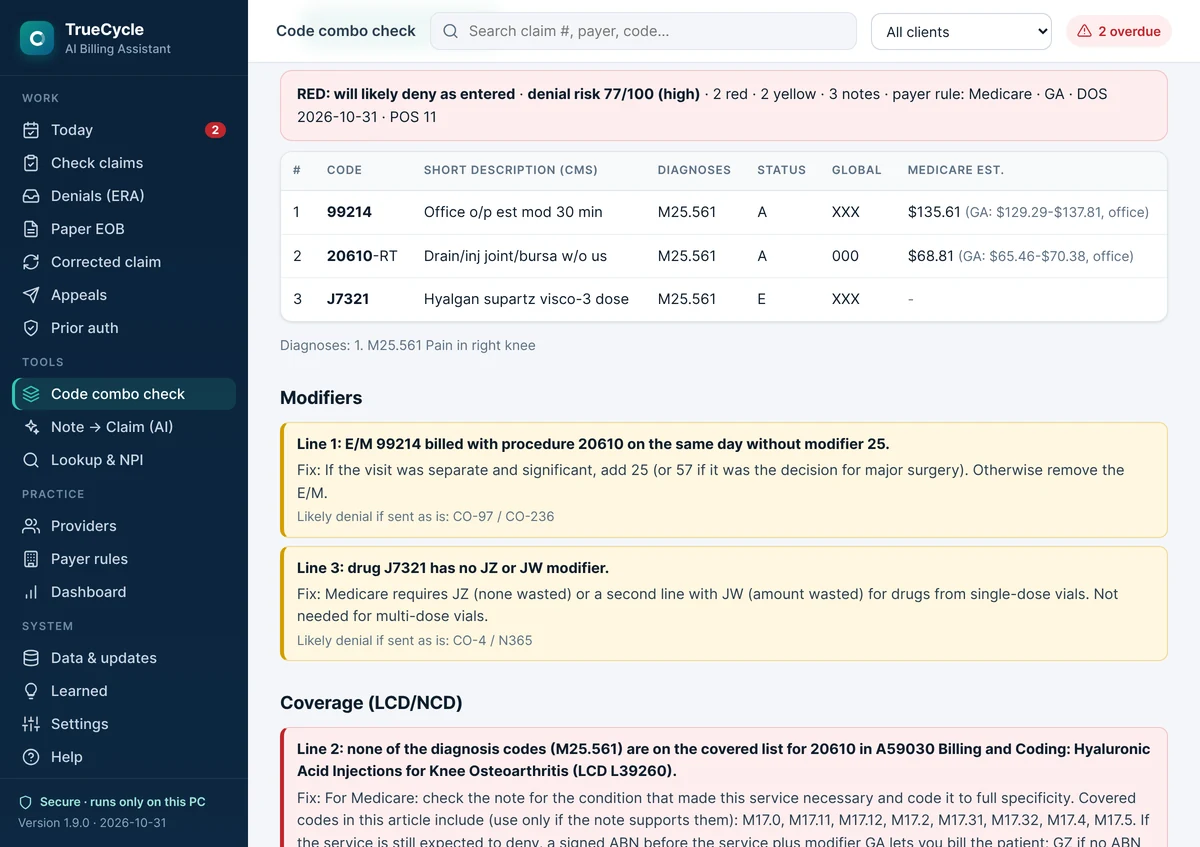
The code combination check on a test claim. It flagged a missing modifier 25, a missing JZ drug modifier and a diagnosis Medicare does not cover for the injection, and wrote the fix for each.
These numbers come from the official CMS NCCI files for practitioners (October 2026 quarter) and the full X12 reason and remark code lists. We load each new quarter when CMS releases it.
Step 2: we read every ERA and sort every denial
When the payer's 835 ERA comes back, the denial worker reads each claim line. It groups denials by what has to happen next, shows how many days are left to act on each, and drafts the appeal letter when one is needed.
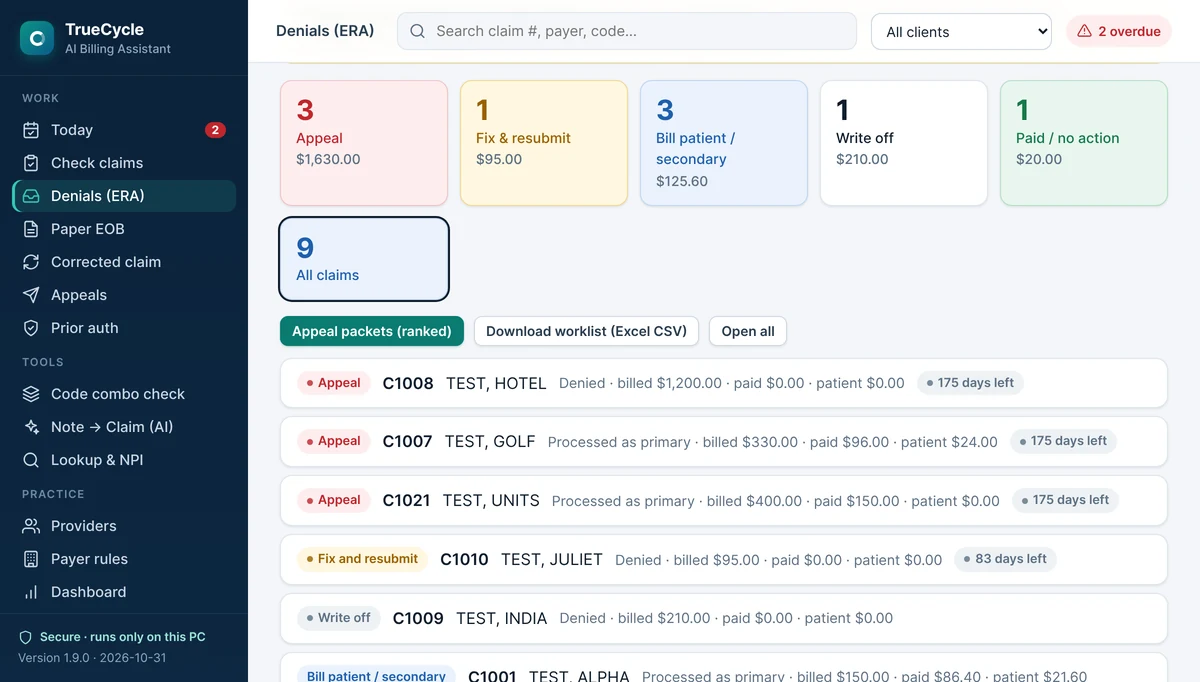
The denial worker on a test ERA. Every claim is sorted by what has to happen next, with the days left to act.
- Underpayments: paid amounts are compared with your fee schedule, so a short payment is disputed instead of written off.
- Deadlines: each payer's appeal and corrected-claim window is counted from the right date.
- It learns: when a payer denies the same code the same way twice, the checker warns us on the next claim before it goes out.
Step 3: coding help from the visit note
For practices that want it, the software can read a visit note and suggest ICD-10 and CPT codes, quoting the words in the note behind each one. We switch this on only after a Business Associate Agreement covers the AI service it uses, and a person checks every suggested code before anything is billed.
Software flags. People decide.
The software never sends a claim or an appeal by itself. It gives our billers a short, sorted list of what is wrong and how to fix it. That means more time on the claims that need judgment, and less time hunting for a missing modifier.
How your data is handled
- BAA first. We sign a Business Associate Agreement before we see any patient data.
- Runs on our own secured computer. The checker and denial worker are not a cloud service, so your files are not stored on outside servers.
- Only what is needed. We use the claim and ERA files your system already exports, and delete them when the work is done.
Send us 90 days of ERA files and get a free report of every denial, what it cost, and which claims you can still fix. Or let us work 25 claims for free.
Questions
Does AI decide the codes on my claims?
No. The software flags problems and suggests fixes, and a person on our billing team makes every change. When AI reads a visit note, it only suggests codes and shows the words in the note behind each one. Nothing is billed without a person checking it.
Do I need to change my billing software or EHR?
No. We keep working in your system, such as Tebra, eClinicalWorks or AdvancedMD. Our software reads the claim and ERA files your system already exports, and the fixes are made back in your system.
Is my patient data sent to an AI company?
Not by default. The claim checker and denial worker run on our own secured computer and use public CMS and payer data, not an outside AI service. The visit-note feature is switched on only for practices that want it, and only after a Business Associate Agreement covers the AI service it uses.
What does the claim checker look at?
Patient and insurance details, NPIs, ICD-10 codes for the date of service, diagnosis pointers, CPT and HCPCS code pairs that CMS bundles (NCCI edits), daily unit limits (MUEs), modifiers such as 25 and 59, place of service, prior authorization lists and each payer's filing limit.
How often are the CMS edits updated?
CMS publishes NCCI and MUE files every quarter. We load each new file when it comes out, so the checks match the rules in force on the date of service.
Does this cost extra?
No. It is part of how we do billing for every client. The free denial audit uses the same software.