No. 90791 and 90837 can't be billed for the same patient by the same provider on the same day. CMS pairs 90791 with every psychotherapy code at modifier indicator 0, which means no modifier fixes it. Do the intake on one day and bill therapy from the next visit. The same rule bundles 96127 into therapy for Medicare, and an E/M visit needs the add-on therapy codes (90833, 90836, 90838), not 90832, 90834 or 90837.
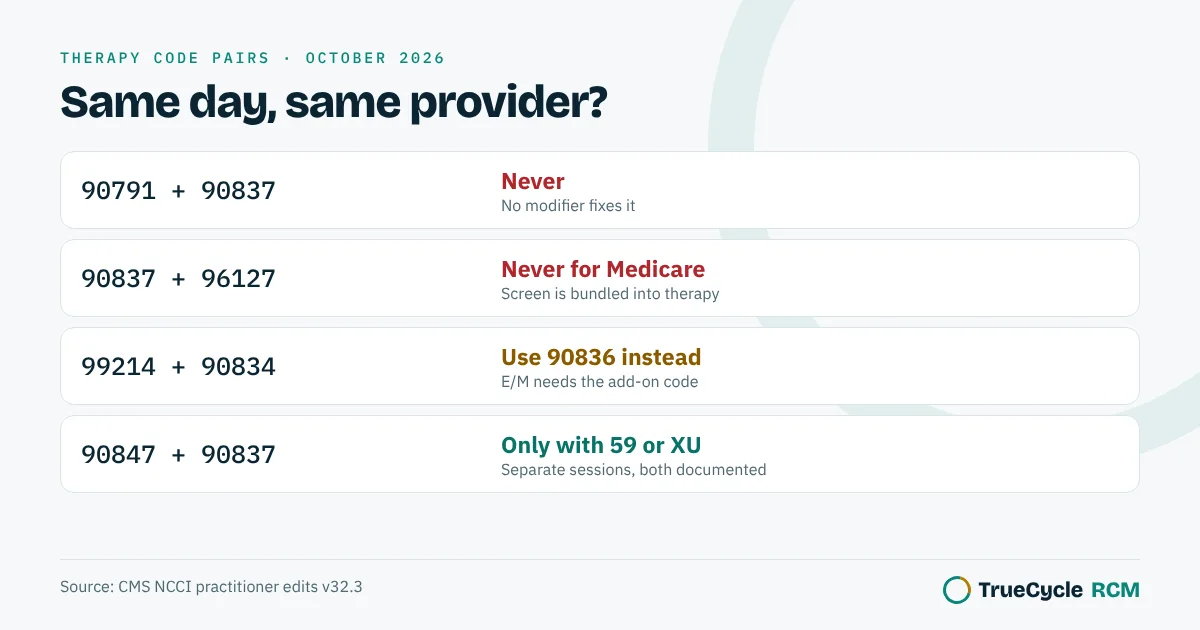
The therapy code pairs that cause denials
NCCI edits come in pairs: a column 1 code and a column 2 code. If both are billed for the same patient, by the same provider, on the same day, the column 2 code is denied unless the pair allows a modifier. Indicator 0 means never. Indicator 1 means only with a modifier such as 59 or XU when the services were truly separate.
| Codes | Same day? | What to do |
|---|---|---|
| 90791 + 90832 / 90834 / 90837 | Never | Bill the intake (90791). Start therapy on the next visit. |
| 90792 + 90791 | Never | Pick one. 90792 is the one with medical services. |
| 90791 + 99213 / 99214 | Never | Bill 90791 or the E/M, not both. |
| 99214 + 90837 | Never | Use the add-on 90838 with the E/M instead. |
| 99214 + 90836 | Allowed | Correct pairing. Keep therapy time separate from E/M. |
| 90837 + 96127 | Never (Medicare) | Don't bill the screen with therapy for Medicare. Check commercial policy. |
| 90837 + 90834 | Never | One psychotherapy code per session. Bill the time you documented. |
| 90847 + 90837 | Only with 59/XU | Only for separate sessions, both documented. 59 or XU on the column 2 code. |
| 90853 + 90837 | Only with 59/XU | Group and individual on one day: separate sessions plus 59 or XU. |
| 90839 + 90785 | Never | No interactive complexity with crisis codes. |
| 90837 + 90785 | Allowed | Fine when the session meets the interactive complexity rules. |
| 99213 + 90863 | Never | 90863 is for prescribers who can't bill E/M. Don't stack it on an E/M. |
Check any two therapy codes
Pick two codes billed on the same day by the same provider. The answer comes from the October 2026 CMS practitioner edit file and the daily unit limits (MUEs).
Why 90791 and therapy never go on the same day
90791 is the diagnostic evaluation: history, mental status, diagnosis and a treatment plan. CMS treats the therapy that happens in that visit as part of the evaluation. That's why every pair of 90791 or 90792 with 90832 to 90838, the crisis codes, family therapy and group therapy carries indicator 0.
Two things practices get wrong:
- Adding modifier 59 to force it through. With indicator 0 the modifier is ignored. If a claim with 59 gets paid, the payer can take the money back in an audit.
- Billing 90791 again for a returning patient. The daily limit is 1 unit. Payers also limit how often a new 90791 is paid for the same patient, so check the plan before you repeat an intake.
E/M plus psychotherapy: use the add-on codes
A psychiatrist or nurse practitioner who manages medication and also does therapy in the same visit bills an E/M code plus an add-on therapy code:
| Therapy time | With an E/M visit | Without an E/M visit |
|---|---|---|
| 16 to 37 minutes | 90833 | 90832 |
| 38 to 52 minutes | 90836 | 90834 |
| 53 minutes or more | 90838 | 90837 |
The stand-alone codes 90832, 90834 and 90837 are paired with office visit codes at indicator 0. The add-on codes have no edit with the E/M. The note has to show the therapy time on its own, apart from the time or medical decision making used to choose the E/M level.
96127 with therapy: bundled for Medicare
Many practices give a PHQ-9 or GAD-7 at each visit and bill 96127. Since October 1, 2020, the CMS edits bundle 96127 into every psychotherapy code, both diagnostic evaluations, family and group therapy, the crisis codes, 90863 and psychological testing, all at indicator 0.
So for Medicare and Medicaid, a 96127 line on a therapy claim is denied, and a modifier won't change that. Some commercial plans still pay it, especially at intake. Read the payer's behavioral health policy before you add it. 96127 is still payable with a primary care office visit, which is where most screening claims come from.
Family or group therapy and individual therapy on one day
90846, 90847 and 90853 are paired with the individual codes at indicator 1. That means both can be paid only when they were separate sessions, at separate times, and the notes show it. Put modifier 59 or the more exact XU (unusual, non-overlapping service) on the column 2 code. CMS prefers the X modifiers where the payer accepts them.
Crisis codes and interactive complexity
- 90839 and 90840 can't be billed with 90832 to 90838 on the same day. Crisis time replaces regular therapy time.
- 90785 (interactive complexity) can't go with the crisis codes or with psychological testing codes. It can go with 90791, 90792, the psychotherapy codes and group therapy.
Daily unit limits (MUEs) for therapy codes
MUEs cap how many units of a code can be paid for one patient on one day. Bill more and the extra units are denied.
| Code | Service | Units per day |
|---|---|---|
| 90791 | Psychiatric diagnostic evaluation | 1 |
| 90792 | Psychiatric diagnostic evaluation with medical services | 1 |
| 90832 | Psychotherapy, 30 min | 2 |
| 90834 | Psychotherapy, 45 min | 2 |
| 90837 | Psychotherapy, 60 min | 2 |
| 90833 | Psychotherapy add-on with E/M, 30 min | 2 |
| 90836 | Psychotherapy add-on with E/M, 45 min | 2 |
| 90838 | Psychotherapy add-on with E/M, 60 min | 2 |
| 90839 | Crisis psychotherapy, first 60 min | 1 |
| 90840 | Crisis psychotherapy, each extra 30 min | 3 |
| 90846 | Family therapy, patient not present | 1 |
| 90847 | Family therapy, patient present | 1 |
| 90853 | Group psychotherapy | 1 |
| 90785 | Interactive complexity add-on | 3 |
| 90863 | Medication management add-on (with psychotherapy) | 1 |
| 96127 | Brief emotional or behavioral screen (PHQ-9, GAD-7) | 4 |
Most of these are date-of-service limits based on clinical data, which means a payer can pay more units on appeal if the records clearly support it.
Send us 90 days of ERA files. We will show you every bundled line, what it cost and which ones you can still fix. Free, in two business days, with a BAA first.
If a therapy line was already denied
- CO-97: the service is included in another one billed that day. Check the pair above. If it's indicator 0, write it off. If it's indicator 1 and the sessions were separate, send a corrected claim with 59 or XU.
- CO-236: the pair isn't allowed under NCCI. Same steps as CO-97.
- CO-151: more units than the payer allows. Compare with the unit limits table and appeal with records only if the extra units were truly needed.
For Medicare, a corrected claim may need to go through the reopening process instead. See our guide to corrected claim deadlines by payer.
Also billing physical or occupational therapy? See the PT code pairs for 2026.
Questions
Can 90791 and 90837 be billed on the same day?
No. In the October 2026 NCCI edits, 90791 and every psychotherapy code (90832 to 90838) carry modifier indicator 0, so no modifier makes the pair payable for the same patient, same provider, same day. Bill 90791 for the intake and start therapy on a later date.
Can 96127 be billed with 90837?
Not for Medicare. Since October 2020 the NCCI edits bundle 96127 into 90837 and the other psychotherapy, diagnostic, family and group codes with indicator 0. Some commercial plans still pay 96127 next to therapy, so check the payer's own policy.
Can a psychiatrist bill an E/M and psychotherapy on the same day?
Yes, but with the add-on codes 90833, 90836 or 90838 next to the E/M code, not the stand-alone codes 90832, 90834 or 90837. The stand-alone codes are paired with E/M codes at indicator 0. The therapy time must be separate from the time used to pick the E/M level.
Can 90847 and 90837 be billed on the same day?
Only when they were separate sessions and both are documented. The pair has modifier indicator 1, so add modifier 59 or XU to the column 2 code. Without a modifier, the second line is denied.
Can 90785 be billed with 90839?
No. Interactive complexity (90785) is paired with the crisis codes 90839 and 90840 at indicator 0. It can go with 90791, 90792, 90832 to 90838 and 90853 when the session meets the interactive complexity rules.
Do commercial insurance plans follow NCCI edits?
Medicare and Medicaid must. Many commercial plans and Medicare Advantage plans use the same edits or their own versions of them, so the NCCI table is a safe default. When a payer publishes its own policy, that policy wins.
Want a second look at your therapy claims?
Send us 25 claims, payer, date of service, codes and denial reason. No patient names. We will tell you what to fix before you send the next batch. Free.
Send my claim listFiling limits, appeal windows and claim addresses change quietly. Get one short email a month with what changed and the free tools we add.
One email a month. No spam. Unsubscribe any time.Sources: CMS Medicare NCCI PTP edits, practitioner files v32.3 (effective October 1, 2026); CMS Medicare NCCI MUE table for practitioner services (effective October 1, 2026); Medicare NCCI Policy Manual, chapter 11 (2026). Code names are short plain-English labels, not the official CPT descriptors. Last reviewed October 27, 2026. General information, not coding or legal advice.